Understanding Your Balance Sheet: Small Business Guide

Did you know that 31% of small business owners now cite cash flow as their top concern, even while 94% of entrepreneurs expect their companies to grow in 2026? This disconnect often happens because many leaders mistake a healthy bank balance for true business profitability, leading to unexpected hurdles when it is time to scale. Truly understanding your balance sheet acts as a safeguard against these surprises, providing a precise picture of your company's actual standing. If looking at your financial statements feels more like a source of anxiety than a source of insight, you are in the right place.
We want to empower you to move past the confusion of unreconciled QuickBooks accounts and the stress of financial uncertainty. By mastering this essential document, you'll gain total clarity on what your business owns versus what it owes, allowing you to identify red flags long before they impact your operations. This guide provides the strategic oversight you need to qualify for SBA loans or prepare for a successful practice expansion. We'll walk through the specific components of your financial health so you can make smarter, data-driven decisions with total confidence.
Table of Contents
The Anatomy of a Balance Sheet: Demystifying the Core Equation
A clear financial perspective is the cornerstone of every successful Phoenix practice. While your bank account tells you how much cash is available today, understanding your balance sheet reveals the total health of your enterprise. Unlike other reports that track performance over time, a Balance Sheet serves as a financial snapshot at a single point in time. It captures exactly what your business is worth on a specific date, providing the transparency needed for long-term planning.
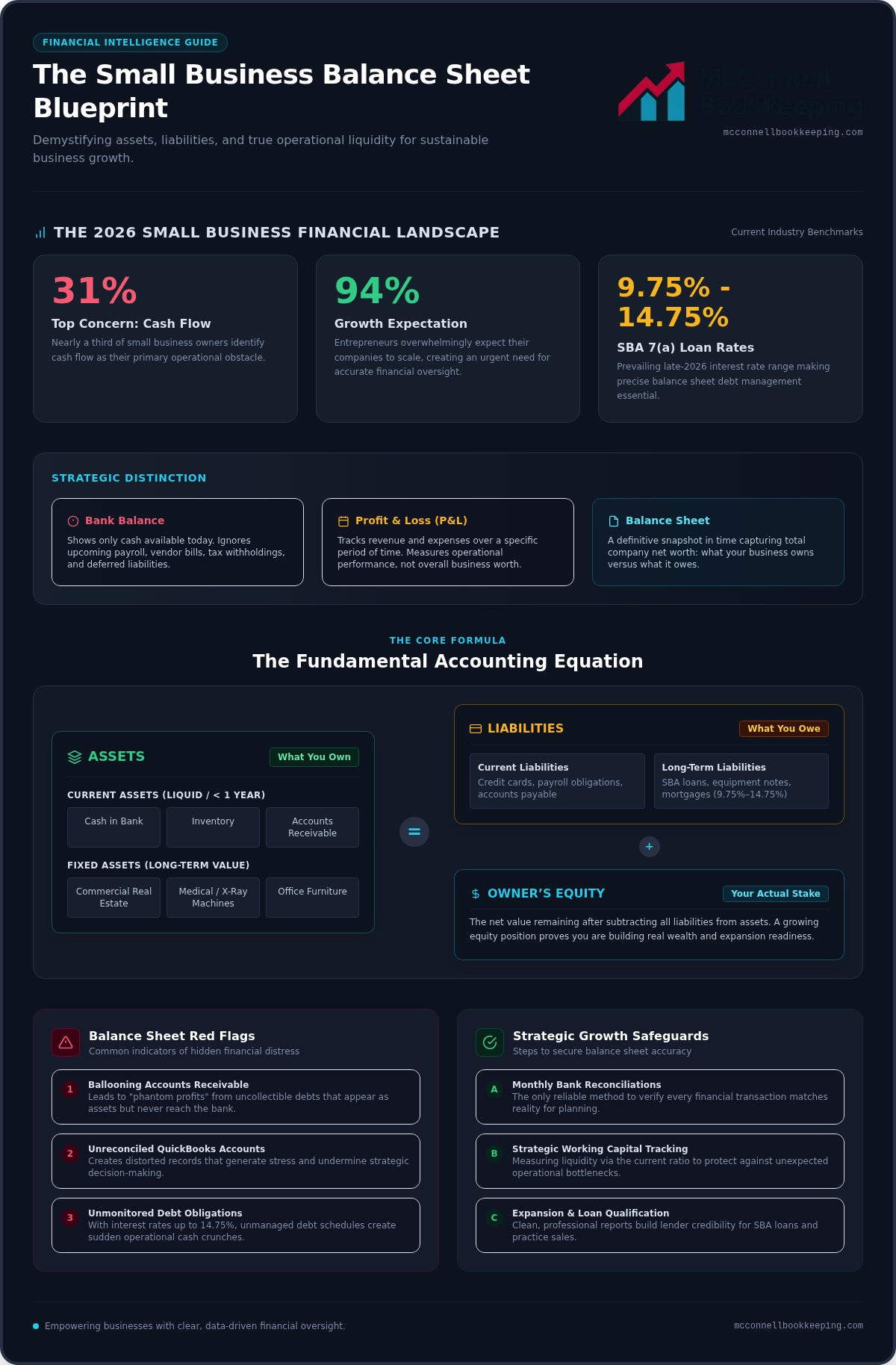
This report differs fundamentally from your Profit and Loss (P&L) statement. While the P&L tracks income and expenses over a period, the balance sheet adheres to a strict accounting equation: Assets equal Liabilities plus Owner's Equity. This balance ensures every dollar is accounted for, creating a reliable foundation for sustainable growth. When these numbers align, you gain the confidence to make proactive decisions rather than reactive fixes.
To better understand this concept, watch this helpful video:
What Your Business Owns: Breaking Down Assets
Assets represent everything your business uses to generate value. These are typically split into two categories to help you evaluate liquidity. Current assets include cash, inventory, and accounts receivable; these are items you expect to convert to cash within a year. For local dental or legal practices, fixed assets often include high-value investments like X-ray machines, office furniture, or commercial real estate. Utilizing professional accounts receivable services ensures these asset values stay accurate. Without diligent management, your balance sheet might reflect "phantom profits" from uncollectible debts that will never actually hit your bank account.
What Your Business Owes: Liabilities and Equity
Liabilities represent your obligations to outside parties, providing a clear view of your debt load. Current liabilities encompass immediate debts like credit card balances, payroll obligations, and accounts payable. Long-term liabilities include business loans, equipment financing notes, and mortgages. With SBA 7(a) loan interest rates currently ranging between 9.75% and 14.75% in late 2026, tracking these obligations is vital for maintaining cash flow. Owner's equity is the net worth remaining for you after all liabilities are subtracted from assets. It represents your actual stake in the company. A growing equity position signals that your business is building real wealth, making it an attractive candidate for future expansion or a potential practice sale.
Why Understanding Your Balance Sheet Matters for Daily Operations
Many Phoenix business owners fall into the trap of checking their bank balance to gauge success. This habit is dangerous because a high balance doesn't account for upcoming payroll, vendor bills, or deferred liabilities. Understanding your balance sheet provides the necessary context to avoid a sudden cash crunch by revealing your true liquidity. It acts as a proactive dashboard, showing you exactly how much cash is actually yours and how much is already spoken for by creditors.
Maintaining a clean balance sheet protects your business from the stress of unexpected financial bottlenecks. It allows you to track ongoing operational costs with precision, ensuring that your growth is built on a stable foundation. When you commit to regular oversight, you transform your financial statements from static tax documents into dynamic tools for managing your finances with confidence. This clarity is only possible through diligent monthly bank reconciliations, which ensure every transaction on your report matches reality.
Measuring Liquidity and Managing Working Capital
The current ratio is a simple yet powerful tool for measuring your short-term financial health. By dividing your current assets by your current liabilities, you determine if you have enough resources to cover your debts over the next twelve months. Ideally, you want a ratio above 1.0 to ensure your operations remain smooth. Tracking these metrics prevents operational bottlenecks that could otherwise delay critical payments. For example, maintaining healthy liquidity ensures you can consistently fund outsourced payroll processing without dipping into emergency reserves. If you're feeling unsure about your current figures, a professional books cleanup can restore the accuracy you need to lead effectively.
Preparing for Business Loans and Future Expansion
When you apply for a line of credit or an expansion loan, traditional commercial banks look directly at your balance sheet during underwriting. They evaluate your debt-to-equity ratio to determine how much risk your business carries. With SBA 7(a) variable interest rates currently capped between 9.75% and 13.25% as of late 2026, lenders are more meticulous than ever about who they approve. Unorganized records or unreconciled accounts can lead to an instant disqualification, even if your revenue is high. As the saying goes in the industry: "Clean financial records are the ultimate passport to securing the capital needed for growth." By keeping your balance sheet investor-ready, you position your practice as a reliable and low-risk partner for future expansion.
Common Balance Sheet Red Flags and How to Spot Them
Identifying warning signs early protects your business from long-term failure. Persistently low liquidity ratios or negative cash balances suggest that your current operational model isn't sustainable. To effectively read and understand a balance sheet, you must scrutinize "Uncategorized Asset" or "Unclassified" accounts. These entries often hide double-counted bank feeds or unreconciled transactions that cloud your financial truth. Mixing personal expenses into business credit card liabilities is another common trap that muddies your reporting. Understanding your balance sheet allows you to separate personal life from professional obligations, ensuring your data remains reliable for strategic growth.
The Danger of Overstated Assets and Uncollected Invoices
Old, uncollectible invoices create a false sense of security by artificially inflating your company's value. If your accounts receivable balance is ballooning while your bank account remains stagnant, you're likely carrying bad debt. This distortion leads to phantom profits, where you might pay taxes on money you'll never actually receive. Maintaining precise dental practice financial metrics helps clinicians identify these collection hurdles before they cripple daily operations. Addressing these issues immediately prevents your assets from becoming a liability to your future success.
Mismanaged Liabilities and Client Trust Account Risks
For legal practices, trust accounts represent a distinct liability that requires extreme precision. Mismanaging IOLTA funds or retainer deposits carries severe compliance risks and can threaten your professional standing. Historical errors in these accounts compound over time, making them increasingly difficult to untangle without expert help. A professional books cleanup restores the integrity of your trust accounting, protecting both your clients and your firm. Proactive management turns these complex liabilities into a transparent record of your professional integrity.
How Monthly Bank Reconciliations Secure Balance Sheet Accuracy
An unreconciled balance sheet is completely unreliable for strategic decision-making. If you don't match your ledger against actual bank statements, you risk making critical choices based on flawed data. Regular bank reconciliations act as a safety net, catching duplicate transactions, hidden bank fees, and missing expenses before they distort your reports. This verification process involves a meticulous, step-by-step matching of your real-world bank statements to your internal accounting software records. Consistent monthly data entry ensures your financial reports remain completely tax-ready year-round, saving you from chaotic rushes at the end of the fiscal year.
True accuracy requires more than a casual review of your accounts. Relying on unverified data can lead to serious compliance issues, especially for medical and legal practices handling sensitive client funds. Understanding your balance sheet requires a commitment to pristine data verification. If you want to ensure your financial statements are accurate enough for long-term planning, consider scheduling a books cleanup to align your records with reality.
The Direct Link Between Your Bank Feed and Your Balance Sheet
Simply downloading transactions into QuickBooks Online is not a true reconciliation. Automated bank feeds often create a false sense of security because they can easily skip transactions or double-count automated entries. Uncleared checks and pending deposits will distort your actual cash position if they aren't manually verified against your statement balances. Utilizing a professional monthly bank rec service guarantees absolute data integrity for your small business. This routine oversight ensures that your reported assets reflect real capital rather than software glitches.
Cleaning Up Historical Accounting and Software Errors
Common software miscalculations, such as incorrect opening balance equity entries, frequently clutter small business ledgers. These historical errors compound over time, making your reports look disorganized to potential lenders or investors. A professional diagnostic cleanup removes these errors, restoring total trust in your financial reporting. Partnering with experts for backlogged bookkeeping help provides immediate administrative relief. Resolving these past errors allows you to look ahead with a clear, accurate financial dashboard.
Taking Control of Your Financial Statements for Sustainable Growth
Mastering your financial statements transforms the way you lead your practice. Instead of reacting to low bank balances with anxiety, you begin to anticipate needs and opportunities with total confidence. Understanding your balance sheet allows you to see the trajectory of your firm clearly, moving you from a state of uncertainty to a state of informed leadership. It turns administrative stress into strategic insight, liberating your executive time to focus on patient care or complex legal work. Professional bookkeeping acts as a strategic asset that fuels your long-term vision rather than just a year-end chore.
Developing a Monthly Financial Review Routine
Establishing a consistent monthly routine ensures you maintain this clarity without feeling overwhelmed. You don't need to be a CPA to spot structural trends in your business; you simply need a structured approach to your data. Reviewing your reports on the first of every month ensures you stay ahead of potential issues before they become critical. Focus on these key areas during your review:
Compare total current assets against current liabilities to verify your liquidity.
Analyze the aging of your accounts receivable to identify collection bottlenecks.
Track changes in owner's equity to measure the real wealth your business is building.
Comparing these figures month-over-month reveals long-term trends that a single snapshot might miss. This habit builds a deep familiarity with your company's financial heartbeat, allowing you to spot red flags early. When your books are clean, these reviews become a source of empowerment rather than a source of dread.
Leveraging Expert Training and Collaborative Bookkeeping Partnerships
Empowering your internal team with professional software training improves every aspect of your billing and data entry workflows. When your staff masters the nuances of your accounting software, you eliminate the common errors that lead to unreconciled accounts and messy reports. Specialized QuickBooks training for business owners builds the long-term confidence required to manage your growth effectively. This investment ensures that your internal systems are as professional and meticulous as the services you provide to your own clients.
You don't have to carry the weight of financial oversight alone. Partnering with a proactive mentor for your operational accounting provides the relief and clarity you deserve. We serve as a diligent guardian for your books, ensuring your balance sheet is always accurate and expansion-ready. By outsourcing these complex tasks, you reclaim the time to grow your practice with absolute peace of mind. Let us handle the details so you can focus on the big picture of your success.
Empowering Your Vision Through Financial Clarity
Transitioning from reactive stress to proactive leadership begins with accurate, real-time data. You've seen how a healthy bank balance is only one piece of the puzzle; it's the structural integrity of your ledger that determines your true potential. Mastering the art of understanding your balance sheet transforms your financial statements into a strategic roadmap for expansion. Whether you're identifying red flags in accounts receivable or ensuring your liquidity ratios meet lender requirements, these insights provide the clarity needed for long-term success.
You don't have to navigate these complexities alone. We provide specialized legal and dental practice bookkeeping experience to ensure your records remain pristine and compliant. Our team offers expert QuickBooks Online training and comprehensive historical books cleanup to restore your financial integrity from the ground up. With dedicated monthly bank reconciliation workflows, we act as a diligent guardian for your daily operations. Schedule a consultation with McConnell Bookkeeping for total financial clarity today. It's time to lead your business with the confidence and calm you deserve.
Frequently Asked Questions
What is the main purpose of a balance sheet for a small business?
The main purpose is to provide an immediate snapshot of your company's financial position on a specific date. It details exactly what your business owns versus what it owes to creditors or owners. For Phoenix entrepreneurs, this document serves as a foundational tool for strategic planning. It allows you to move beyond simply checking your bank balance to seeing the long-term viability of your operations.
How often should a business owner review their balance sheet?
You should review your balance sheet at least once every month. This routine ensures you stay informed about your liquidity and debt levels before small issues become critical cash flow problems. Consistent monthly oversight is particularly vital for Scottsdale and Mesa practices preparing for expansion or seeking new lines of credit. Regular reviews turn your financial data into a proactive dashboard for growth rather than a year-end tax chore.
Why doesn't my balance sheet match the cash balance in my bank account?
Your balance sheet reflects your total financial position, not just the liquid cash currently in your Phoenix bank account. Discrepancies often arise from timing differences, such as uncleared checks or pending deposits that haven't hit your bank feed yet. Additionally, understanding your balance sheet involves accounting for non-cash items like accounts receivable, equipment depreciation, and long-term liabilities. These factors provide a more comprehensive view of your actual business health.
What is the difference between an income statement and a balance sheet?
An income statement tracks your revenue and expenses over a specific period, such as a month or a year. In contrast, the balance sheet provides a static snapshot of your assets and liabilities at a single point in time. While the income statement shows if you were profitable last month, the balance sheet shows the cumulative result of all past transactions. Both reports are essential for a complete view of your Mesa business.
What does it mean if my business has negative owner's equity?
Negative owner's equity occurs when your business's total liabilities exceed its total assets. This situation often signals that the company has accumulated significant losses or has taken on more debt than its assets can currently cover. For a Phoenix SMB, this is a major red flag that requires immediate attention through a professional books cleanup. It indicates that you're operating with a deficit and may struggle to secure future financing.
Can a balance sheet help me get a business loan from a commercial bank?
Yes, a clean balance sheet is a mandatory requirement for securing commercial financing or SBA loans. Lenders analyze your debt-to-equity and current ratios to determine if your practice is a safe investment. With SBA 7(a) rates currently capped between 9.75% and 14.75% in late 2026, banks are highly selective about underwriting. Providing accurate, reconciled financial statements proves that you're a diligent borrower with a stable financial foundation.
How do I know if my QuickBooks balance sheet is actually accurate?
The only way to ensure your QuickBooks data is accurate is through rigorous monthly bank reconciliations. You should look for common errors like duplicate transactions or balances in the Opening Balance Equity account, which often signal software glitches. If your ledger doesn't match your actual bank statements, your reporting is unreliable for decision-making. Expert QuickBooks Online training can help your team identify these discrepancies before they distort your financial reality.
Do I need a certified audit to use my balance sheet for daily operations?
You don't need a certified audit for daily operations or internal management. While public companies require audits, most Phoenix small businesses only need accurate, reconciled financial statements to manage their growth and qualify for loans. understanding your balance sheet through professional bookkeeping provides the clarity you need without the high cost of attestation services. Focused, monthly oversight is the most effective way to maintain a healthy and transparent business.



Comments