How much work does getting your books ready for investors require?

Getting books ready for investors means making sure the numbers are complete, reconciled, and easy to explain. There’s no fixed number of hours: the work depends on the condition of your records, the complexity of your business, and whether key balances have supporting schedules. The goal is a clear financial picture, not simply a tidy set of reports.
It’s understandable to expect the process to involve more than exporting a profit-and-loss statement. Investors may look for monthly financial statements covering 12 to 24 months, along with reconciliations and explanations for material transactions or changes. If your records have gaps or balances that don’t tie out, resolving those issues adds work, but it also gives you a stronger foundation for answering questions with confidence.
This guide covers the preparation process, from balance-sheet reconciliations and supporting schedules to a practical investor-readiness checklist. You’ll learn which records to prioritize, why cash flow can differ from reported profit, and what to organize before due diligence begins. Use these steps to plan the work and identify where your books need attention.
Table of Contents
1. Balance sheet reconciliations and supporting schedules
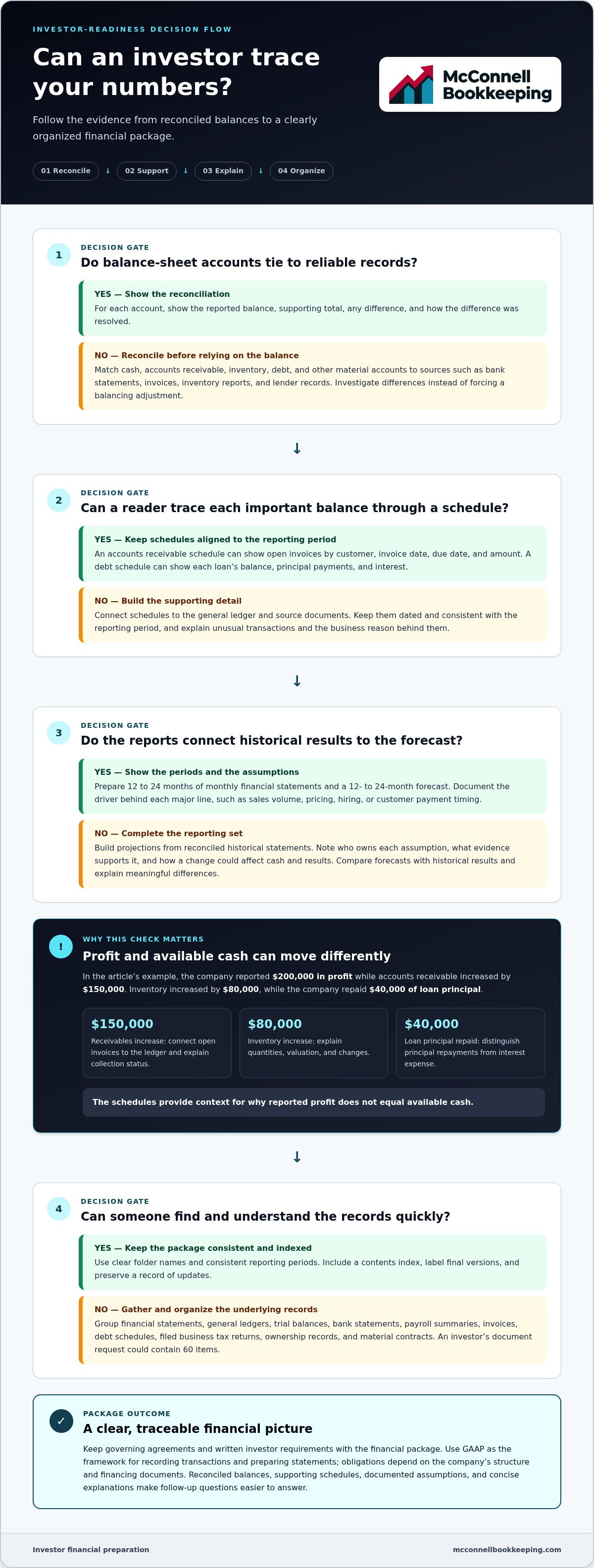
A balance sheet is useful only when its account balances tie back to underlying records. Reconcile cash, accounts receivable, inventory, debt, and other material accounts against bank statements, customer invoices, inventory reports, and lender records. For each reconciliation, show the account balance, supporting total, any difference, and how you resolved it.
Supporting schedules make balances easier to verify. For example, an accounts receivable schedule can list open invoices by customer, invoice date, due date, and amount. A debt schedule can separate each loan’s balance, principal payments, and interest. These details let investors trace a reported figure instead of relying on an unexplained total.
For a practical look at the records and cleanup involved in due diligence, watch this founder-focused checklist:
Cash and profit can move in different directions. In one example, a company reported $200,000 in profit while accounts receivable increased by $150,000 during the same period. That increase may mean more sales remained uncollected, so the receivables schedule should connect open invoices to the general ledger and explain collection status.
Other balances also need context. In the same example, inventory increased by $80,000 during the period, while the company repaid $40,000 of loan principal. An inventory schedule can explain quantities, valuation, and changes; a debt schedule can distinguish principal repayments from interest expense. Together, these records explain why reported profit does not equal available cash.
How should a company prepare financial projections and document its assumptions? Build projections from reconciled historical statements, then note the driver behind each major line, such as expected sales volume, pricing, hiring, or customer payment timing. Identify who owns each assumption, what evidence supports it, and how a change could affect cash and results.
Match each balance-sheet account to a reliable source record.
Keep schedules dated and consistent with the reporting period.
Investigate differences instead of forcing a balancing adjustment.
Document unusual transactions and the business reason behind them.
GAAP comprises the standards, conventions, and rules accountants follow to record and summarize transactions and prepare financial statements, according to the U.S. Environmental Protection Agency. Consistent records help investors compare statements and understand how the company manages its assets, obligations, and operations. A clear schedule explains the movement; a concise note adds context the numbers alone can’t provide.
2. Investor-readiness checklist
A founder can start with a written checklist that connects statements, source documents, forecasts, and explanations. Prepare 12 to 24 months of monthly financial statements, then compare balances across periods and flag unusual movements. Add a 12- to 24-month forecast with documented assumptions, so investors can see how expected revenue, spending, and cash needs support the strategy.
Use GAAP as the framework for recording transactions and preparing financial statements, according to the U.S. Environmental Protection Agency. The obligations relevant to a company depend on its structure and financing documents. Keep governing agreements and written investor requirements with the financial package.
There is no single cost for hiring a bookkeeper, CPA, or CFO to prepare investor materials. The scope depends on record condition, transaction volume, cleanup needs, reporting complexity, and whether projections need higher-level financial analysis. Fees are determined after a quote request.
Gather previously filed business tax returns and supporting records, such as general ledgers, trial balances, bank statements, payroll summaries, invoices, and debt schedules. These documents help show how reported figures connect to transactions. Keep ownership records and material contracts available when they affect revenue, liabilities, or the company’s capital position.
Organize the data room by topic, using clear folder names and consistent reporting periods. Include a contents index, label final versions, and preserve a record of updates. Prepare before a request arrives: an investor’s document request could contain 60 items, and orderly files make it easier to locate each requested record.
Reconcile account balances and attach supporting schedules.
Include monthly statements and forecasts, with assumptions explained.
Keep contracts, tax records, ownership documents, and debt details together.
Write a short explanation for material changes and unusual transactions.
Investors may examine strategy and market position from different perspectives. Someone interested in value investing may assess the company differently from someone focused on growth, capital needs, or stock-market exposure. Investor reading may refer to Benjamin Graham’s The Intelligent Investor, Warren Buffett, Howard Marks, and Daniel Kahneman, but clear company records matter more than investing books, essays, or Wall Street terminology.
Common red flags include unreconciled accounts, inconsistent statements, unexplained owner transactions, and forecasts that lack support. A $30,000 software payment, for example, may need an explanation beyond its bookkeeping entry. Document its purpose, approval, and relationship to operations so the number has context.
Preparation time depends on how many periods need cleanup, the volume of transactions, missing records, and the speed of resolving questions. A month-end close within 10 business days is a reasonable starting target for many small businesses, not a measure of the full due-diligence preparation period.
When bookkeeping gaps or incomplete reporting make the checklist difficult to complete, organized investor financial records can help bring the supporting details together.
3. What financial statements and reports do investors expect to review?
Investors use financial statements to understand performance, financial position, and cash movement. Prepare a balance sheet, income statement, and cash flow statement for matching periods. Together, these reports show what the company owns and owes, how it earns revenue, and how cash moves into or out of the business.
Use consistent accounting methods and reporting periods so readers can compare results. GAAP comprises the standards, conventions, and rules accountants follow to record transactions and prepare financial statements, according to the U.S. Environmental Protection Agency. Clear policies explain how the company records revenue, expenses, and assets.
A monthly reporting package can help investors follow operating changes rather than relying on one annual snapshot. The investor-readiness checklist recommends providing at least 12 to 24 months of monthly financial statements. Include the same reporting basis across periods, then flag changes in presentation that could affect comparisons.
Balance sheet: Show assets, liabilities, and equity at each reporting date. Tie major balances to schedules that explain their composition.
Income statement: Present revenue, direct costs, operating expenses, and net income. Compare actual results with budget to make variances visible.
Cash flow statement: Separate operating, investing, and financing activity. This helps explain why cash changed even when reported earnings moved differently.
Trial balance and general ledger: Provide the account-level detail behind statement totals. Use them to trace a reported expense or balance to underlying entries.
Investors may also review operating reports that connect accounting results to business activity. A revenue report by product or customer can reveal sales patterns and customer concentration. An accounts receivable aging report explains overdue balances, while an accounts payable schedule clarifies upcoming obligations and payment timing.
Forecasts provide a forward-looking view, but their assumptions should connect to historical results. If a forecast uses a different margin or growth pattern, explain the operational reason, such as a pricing change, planned hiring, or a new sales channel. Keep assumptions alongside the forecast, not buried in unrelated notes.
Label each report with its period, currency, and version date. Mark figures as actual, budgeted, or forecast, and keep revised files separate from earlier versions. This simple control helps investors trace questions to the right statement without confusing draft numbers with the final package.
Before sharing, compare statement totals with the trial balance and make sure supporting reports use the same cutoff dates. A carefully prepared financial statement package gives investors a consistent starting point for evaluating results and asking focused follow-up questions.
4. How many years of financial statements do investors typically request?
Prepare 12 to 24 months of monthly financial statements as a practical starting point. That range gives a reader a year or more of monthly detail without requiring you to treat complete fiscal years as the only useful format. Keep the reports in chronological order and identify each period clearly.
When a request specifies a number of years, distinguish annual statements from monthly records. Annual reports summarize a full fiscal year, while monthly statements show when revenue, expenses, and cash movements occurred. Prepare both formats from consistent records when available, and label any partial year so it isn’t mistaken for a complete reporting period.
A company’s age affects the historical coverage available. A young business may have only a short operating history, while an established company can organize statements across more periods. Present available records in sequence and clearly identify the first operating period. Don’t present a partial year as a full year.
For each period, use a consistent set of statements, including the balance sheet, income statement, and cash flow statement. Align the reporting dates so one month’s closing balance carries into the next. If the accounting method or presentation changes, add a brief note explaining the change and its effect on comparisons.
Use a simple preparation sequence to make the history easier to review:
List the fiscal periods available and mark any partial periods.
Arrange monthly reports chronologically, with clear labels and dates.
Compare annual totals with the monthly reports for the same period.
Document changes in accounting treatment, business structure, or reporting presentation.
Keep the detailed schedules and transaction records connected to their statements.
For example, if annual revenue appears steady but monthly income statements show a sharp increase near year-end, explain the timing. A large contract, delayed invoicing, or seasonal sales may account for the change. Link the explanation to relevant reports so readers can understand the company’s history without guessing.
Forecasts should remain separate from historical results. The investor-readiness checklist calls for a 12- to 24-month financial forecast. Label projected periods clearly, distinguish assumptions from actual figures, and explain how expected sales, expenses, and customer collections relate to the company’s recorded performance.
Useful historical coverage depends on the records available, the company’s operating history, and the detail needed to explain changes. A well-organized sequence of monthly statements can make a short history informative, while unexplained gaps can make longer records difficult to interpret. Clear labels and concise notes help readers assess each period on its own terms.
5. What financial metrics and KPIs should a startup include in an investor data room?
Choose measures that explain the business model, financial health, and use of capital. A focused package helps investors connect operating performance with the financial statements. Capital providers assess financial health using ratios based on balance-sheet and income-and-expense statement figures, according to Dawnbreaker Press.
Start with a concise view of revenue, gross margin, operating expenses, and net income. Add cash balance, operating cash flow, and accounts receivable trends to show how reported performance translates into available cash. Select measures that reflect how the business earns revenue, serves customers, and funds operations.
For a subscription business, useful operating measures may include recurring revenue, customer retention, and customer acquisition costs. A product company might instead track units sold, average selling price, and return rates. Define each metric, state its reporting period, and apply the same calculation method consistently.
Growth: Show revenue trends and explain material changes by product, customer, or channel.
Profitability: Track gross margin and operating expenses against historical results.
Liquidity: Present cash movement, customer collections, and upcoming obligations.
Operating performance: Select customer or production measures tied directly to the company’s model.
Keep the dashboard selective. Avoid overwhelming readers with 40 KPIs; choose measures that answer specific questions and connect to documented business activity. Pair each key metric with a source report, calculation note, and brief explanation of important changes. That structure makes the figures easier to trace and compare.
Historical context matters. If reported profit is $200,000 while cash flow shifts substantially, explain the movements rather than relying on profit alone. Changes in receivables, inventory, or debt payments can affect cash available for operations, even when the income statement shows positive earnings.
Forecast assumptions deserve the same clarity. If a projection assumes a 70% gross margin while historical gross margin is 42%, explain the reason for the difference. A planned pricing change, product mix shift, or lower production cost may support the forecast, but the data room should show the underlying logic.
Build customer payment timing into cash projections. If customers typically pay after 60 days, reflect that collection pattern instead of assuming immediate cash receipt. Connect the assumption to invoice and collection records, then describe any meaningful change in payment behavior.
Use a short metric glossary to define formulas, data sources, and reporting periods. For polished, consistent reporting, prepare clear financial statements that support the KPIs investors review.
McConnell Bookkeeping: Monthly Bank Reconciliations
McConnell Bookkeeping provides Monthly Bank Reconciliations to match recorded cash activity with bank records and identify items that need attention. This support is useful when unreconciled accounts, missing transaction details, or inconsistent balances make investor reporting harder to prepare.
Financial Statement Preparation organizes key results into reports investors can review, while Books Cleanup addresses underlying recordkeeping gaps. Accounts Receivable Management can clarify outstanding customer balances that affect cash expectations. Together, these services help organize clearer books and more useful financial information for due diligence.
With reconciliations and records in order, you can spend less time tracing figures and more time explaining your business clearly. Contact McConnell Bookkeeping to discuss support for your investor-readiness work.
Build a Clear Path Toward Investor Readiness
Getting books ready for investors is also an opportunity to strengthen financial decision-making. Clear, dependable records help you answer questions with confidence and focus on your business rather than searching for missing details. Choose a next step that addresses the biggest gap in your process, whether that means improving transaction records or establishing a consistent reporting routine.
McConnell Bookkeeping supports this work with Monthly Bank Reconciliations, Financial Statement Preparation, and Books Cleanup. These services organize your financial information so it is easier to understand and maintain as your business moves into its next stage. Start with the part of your books that needs the most attention, then build from there.
Contact McConnell Bookkeeping today to discuss support for your bookkeeping needs. With a clearer financial foundation, you can move forward with focus and confidence.
Frequently Asked Questions
How Much Does Investor Readiness Really Require?
The work depends on how complete and consistent the company’s records are, not simply on how many reports are requested. A business with organized transactions may mainly need review and presentation, while one with duplicate entries, missing documents, or unclear owner transactions needs more cleanup. Start by identifying unresolved items, assigning someone to locate supporting records, and prioritizing issues that could change reported results.
What Does “Investor-Ready” Actually Mean?
Investor-ready means the company can explain its financial information and connect important figures to reliable records. It doesn’t mean every result looks favorable or that the statements have been audited. For example, if one customer accounts for a large share of sales, the business should be able to explain that concentration and show how it appears in the records. Clear explanations make questions easier to address.
What does getting books ready for investors mean?
Getting books ready for investors means preparing accounting records so someone else can follow the company’s financial story. Correct posting errors, clarify unusual transactions, and make sure the same transaction hasn’t been recorded twice. A founder might also write brief notes explaining one-time expenses or changes in customer billing. These details add context to the ledger and keep financial conversations focused on the business.
How should a company clean up and reconcile its accounting records before fundraising?
Start with a completed reporting period, then compare bank activity with the accounting records and investigate unmatched transactions. Confirm that customer and vendor balances reflect actual open invoices, and document corrections rather than changing entries without explanation. In Mesa and the greater Phoenix business community, McConnell Bookkeeping provides Books Cleanup and Monthly Bank Reconciliations to address unresolved records that are delaying fundraising preparation.
What accounting standards and legal requirements apply to investor-ready financial statements in the United States?
Use GAAP as the framework for recording transactions and preparing financial statements. The obligations relevant to a company depend on its structure and financing documents, so keep governing agreements and written investor requirements with the financial package.



Comments