Small Business Cash Flow Guide for Gilbert

What if your bank balance looked healthy today but couldn’t cover payroll next week? For Gilbert business owners, late customer payments and upcoming bills can make cash feel unpredictable, even when sales are steady. Cash flow management for small business Gilbert owners can start with a clearer view of what’s coming in, what’s going out, and when.
It’s understandable to want one dependable number that tells you what’s available. But a bank balance alone may not reflect outstanding invoices, scheduled payments, or transactions that haven’t been reconciled. Trustworthy bookkeeping and a consistent review rhythm help you spot potential shortfalls sooner and consider your next steps with more confidence.
This guide explains how to track cash inflows and outflows, plan for upcoming obligations, and build a repeatable routine for reviewing your finances. You’ll also learn how monthly bank reconciliations, financial statement preparation, accounts receivable and payable management, or QuickBooks Online training may support a more timely, reliable financial picture, depending on your business’s needs.
Table of Contents
Why cash flow management matters for small businesses in Gilbert
Sales and profit can look reassuring while the timing of payments still leaves a business short on cash. For owners exploring cash flow management for small business Gilbert, the key is to track not only how much money the business earns and spends, but when it actually arrives and leaves.
Cash flow is the movement of money received and money paid over a period of time. A basic understanding of what cash flow means can help distinguish day-to-day operating activity from other cash movements. A business may record a sale before the customer pays, while rent, payroll, supplier invoices, and other bills come due on set dates. That timing difference can create a short-term cash shortage even if the business is profitable overall.
For a brief overview of practical approaches, watch this video from CSI Accounting:
Cash flow versus profit: what Gilbert owners should know
Revenue is the amount earned from sales; profit is what remains after expenses are accounted for. A bank balance shows money in an account at a particular moment, but it may not reflect bills about to clear or deposits that haven’t arrived. To estimate available cash, look beyond the balance: check which payments are pending, which invoices are still unpaid, and what obligations are due soon.
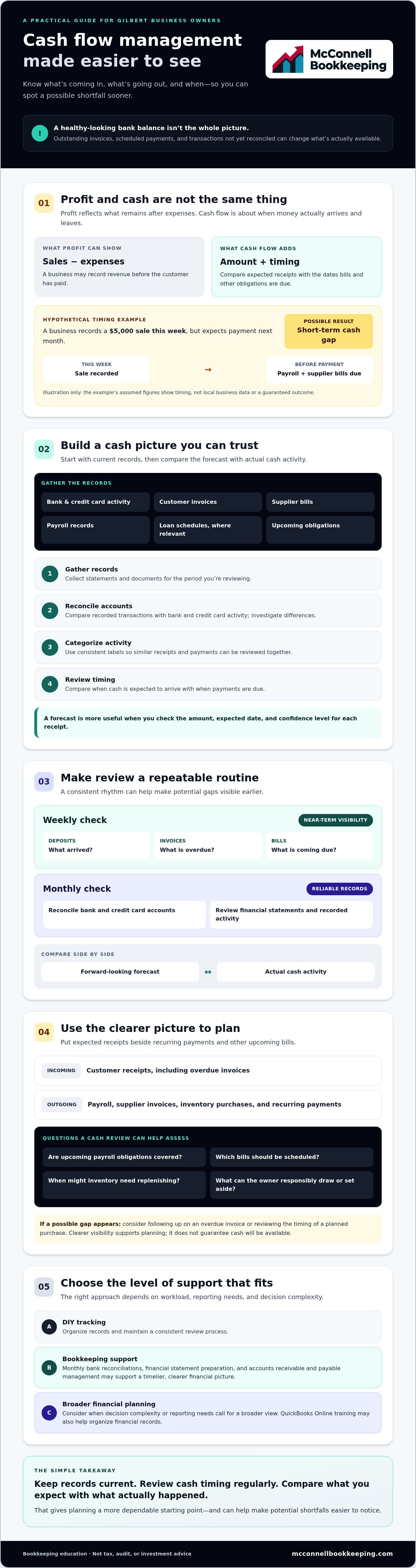
Hypothetical example: Assume a business records a $5,000 sale this week, but the customer’s payment is expected next month. If payroll and supplier bills are due before then, the business could face a cash gap despite recording revenue. These assumed figures illustrate timing only, not local business data or a guaranteed outcome.
What a basic cash flow review can reveal
Cash flow management is the process of tracking when money is expected to come in and go out so a business can plan for its obligations. A regular review can put expected customer receipts alongside recurring payments, payroll, inventory purchases, and other upcoming bills. Check the amount, expected date, and confidence level for each receipt. This can help you notice a possible gap earlier and assess options, such as following up on an overdue invoice or reviewing the timing of a planned purchase.
Clearer cash visibility can support decisions about which bills to schedule, whether payroll is covered, when to replenish inventory, and how much the owner can responsibly draw or set aside. It doesn’t guarantee cash will be available, but it gives planning a more dependable starting point. This article provides bookkeeping education, not tax, audit, or investment advice.
Build a reliable cash flow picture from records and forecasts
A useful cash flow view begins with records you can trust. Before deciding whether cash is available, bring the underlying activity up to date and check that recorded transactions match what actually happened. Monthly bank reconciliations help identify discrepancies and support a more dependable view of recorded cash activity.
Which records help create a useful cash flow view?
Gather bank and credit card activity, customer invoices, supplier bills, payroll records, and loan schedules where relevant. Keep entries current and apply categories consistently, so you can distinguish operating costs from other transactions. QuickBooks Online can help organize financial records, but the information still needs review. For further guidance on tracking finances and understanding bookkeeping support for clearer cash flow, see Santa Clara University’s small business resource.
Use this repeatable sequence:
Gather records: Collect statements and documents for the period you’re reviewing.
Reconcile accounts: Compare recorded transactions with bank and credit card activity, then investigate differences.
Categorize activity: Apply consistent labels to receipts and payments so similar items can be reviewed together.
Review timing: Compare when cash is expected to arrive with when payments are due.
How to review expected cash inflows and outflows
Keep expected customer receipts separate from confirmed deposits. For each expected payment, note the amount, anticipated arrival date, and whether the timing is confirmed or estimated. Update the estimate if the customer’s timing changes. Then group upcoming outflows by due date and purpose, such as payroll, rent, supplier bills, and loan payments. This makes timing easier to assess without treating an uncollected invoice as cash already in the bank.
A historical cash flow statement summarizes cash activity that has already occurred. A forecast estimates future receipts and payments using current records and assumptions. A rolling forecast is updated regularly by adding a new future period as time passes. Choose a horizon that fits your planning needs rather than assuming one period works for every business.
A forecast is only as useful as its assumptions, so refresh it whenever expected receipts or bills change. Mark estimates clearly, distinguish them from confirmed amounts, and compare the forecast with actual activity as new information comes in. This helps cash flow management for small business Gilbert owners use records as a planning tool, not just a report of the past.
If keeping records current is difficult, bookkeeping support such as monthly bank reconciliations, books cleanup, or QuickBooks Online training may help establish a more reliable process. Explore McConnell Bookkeeping’s services to see which type of support may fit your recordkeeping needs.
Compare cash flow approaches: DIY tracking, bookkeeping, or broader planning
The right approach depends on how much time you can give your records and how complex your financial decisions have become. DIY tracking, bookkeeping support, and broader financial planning serve different needs. Bookkeeping organizes and reports financial activity; it doesn’t guarantee cash flow or make business decisions for you.
The U.S. Small Business Administration’s SBA guide to financial projections outlines financial statements used in planning. It’s a useful reference for understanding how cash flow projections fit alongside other financial information.
When owner-managed cash flow tracking may be enough
DIY tracking can work when transactions are simple, records stay current, and you have time for regular reviews. Document the assumptions behind expected receipts and payments, then compare forecasts with actual results. If reconciliations fall behind, categories become inconsistent, or you can’t explain differences between expected and actual cash, your process may need more structure.
When bookkeeping or planning support may fit better
Recurring reconciliation and reporting needs may point toward bookkeeping support. More involved decisions about future business direction are different from routine recordkeeping and may call for broader planning expertise. Before engaging support, clarify the scope, deliverables, communication process, and who handles software access and responsibilities.
For cash flow management for small business Gilbert owners, matching support to the actual need can keep expectations clear. McConnell Bookkeeping offers services such as monthly bank reconciliations, financial statement preparation, and accounts receivable management, but these services don’t replace the owner’s judgment or promise a particular cash position. If invoice follow-up is a priority, learn more about accounts receivable services in Mesa. You can also review bookkeeping support options and consider which records or reporting tasks you want help managing.
Create a weekly and monthly cash flow management routine
A repeatable review rhythm turns financial records into timely information for decisions. For cash flow management for small business Gilbert owners, a brief weekly check can highlight near-term timing concerns, while a monthly review helps explain what changed and whether the forecast still reflects current conditions.
Cash flow management for small business Gilbert owners: weekly checks
Set aside time each week to review recent bank activity alongside expected customer receipts. Keep anticipated payments separate from deposits that have cleared, and follow up on overdue invoices by assigning a person and next action. Then check upcoming payroll, vendor bills, loan payments, and recurring expenses against expected cash on hand. Record changes so the next review starts with current information.
Confirm expected deposits: Note which customer payments are anticipated and whether their timing has changed.
Review overdue invoices: Identify who will follow up and when, then record any updated payment information.
Check near-term obligations: Sort bills by due date and business purpose so upcoming commitments are visible.
Use a consistent bill review process to understand due dates and payment timing. McConnell Bookkeeping’s information on accounts payable management in Gilbert offers more context on vendor payment workflows. If a possible shortfall appears, identify essential obligations first and investigate flexible timing or overdue receipts. Don’t delay essential payments without understanding the consequences.
Monthly review: reconcile, report, and adjust
At month-end, reconcile bank accounts before using their balances to make decisions. Review financial statements alongside the cash forecast, then compare expected receipts and payments with what actually occurred. A difference may reflect a delayed customer payment, an unplanned expense, or an estimate that needs adjusting. Investigate meaningful variances and update assumptions rather than carrying outdated expectations into the next period.
Keep a short record of decisions and changed circumstances: which invoices need follow-up, what payment timing shifted, and why an estimate changed. Assign responsibility for each next step. These notes give the next review a useful starting point and make it easier to distinguish a one-time surprise from a recurring timing issue.
Consistent records and timely reconciliation can support clearer reviews, but they can’t guarantee a particular cash position. If monthly reconciliations or financial statement preparation are taking time away from your review routine, explore bookkeeping support options to identify services that may fit your recordkeeping needs.
Get bookkeeping support for clearer cash flow in Gilbert
Bookkeeping support can help make the records behind cash flow reviews more dependable. Reconciliations compare recorded activity with bank records, financial statements organize information for owner review, and accounts receivable and payable management address routine customer receipts and business payments. Together, these tasks can make cash activity easier to assess, but they don’t guarantee that funds will be available or replace your decisions about how to use them.
For cash flow management for small business Gilbert owners, the right support depends on which tasks need attention and what information you want to review. Before choosing a provider, clarify the scope and expectations. Useful questions include:
Reconciliation and reports: How often will accounts be reconciled, and which financial statements or reports are included?
Day-to-day responsibilities: Who manages invoices, bills, and payroll records? Who provides and maintains accounting software access?
Communication and follow-up: How will questions or discrepancies be raised, and what process is used to resolve them?
Source records and boundaries: What documents must you provide, and which tasks fall outside the bookkeeping engagement?
Be clear about what you need from the relationship. Some owners mainly need consistent reconciliations; others may need help organizing receivables, payables, payroll records, or books that have fallen behind. Confirm deliverables and communication practices before work begins, including who is responsible for keeping source records complete and current.
How McConnell Bookkeeping can support the process
McConnell Bookkeeping offers monthly bank reconciliations, financial statement preparation, books cleanup, accounts receivable management, accounts payable management, payroll management, and QuickBooks Online training. Reconciliations support a more dependable record of cash activity, while financial statements help owners review business performance and position. Receivables and payables management address routine cash inflow and outflow processes. This bookkeeping support provides an operational foundation for review, not a promise of savings, funding, or a particular business result.
Bookkeeping is distinct from income tax return filing, certified audits, and attestation. McConnell Bookkeeping doesn’t provide those services. If you need them, clarify the appropriate provider and scope separately rather than assuming they’re part of a bookkeeping engagement.
A clearer view starts with knowing what records and tasks you want help managing. If you’re considering bookkeeping support in Gilbert, discuss your bookkeeping needs and the services that may fit your business.
Build a clearer cash flow routine for your Gilbert business
More confident cash decisions begin with reliable records and a review rhythm you can maintain. Track when receipts are expected, keep upcoming obligations visible, and compare your forecast with actual activity so you can revisit assumptions when circumstances change. That practical foundation can make cash flow management for small business Gilbert owners more manageable, without treating a forecast as a guarantee.
Bookkeeping support can help keep the information behind those reviews organized. McConnell Bookkeeping offers monthly bank reconciliations and financial statement preparation, along with accounts receivable, accounts payable, and payroll management. QuickBooks Online training is also available for owners who want to improve how they use their accounting system. These services support recordkeeping and review, while business decisions remain yours.
If you’re deciding which tasks to manage yourself and where support may help, start by identifying the records or recurring work that’s taking the most attention. Discuss your bookkeeping needs with McConnell Bookkeeping and consider a practical next step for your business in Gilbert, Mesa, Phoenix, Tempe, Chandler, or Scottsdale. With a steady process and a clearer financial picture, you can plan ahead with greater confidence.
Frequently Asked Questions
What is cash flow management for a small business?
Cash flow management is the process of tracking and planning when business money is expected to arrive and when payments are due. It differs from measuring profit alone because a recorded sale may not yet have been collected, while bills may already be payable. A consistent process is central to cash flow management for small business Gilbert owners: keep current records, estimate expected inflows and outflows, and review the timing regularly. Forecasts inform planning but can’t prevent every shortage.
How can a small business improve cash flow without taking out a loan?
Start by reviewing invoice timing, following up on overdue receivables, and checking upcoming bills and recurring expenses. Confirm which customer payments are expected and when, then compare them with obligations such as payroll and vendor invoices. Any changes to payment timing depend on your contracts, obligations, and circumstances. Don’t assume a due date can be moved or delay a legally or contractually required payment without first understanding the terms.
How often should a small business review its cash flow?
Choose a review cadence that fits your transaction volume and business complexity. A weekly check of deposits, overdue invoices, and near-term bills can help owners monitor timing, while a monthly review of reconciled records offers a broader look at activity. These are practical examples, not universal requirements. Compare forecast assumptions with actual receipts and payments, and refresh the outlook whenever customer timing, expenses, or other circumstances change.
Can bookkeeping help a small business manage cash flow?
Yes. Organized records, reconciliations, and timely financial reporting help owners understand recorded activity and review the timing of cash receipts and payments. Bookkeeping doesn’t create cash, guarantee a particular outcome, or replace the owner’s decisions. McConnell Bookkeeping offers monthly bank reconciliations, financial statement preparation, and accounts receivable and payable management. Its services don’t include income tax return filing or certified audits and attestation.
What is the difference between cash flow and profit?
Profit is the difference between recognized revenue and expenses for a period; cash flow tracks money entering and leaving business accounts. The two can differ because a sale may be recorded before an invoice is paid, or a bill may be paid in a different period from when an expense is recognized. Other transactions can also affect cash. To assess a specific business’s figures, review its records rather than relying on a general example.
What should I look for in a bookkeeper in Gilbert, Arizona?
Ask about the service scope, reconciliation process, reports, software familiarity, communication practices, and how discrepancies are addressed. Clarify who supplies source records, manages invoices or bills, and handles software access. Confirm current availability and responsibilities directly. McConnell Bookkeeping serves Gilbert and nearby communities including Mesa, Phoenix, Tempe, Chandler, and Scottsdale. Bookkeeping is distinct from income tax return filing and certified audit services, so confirm those boundaries before engaging a provider.
Can QuickBooks Online forecast cash flow for a small business?
QuickBooks Online may help organize transactions and support reporting or forecasting workflows, depending on its setup and currently available features. Verify the functionality that applies to your account rather than assuming a particular forecasting tool is included. Any software output depends on accurate, current records and reasonable assumptions about future receipts and payments. Regularly review those assumptions and compare estimates with actual activity. McConnell Bookkeeping also offers QuickBooks Online training.



Comments