Monthly financial statement service in Mesa: What’s included

Timely numbers matter when they help you understand what is happening in your business. A monthly financial statement service in Mesa can combine regular bank reconciliations with prepared financial statements, giving you an organized view of business activity. Cloud accounting keeps records accessible and supports regular updates, while accurate entries help make reports useful.
It’s natural to focus first on whether the business made a profit, but the income statement is only part of the picture. A balance sheet shows assets, liabilities, and equity at a point in time, while a cash flow statement tracks money moving in and out. Notes and disclosures can add context to the figures and explain what the reports include.
This article explains how cloud accounting supports recurring statement updates and what to look for in income statements, disclosures, and notes. You’ll also learn how the statements relate to one another, so each report can provide a clearer view of your business’s financial position and performance.
Table of Contents
Cloud accounting and regular financial statement updates
Cloud accounting keeps transaction records in shared software and supports regular updates to business reports. Its value depends on accurate entries, reconciled accounts, and clearly assigned reporting responsibilities.
Monthly Bookkeeping and Financial Statement Services
Monthly bookkeeping records and organizes transactions; financial statement services use those records to prepare reports. The distinction matters because statements depend on complete, correctly categorized bookkeeping. Cloud accounting keeps records accessible as transactions are entered, while monthly review and reconciliation help identify items to resolve before preparing statements.
Software supports the process, but it doesn’t replace accounting judgment. A bank feed, for example, may import transactions into a cloud system, but each item still needs an appropriate category and supporting record. Regular reconciliation compares recorded activity with account statements, helping uncover missing entries or mismatches before they affect reports. Financial statement preparation relies on information produced through bookkeeping.
A balance sheet presents assets, liabilities, and equity at a specific point in time. Its accounting equation is assets equal liabilities plus equity. Equity is calculated by subtracting liabilities from assets, and net income from the income statement increases balance-sheet equity. Reading the accounts together helps explain how recorded transactions affect the business, rather than treating each statement as an isolated report.
The City of Mesa Accounting division handles municipal accounting, not private businesses’ monthly reporting. Its listed office is at 20 E. Main St., Suite 350, Mesa, Arizona 85201, with hours Monday through Thursday, 7:00 am to 6:00 pm. The division’s phone is 480-644-2275 and fax is 480-644-2999. Its mailing address is P.O. Box 1466, Mesa, Arizona 85211. These details identify the City office; business financial statement preparation concerns a separate organization’s records.
Choosing Monthly Reporting Providers
When comparing Mesa CPA firms and bookkeepers, assess the reporting work, record handling, and level of assurance you need. Ask which reports the service prepares, how transactions are reconciled, and how corrections are handled. A business doesn’t automatically need a CPA for monthly statements; the need depends on the intended use and any lender requirements. Banks may require compilations from an independent CPA under lending agreements. Compiled statements provide no assurance.
Outsourced reports depend on accurate, complete information, so missing records can affect the statements. To get started, organize transaction records, identify the accounts to report, and agree on a regular process for sharing updates. Clarify who reviews reconciliations and prepares each statement. These steps establish a clear foundation and make the resulting statements easier to interpret.
Income statements and profit and loss
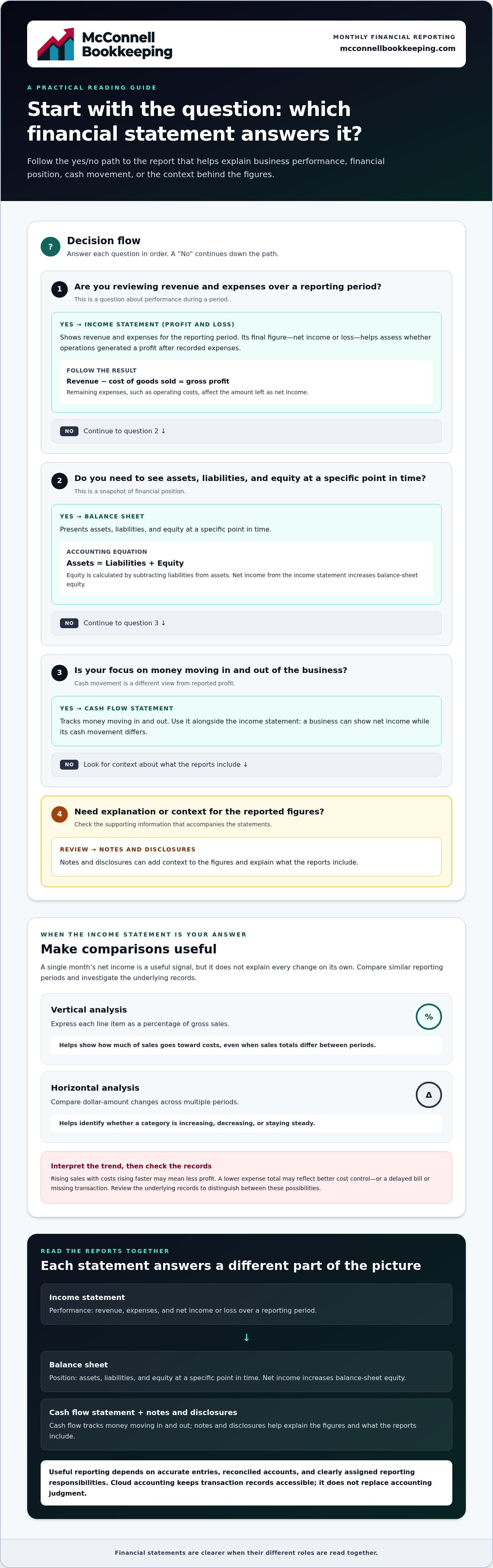
An income statement, also called a profit and loss statement, shows revenue and expenses over a reporting period. Its final figure, net income or loss, helps owners assess whether operations generated a profit after recorded expenses. It complements the balance sheet, which shows assets and liabilities at a particular point in time. Read together, the statements connect performance during a period with the resources and obligations the business holds.
Start with revenue, then examine the costs required to earn it. Gross profit equals total revenue minus the cost of goods sold. Remaining expenses, such as operating costs, affect the amount left as net income. A restaurant, for example, can compare sales with food costs, then consider payroll and other operating expenses to see how costs affect the result. Profit is what remains after total costs are subtracted from total sales.
One month’s net income is a useful signal, but it doesn’t explain every change on its own. Compare similar reporting periods and investigate changes in revenue or expense categories. If sales rise while costs rise faster, the business may have less profit. A lower expense total may reflect better cost control, but it could also result from a delayed bill or missing transaction. Reviewing the underlying records helps distinguish between these possibilities.
Two analysis methods can make comparisons clearer:
Vertical analysis: Express each line item as a percentage of gross sales. This shows how much of sales goes toward costs, even when sales totals differ between periods.
Horizontal analysis: Compare dollar-amount changes across multiple periods. This helps identify whether a category is increasing, decreasing, or staying steady.
Use these methods to investigate a result, not just label it. If cost of goods sold takes a larger share of sales, review purchasing and inventory records. If rent or payroll rises, compare the change with business activity and the period being reviewed. Consistent categories make comparisons more useful; changing how expenses are classified can make trends harder to interpret.
A profit and loss statement supports decisions about pricing, spending, and operational priorities, but it isn’t a cash report. A business can show net income while cash movement differs, because the income statement records revenues and expenses rather than tracking every cash receipt and payment. For clearer monthly reporting, financial statement preparation can help organize those figures into reports that are easier to review and compare.
An income statement can also help readers compare effective tax rates across reporting periods. Mesa Air Group reported an effective income tax rate of 6.9% for its fiscal year ended September 30, 2023, compared with 22.2% for its fiscal year ended September 30, 2022, and 26.0% for its fiscal year ended September 30, 2021.
Financial statements, disclosures, and notes
Financial statements show different parts of a business’s finances, while disclosures and notes explain details behind the reported figures. Reviewing them together can help an owner understand how operating results relate to resources, obligations, and cash movement. For example, a profit in the income statement doesn’t by itself show whether customers have paid their invoices or whether cash is available for upcoming expenses.
The balance sheet presents financial position at a specific point in time. It organizes assets, liabilities, and equity, with assets equal to liabilities plus equity. Assets may be current, such as items expected to convert into cash within a year, or non-current, such as longer-term resources. Liabilities may also be current or non-current. This distinction helps readers see which resources and obligations are short-term and which extend further ahead.
A cash flow statement tracks money moving into and out of the business, grouping flows into operating, investing, and financing activities. Operating activity reflects cash connected with core business operations. Investing activity covers cash movements tied to longer-term resources, while financing activity shows cash connected with borrowing or funding. A loan, for example, can bring cash into the business without being revenue earned from sales. The cash flow statement helps connect the income statement with the balance sheet.
The statement of retained earnings explains changes in equity during a reporting period. It can show changes resulting from profits or losses, dividend payments, and share sales or repurchases. Net income can increase equity, while distributions to owners can affect retained earnings. Reading this statement alongside the balance sheet helps explain why equity changed, rather than showing only the closing balance.
Notes and disclosures add context to financial statements. They can explain accounting methods, significant balances, or details that are difficult to understand from a line item alone. For example, a note may clarify how an asset balance is presented or provide context for a liability. Read the relevant note when a figure is large, changes between reports, or needs explanation. Consistent accounting methods from year to year also make statements easier to compare.
Comparative information gives readers a reference point. Under IFRS, financial statements require one year of comparative information. Comparative information can help readers assess changes across reporting periods, though the details presented may depend on the accounting framework used. Comparing periods can reveal changes that a single report cannot show, but meaningful comparisons also depend on consistent accounting methods. A change in how transactions are classified may affect interpretation, even if the underlying business activity hasn’t changed.
Reviewed financial statements must include all required footnotes and other disclosures. For a restaurant, current liabilities are obligations due within one year, while long-term liabilities are due after one year.
What is included in a monthly financial statement service package?
A monthly reporting package turns recorded transactions into reports for a defined accounting period. Its scope may include organizing activity, reconciling accounts, preparing statements, and explaining items that need attention. Each stage connects to the next: incomplete transaction records can affect reconciliations, and unresolved differences can carry through to final reports. For a Mesa business, a monthly financial statement service can align reporting with the decisions owners need to make.
Transaction processing establishes the accounting records behind the statements. Sales, expenses, payments, and deposits are categorized so readers can see how business activity is reflected. For example, a customer payment should reduce the amount owed by that customer, rather than appear as a new sale. Accurate categorization helps keep revenue and receivables distinct when the reporting period closes.
Account reconciliation compares recorded balances with supporting account statements. It can identify duplicate entries, missing transactions, or differences that need investigation. A bank deposit recorded twice, for instance, can make the cash balance appear higher than the bank’s records. Resolving the mismatch before preparing statements gives reports a more reliable starting point.
Income statement: Summarizes revenue and expenses for the selected month and shows the resulting net income or loss.
Balance sheet: Presents assets, liabilities, and equity as of the period’s closing date.
Cash flow statement: Organizes cash movements into operating, investing, and financing activities when this report is part of the agreed scope.
Reconciliation review: Identifies differences between recorded balances and supporting account statements.
Follow-up notes: Flags unclear transactions, unusual changes, or records that need attention before interpretation.
These reports answer different questions. The income statement shows performance across the month; the balance sheet gives a snapshot at its close. A cash flow statement helps explain how cash moved during that period. If revenue rises while cash receipts fall, customer balances or payment timing may explain the difference. Reviewing the reports together gives more context than relying on a single total.
The reporting package also depends on the records and accounts being handled. A business with multiple bank accounts may need each account reconciled, while a simpler setup may involve fewer balances. The reporting period, statements included, and treatment of unclear transactions all shape the work. A clear scope also identifies which records the business supplies and how unresolved items are communicated.
Before monthly work begins, establish the closing period and the reports needed for decisions. Agree how transaction records will be shared, how reconciliation differences will be raised, and who reviews the finished statements. Choosing a monthly financial statement service in Mesa means matching the reporting scope to your priorities. A lender’s reporting needs, for example, may differ from an owner’s focus on operating costs. Clear expectations help keep monthly reporting consistent.
What records and documents are needed to prepare monthly financial statements?
Monthly statements rely on records that explain each transaction and support account balances. Gather documents for the reporting period, then organize them by account and activity. A bank statement, customer invoice, or supplier receipt can help explain an entry. Consistent records make it easier to spot missing information before it appears in reports.
Start with statements for every business bank and credit card account. Include all pages and transaction details needed to identify deposits, payments, transfers, and fees. A bank deposit, for example, may combine several customer payments. Sales records or payment processor summaries can connect the deposit to individual transactions instead of leaving it as one unexplained sale.
Sales and receivables records show what the business earned and what customers still owe. Gather invoices, sales receipts, point-of-sale reports, payment processor records, and customer payment details. If an invoice remains unpaid, its date and amount help explain the receivable balance. If a customer pays in installments, payment records show how much remains outstanding.
Expense documents support the costs recorded during the month. Collect vendor bills, receipts, subscription invoices, rent records, and payment confirmations. A card charge for equipment, for instance, needs a receipt or invoice to clarify the purchase. Payroll reports and related payment records support wage expenses, while loan statements clarify principal payments, interest, and outstanding balances.
Cash and credit accounts: Statements and transaction details for each business account.
Sales activity: Invoices, receipts, point-of-sale summaries, and payment processor records.
Purchases and expenses: Supplier bills, receipts, recurring invoices, and payment confirmations.
Payroll and loans: Payroll summaries, loan statements, and payment details.
Assets and changes: Purchase documents for equipment, plus records of disposals or transfers.
Asset records help explain purchases that remain useful beyond the month they were bought. Keep invoices for equipment and other long-term assets, along with records of sales or disposals. These documents support account balances and help explain changes between reporting periods. A receipt may show a purchase, while a disposal record explains why the item no longer appears among the business’s assets.
Before closing the reporting period, match each document to its transaction and flag unclear items. Note missing invoices, duplicate receipts, unexplained deposits, or payments without vendor details. Keep records in a consistent folder structure or accounting system, grouped by month and account. This makes follow-up more focused and helps prevent unresolved items from blending into later activity.
For a clear monthly close, assemble account statements and supporting transaction records together. Arrange monthly bank reconciliations to compare recorded activity with account statements and identify discrepancies that need attention.
McConnell Bookkeeping: Monthly Bank Reconciliations
McConnell Bookkeeping offers Monthly Bank Reconciliations to help match recorded activity with bank statements and identify differences for review. This can be a useful next step when account balances need regular reconciliation before financial statements are prepared. Its Financial Statement Preparation uses organized accounting records to present business activity in reports. If past entries need organizing first, Books Cleanup can help address that groundwork; Accounts Receivable Management can support clearer oversight of customer invoices and balances.
Consider these services when transaction records have fallen behind, balances are difficult to explain, or regular reports would help you monitor business performance. The right starting point depends on where your records need support. Contact McConnell Bookkeeping to discuss your bookkeeping needs.
Build a Reporting Routine That Supports Your Next Decision
Make your next step a clear decision about what you need monthly reports to help you manage. You might want to monitor expenses, understand customer balances, or organize records that have fallen behind. That priority can guide which reports matter most and what information your accounting process should capture. A monthly financial statement service in Mesa is most useful when its reporting rhythm fits the way you run your business, not when figures arrive without a clear purpose.
Before setting up a routine, consider who will use the statements and what questions they need answered. A lender, business owner, or internal manager may focus on different details. A defined reporting purpose helps keep records relevant and makes it easier to act on what the reports show.
McConnell Bookkeeping can help you take the next step toward a more organized reporting process. Contact McConnell Bookkeeping to discuss your bookkeeping needs and move forward with greater clarity.
Frequently Asked Questions
What monthly financial statement services are available in Mesa, Arizona?
Mesa businesses can use monthly bank reconciliations and financial statement preparation to organize account activity and produce regular reports. McConnell Bookkeeping also offers books cleanup and accounts receivable management, which can support organized records and customer balance tracking. Other bookkeeping services include accounts payable and payroll management, QuickBooks Online training, IOLTA management, and law and dental practice bookkeeping. Its local service area also includes Phoenix, Gilbert, Tempe, Chandler, and Scottsdale.
How often do Mesa financial statement providers deliver monthly reports?
Monthly reports cover a defined accounting month, and their preparation follows completion of that period’s bookkeeping and review. The closing date depends on when transaction records arrive, account activity is reconciled, and questions about entries are resolved. For example, a missing sales record can make revenue harder to assess. Set a consistent record-sharing routine and reporting period so you know which month each report covers.
What should small businesses in Mesa look for in a monthly financial reporting provider?
Choose a reporting service whose scope matches the decisions your business needs to make. Clarify which statements you’ll receive, how reconciliations and corrections are handled, and how records are shared. A sample report format can show whether categories are easy to interpret. Mesa businesses using QuickBooks Online can also benefit from organized accounting records and consistent reports across periods.



Comments