Managing accounts payable effectively with accurate invoices

Accurate invoices turn accounts payable from a list of bills into a clear, manageable process. Managing accounts payable effectively means recording what you owe suppliers for goods or services received on credit, checking invoice details, approving payments, and keeping records current. This gives you a reliable view of what’s due and when.
Accounts payable may seem like an administrative task, but invoice handling also affects cash flow and supplier relationships. Missing details, unclear approvals, or late payments can create avoidable friction. A consistent process helps you make informed payment decisions and maintain a clearer picture of your obligations.
This article explains how accurate invoice data and statement reconciliation support sound accounts payable management, with practical ways to organize approvals, reduce processing errors, and strengthen supplier relationships. It also covers how effective payables practices can preserve working capital and make day-to-day financial management more predictable.
Table of Contents
1. What Is Accounts Payable Management?
Accounts payable management tracks money a business owes suppliers for goods or services received on credit. These amounts appear as current liabilities on the balance sheet until payment. For example, when a business receives a $5,000 supplier invoice, it records the obligation and pays it within the agreed terms. Inventory, utilities, rent, raw materials, and professional services can all create payables.
Managing accounts payable effectively means coordinating invoice processing, payments, supplier records, and reporting. When the business receives goods or services on credit, record the payable, capture the invoice details, route it for approval, and track the payment. Clear steps connect daily operations with an up-to-date view of cash flow.
Accurate controls help catch duplicate invoices and payment discrepancies before they recur. Check each invoice’s supplier, number, amount, and payment status, then match issued checks and ACH payments against bank activity. Investigate a duplicate invoice number or a payment that differs from the approved amount before releasing another payment. Matching invoices with purchase orders and receiving records can also reduce duplicate-payment risk.
Electronic payments can simplify payment handling. Businesses can use ACH transfers to pay vendors, collect payments, or consolidate funds, while online bill payment can link invoice and credit memo details to each payment. Those links make it easier to trace why a payment was made and which balance it cleared. Keep the payment record connected to the supplier invoice to maintain a clear audit trail for reconciliation.
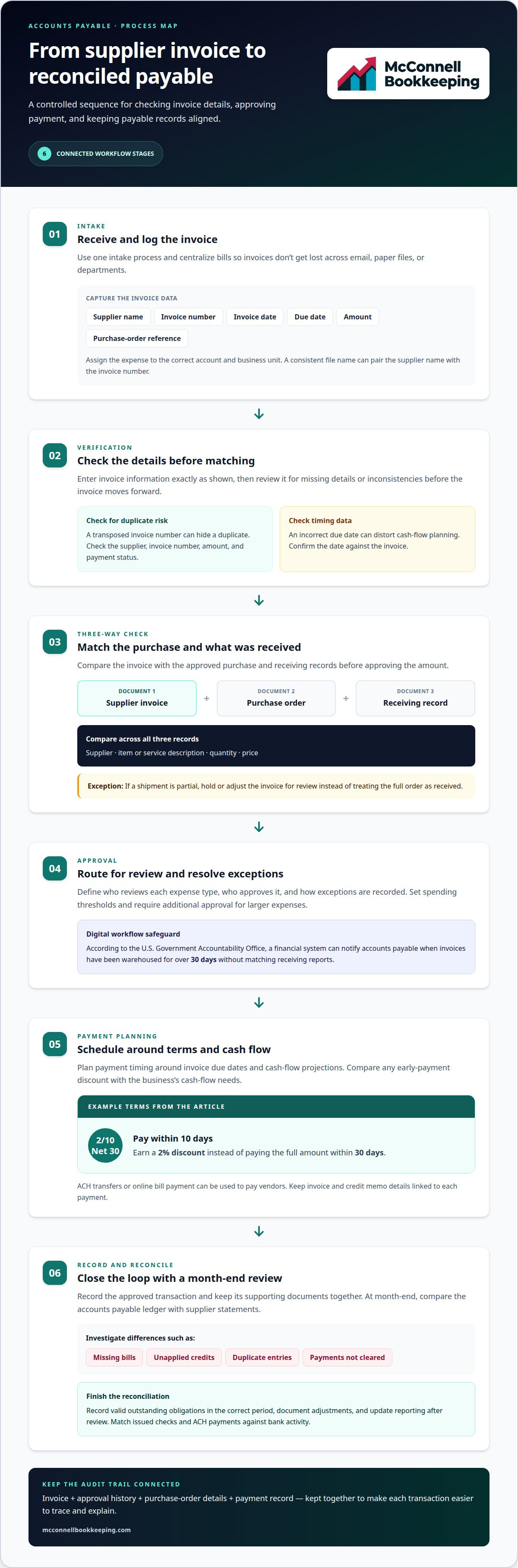
Supplier terms shape payment timing and available discounts. Payables are typically due within 30 to 90 days, while an invoice may set a specific due date or early-payment offer. Under 2/10 Net 30 terms, paying within 10 days earns a 2% discount instead of paying the full amount within 30 days. Compare the discount with cash-flow needs before choosing when to pay.
Late supplier payments can damage goodwill and may lead to late fees, while unresolved invoice disputes can strain ongoing relationships. Reduce these risks by scheduling payments around due dates and cash-flow projections, and resolving discrepancies promptly. Review supplier contracts and payment terms regularly so records reflect current agreements and the business can discuss terms that fit its operations.
Consistent payment records also support reliable supplier relationships. Paying on time and responding promptly to invoice questions gives suppliers a clearer basis for planning. Batch payments at regular intervals when appropriate, while preserving each invoice’s due date and approval history. This keeps payment operations organized without losing sight of individual obligations.
2. Invoice data accuracy and statement reconciliation
Invoice accuracy starts with consistent data entry. Capture the supplier name, invoice number, invoice date, due date, amount, and purchase-order reference exactly as shown. Assign the expense to the correct account and business unit. A transposed invoice number can hide a duplicate, while an incorrect due date can distort cash-flow planning. Documented review practices clarify the purpose of each field and make reporting more dependable.
An effective accounts payable process follows a clear sequence: receive and log each invoice, verify its details, match it with purchasing and receiving records, obtain approval, schedule payment, and record the completed transaction. A documented workflow assigns responsibility at each stage so an invoice doesn’t move forward with missing information or unresolved differences.
Purchase-order matching checks whether an invoice reflects an approved purchase and the goods or services received. Compare the supplier, item or service description, quantity, and price across the invoice, purchase order, and receiving record. If a shipment is partial, hold or adjust the invoice for review instead of treating the full order as received. This check improves accuracy before approval.
An invoice management system can centralize bills, extract data, route approval requests, and help schedule payments. Accounting software stores the approved transaction and connects it to financial reporting. To build a useful workflow, define who reviews each type of expense, who approves it, and how exceptions are recorded. Set spending thresholds and require additional approval for larger expenses.
Centralization helps prevent invoices from getting lost across email accounts, paper files, or departments. Use one intake process and a consistent file-naming practice, such as supplier name plus invoice number. Keep the invoice, approval history, purchase-order details, and payment record together. These controls make it easier to trace a transaction and explain its status during a review.
At month-end, compare the accounts payable ledger with supplier statements and investigate differences before closing the period. Match statement balances to recorded invoices and payments, then identify missing bills, unapplied credits, duplicate entries, and payments that haven’t cleared. Record valid outstanding obligations in the correct period, document adjustments, and update reporting after review. This keeps the payable balance aligned with its supporting records.
Reconcile and close accounts payable at month-end by matching the ledger to supplier statements, resolving exceptions, recording valid unpaid invoices and credits, and checking payment entries against bank activity. Record each correction and its approval so the final balance has a clear audit trail.
A written approval procedure turns these practices into a repeatable strategy rather than an informal habit. For clearer month-end records, structured reconciliation practices can help connect payable activity with the wider books.
3. Paperless processing, EDI, and automation
Paperless accounts payable replaces scattered paper invoices with organized digital records. A consistent intake process captures invoices, assigns them to the right supplier, and routes them for review. Electronic data interchange, or EDI, lets business systems exchange transaction information electronically. Connecting purchasing, receiving, and accounting processes helps reduce manual re-entry and keeps obligations visible.
Automation supports each stage through defined digital workflows. An invoice management system can receive bills, extract information, route approvals, and schedule payments. Matching invoice data with purchase orders and receiving records helps flag exceptions for review rather than advancing them automatically. Set clear rules for who handles exceptions, how approvals are recorded, and when an invoice is ready for payment.
Digital processing can also strengthen follow-up. According to the U.S. Government Accountability Office, a financial system can notify the accounts payable office when invoices have been warehoused for over 30 days without matching receiving reports. This alert gives staff a prompt to investigate missing receiving information, resolve the mismatch, and document the next step. The U.S. Government Accountability Office also describes a District purchasing system integrated with requisition, purchasing, and inventory processing, connecting related operations.
When comparing accounts payable automation software, assess invoice capture, purchase-order matching, approval routing, exception alerts, audit trails, and integration with accounting systems. Review the pricing structure and relevant charges, such as subscription, transaction, setup, or support costs, alongside implementation time and processes. Choose a tool that supports existing approval controls rather than creating a separate workflow staff must maintain.
Paperless records work best when each digital invoice stays connected to its approval, supporting documents, and payment entry. Use consistent file labels, searchable supplier records, and role-based access to keep documents easy to retrieve. Retain a clear history of edits and approvals so a reviewer can trace a transaction from receipt through payment. These steps help reduce errors while keeping human review in place for exceptions.
Businesses can improve efficiency and reduce processing costs by removing repeat data entry, centralizing invoice intake, and routing approvals promptly to the right person. Review where invoices stall and improve that step, such as receipt matching or clarity around approval responsibilities. Track invoice cycle time, payment accuracy, and time spent handling disputes to assess whether changes improve operations.
Automation should support sound judgment, not replace it. Staff still need to investigate mismatched amounts, unfamiliar supplier details, and incomplete receiving records before payment. Start by mapping the current accounts payable process, identifying repeated manual steps, and automating tasks where the rules are clear. A measured rollout lets the business refine workflows while keeping payment controls and reporting dependable.
4. Vendor management and supplier relationships
A well-maintained supplier record gives every invoice a reliable reference point. Keep each supplier’s legal name, contact details, payment instructions, contract terms, and purchasing history together. Update the record when an agreement changes, and note the date and reason for each change. This helps staff distinguish an established supplier from a new or similarly named payee.
Supplier setup needs clear controls because an inaccurate vendor file can lead to payment errors or fictitious invoices. Separate vendor creation from invoice approval and payment authorization where staffing allows. Verify changes to payment information by calling a known supplier contact at a number already on file. Don’t rely only on contact details provided in a change request.
Written accounts payable policies set consistent expectations for purchasing and payment. Define who can approve spending, how invoices are submitted, which records support a purchase, and who resolves disputed charges. Set approval authority by purchase price or quantity, then route larger expenses for additional review. A clear policy reduces manual exceptions and helps employees apply the same controls across departments.
Supplier relationships also depend on predictable communication. Explain how to submit invoices and identify purchase references, then respond promptly when a bill needs clarification. If a delivery is delayed or an invoice differs from the agreement, record the issue and its resolution in the supplier file. Timely payments and prompt dispute resolution demonstrate reliability and support long-term partnerships.
Review contracts and purchasing patterns regularly. Before renewing an agreement, compare current prices, delivery expectations, and payment terms with the business’s actual needs. A business may negotiate monthly or quarterly purchasing agreements, or discuss bulk-purchase discounts, when its purchasing volume and timing support them. Ongoing relationships with a smaller number of suppliers may also create opportunities for more favorable terms.
Supplier reconciliation connects agreements with recorded transactions. Compare supplier statements against the payable ledger, invoices, credits, and payments. A statement might show an invoice missing from the accounting records or a credit that hasn’t been applied. Note the difference, assign follow-up, and retain supporting communication so the next review can trace the resolution.
Supplier portals can streamline routine communication by showing suppliers order status, scheduled delivery, shortages, and received payments. If a portal isn’t used, keep a consistent manual record of those updates in the supplier file. Review open issues and contract terms during regular supplier checks. These practices keep records current, clarify responsibilities, and make supplier relationships easier to manage as purchasing needs change.
5. Benefits of effective accounts payable management
A well-run accounts payable process gives owners a more useful view of working capital. Each recorded invoice shows an upcoming obligation, while payment dates help forecast when cash will leave the business. Aligning payable due dates with expected customer receipts can create more flexibility in cash-flow planning. The goal isn’t simply to delay payments. It’s to make deliberate decisions using current records and agreed terms.
Clear records can also support better use of supplier credit. When a business understands its payment terms, it can plan purchases and payment timing around operating needs. Favorable terms may preserve cash for payroll, inventory, or other commitments. Reviewing contracts alongside purchasing plans can reveal where timing, order size, or negotiated terms could improve cash flow.
Early-payment discounts can be worthwhile when they fit the business’s cash position. Compare the discount deadline with forecast receipts and upcoming obligations before releasing payment. A discount that strains available cash may not suit current needs, while a suitable offer can lower purchasing costs. Recording the decision and its effect helps owners assess whether the approach supports their broader financial strategy.
Consistent invoice records and approval controls strengthen fraud prevention. Where practical, separate vendor setup, invoice approval, and payment authorization among different people. Review unusual changes to payment instructions, duplicate entries, and differences between approved invoices and payment records. These controls reduce the chance that an overlooked change or manual error leads to an improper payment.
Automated workflows can reduce repetitive data entry and direct exceptions to the right reviewer. Electronic invoice records also make it easier to trace payments to their supporting documents. Automation still needs oversight: staff should investigate mismatched amounts, unclear approvals, and unexpected supplier details. Reviewing exceptions helps ensure efficiency gains don’t weaken payment controls.
Track measures such as invoice cycle time, payment accuracy, supplier discounts, cost per invoice, and time spent resolving disputes. These indicators help pinpoint process gaps. Rising dispute-handling time, for example, may point to unclear purchase documentation, while payment errors may indicate weak review controls. Regularly reviewing the measures gives managers practical evidence to improve operations.
Effective payables management also supports supplier confidence. Paying according to agreed terms and resolving disputes promptly helps maintain dependable business relationships. If invoice workflows or payable records are consuming time and obscuring cash-flow decisions, get support organizing accounts payable and bring more clarity to routine financial operations.
McConnell Bookkeeping: Accounts Receivable Management
McConnell Bookkeeping helps bring clarity to the financial records that support day-to-day decisions. When payable processes need broader bookkeeping context, Monthly Bank Reconciliations can connect recorded activity with bank records, while Financial Statement Preparation organizes financial information for review.
If older or inconsistent entries make it harder to understand what the business owes and collects, Books Cleanup can help restore order. Accounts Receivable Management focuses on amounts customers owe, complementing a clearer view of outgoing payments with oversight of incoming funds.
For support with these bookkeeping needs, contact McConnell Bookkeeping.
Build a clearer financial routine
Build a repeatable financial routine that gives decisions a dependable foundation. Set a regular time to review records, resolve outstanding questions, and keep financial information ready for the choices ahead. With consistent records, managing accounts payable effectively becomes part of a broader effort to understand the business’s financial position and plan with greater clarity.
McConnell Bookkeeping can support that wider view through Monthly Bank Reconciliations, Financial Statement Preparation, and Books Cleanup. These services help connect recorded activity, organized books, and useful financial reports, giving business owners a clearer starting point for planning. The right support can be especially valuable when bookkeeping demands make it difficult to maintain that rhythm alongside daily operations.
Contact McConnell Bookkeeping today to discuss your bookkeeping needs and take a practical next step toward clearer financial records. A steadier routine can help you move forward with confidence.
Frequently Asked Questions
What Is Accounts Payable Management?
Accounts payable management organizes a business’s unpaid supplier obligations from purchase through settlement. It combines accurate liability records with decisions about approvals, timing, and documentation. For example, when an invoice arrives after a delivery, the business records the obligation and links the bill to supporting purchase information. A reliable process gives managers a clearer view of upcoming outflows and helps them address discrepancies promptly.
What are the key AP metrics to keep track of?
Track invoice cycle time, payment accuracy, on-time payment rate, supplier discounts captured, cost per invoice, and time spent handling disputes. Days Payable Outstanding (DPO) adds context about payment timing. Read the measures together: a shorter cycle time isn’t useful if errors rise, and a higher discount rate may not help if it strains available cash. A monthly dashboard can show trends and help identify which process needs attention.
What is a good Days Payable Outstanding (DPO)?
A DPO of 30 to 45 days is considered typical by many businesses, but a suitable target depends on supplier terms, cash flow, and the company’s purchasing cycle. DPO uses accounts payable, cost of goods sold, and 365 days in its calculation. Treat the result as a planning indicator, not a goal to maximize. Compare it with agreed terms and investigate sharp changes that may reflect delayed payments or shifts in purchasing.
What accounts payable KPIs should companies track, and what are typical benchmarks?
Useful KPIs include invoice cycle time, payment accuracy, on-time payments, cost per invoice, discount capture, and dispute-resolution time. No single benchmark fits every company, since invoice volume, approval steps, supplier terms, and accounting processes differ. Establish a baseline using consistent definitions, then compare results across reporting periods. For instance, rising error rates alongside faster processing may signal that reviews need strengthening, not further acceleration.
What is the best way to prevent invoice errors, duplicate payments, and fraud?
Use layered controls rather than relying on a single review. Match invoice details with purchasing and receiving records, search for existing invoice numbers before approval, and separate vendor setup from payment authorization. Verify changes to supplier payment instructions through a previously established contact channel. Keep an audit trail of approvals and edits, then compare issued checks and electronic payments with bank activity to identify discrepancies for investigation.
How should businesses set up invoice approval workflows and payment controls?
Set approval authority according to purchase value or quantity, and route invoices to the person responsible for that expense. Define how staff document exceptions, reject incomplete bills, and record final authorization. Where practical, separate invoice approval, payment release, and vendor setup among different people. For example, an invoice can require department approval before an authorized payment reviewer releases it, leaving a traceable record of each decision.
How can companies optimize payment timing and capture early payment discounts?
Start with a cash forecast that includes expected receipts, payroll, and other scheduled obligations. Compare each discount deadline with available funds and the value of preserving working capital. Schedule payments according to supplier terms, then record whether the discount was taken and why. This creates a basis for reviewing future offers. Avoid paying early automatically if it would leave insufficient cash for planned operating needs.
What records should businesses keep for accounts payable, and for how long under U.S. rules?
Keep invoices, purchase orders, receiving records, approvals, supplier agreements, credit memos, payment confirmations, and reconciliation notes together or linked in a searchable system. No single retention period applies to every accounts payable document. Create a written schedule based on record type and applicable federal, state, contractual, and business requirements. Apply it consistently, and preserve relevant records while a dispute or review remains open.


Comments