Law Practice Bookkeeping Services for Law Firms

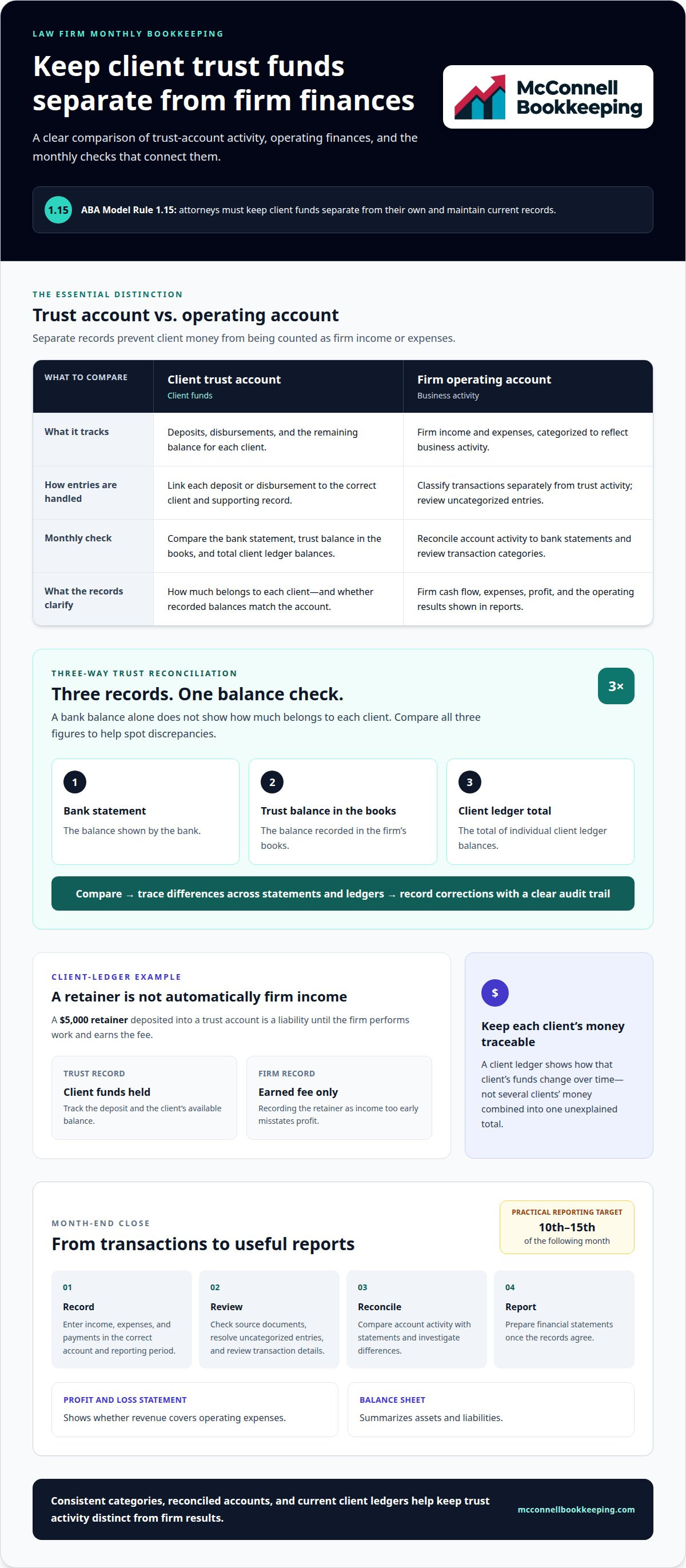
Trust-account errors can turn a routine month-end task into a serious financial concern. Each month, a law firm bookkeeper records transactions, tracks billing and payments, and reconciles firm and client trust accounts. The three-way trust reconciliation compares the bank balance, the books, and each client’s trust ledger; ABA Model Rule 1.15 requires attorneys to keep client funds separate from their own and maintain current records.
Bookkeeping does more than keep a law firm’s numbers organized: client funds must remain distinct from firm income and expenses. This guide explains what a law firm bookkeeper handles each month, how legal bookkeeping differs from general business bookkeeping, and how law practice bookkeeping services can support billing and firm growth. You’ll also learn how reconciliations, financial statements, and accounts receivable management work together to provide clearer records and more consistent financial oversight.
Table of Contents
What does a law firm bookkeeper do each month?
Each month, a law firm bookkeeper records transactions, reconciles accounts, and organizes financial statements. Because trust-account rules vary by jurisdiction, firms need procedures suited to the requirements that apply to them.
Trust Account Reconciliation
Monthly trust reconciliation compares three figures: the bank statement balance, the trust account balance in the books, and the total of individual client ledger balances. Comparing them helps reveal discrepancies and confirm that recorded client funds match the account.
ABA Model Rule 1.15 requires attorneys to keep client funds separate from their own funds and maintain current records. IOLTA bookkeeping applies that separation in the records, while a monthly reconciliation makes differences easier to detect and investigate.
The comparison matters because a bank balance alone doesn’t show how much belongs to each client. A law firm bookkeeper traces any difference across the statements and ledgers, then records corrections with a clear audit trail.
Client Ledgers and Account Activity
Each client’s trust ledger tracks deposits, disbursements, and the remaining balance. It should show how that client’s funds change over time, rather than combining several clients’ money into one unexplained total.
For example, a $5,000 retainer deposited into a trust account is a liability until the firm performs work and earns the fee. Recording it as firm income too early would misstate the firm’s profit and the client’s available balance.
For each deposit or disbursement, legal bookkeeping links the transaction to the correct client and supporting record. This helps distinguish client funds from operating money and track each balance through account activity.
Operating Account Categorization
Operating account transactions are categorized separately from trust activity. A bookkeeper classifies firm income and expenses so financial statements reflect business activity without counting client funds as operating results.
Jurisdiction-specific rules can affect trust-account recordkeeping and reporting. The applicable state bar’s requirements shape a firm’s procedures, so client ledgers and account records need to be organized for that jurisdiction.
Monthly work also includes reconciling operating accounts to bank statements and reviewing uncategorized transactions. Correctly classifying a client payment, payroll expense, or office cost gives the firm a clearer view of cash flow and profit.
A consistent monthly process links transaction records, client ledgers, and reconciliations. When an entry doesn’t match a bank statement or client record, the discrepancy can be traced before the figures flow into financial statements. This supports clearer oversight of trust activity and firm finances.
Monthly bookkeeping and financial statements
A monthly close turns transaction records into reports a law firm can use. Accurate entries and timely statements help owners understand cash flow, expenses, and operating results. Law practice bookkeeping services connect routine transaction recording with reporting that supports informed decisions.
Recording Firm Transactions
Law firm bookkeeping records income, expenses, and payments as they occur, assigning each transaction to the correct account and reporting period. Review each transaction from its source document to the accounting record, checking the date, amount, payee, and business purpose. This keeps records consistent and makes entries easier to explain later.
For example, a retainer received into a trust account is not the same as earned firm revenue. Monthly records should preserve that distinction rather than treating every incoming payment as income. Expense categories matter too: separating payroll from office costs gives management reports a more useful view of spending.
Month-End Close and Reporting
At month-end, the bookkeeper reviews recorded transactions, resolves uncategorized entries, and reconciles account activity with statements. Once the records agree, financial statements can summarize the firm’s financial position and activity. A practical reporting target is the 10th to 15th day of the month following the reporting month, giving firm leaders current information for review.
Reports are most useful when they answer specific management questions. A profit and loss statement shows whether revenue covers operating expenses, while a balance sheet summarizes assets and liabilities. Comparing current reports with prior periods can reveal changes, such as rising costs or lower collected income, and help the owner investigate the underlying entries.
An organized monthly close also supports better decisions. When reviewing expenses, a firm can trace a change to a transaction category instead of relying on a vague total. Consistent categories and reporting periods help distinguish changes in business activity from differences in recordkeeping. Law practice bookkeeping services can maintain this routine and turn accurate records into useful financial statements.
Organized financial records also support tax preparation. Accurate income and expense entries can help with quarterly and annual tax filings and financial planning, but bookkeeping records are not a tax return. Retaining transaction details and statements helps the firm and its tax preparer trace how reported totals were assembled.
For firms that need a consistent reporting process, financial statement preparation can turn organized monthly records into clear reports for review. The value comes from connecting accurate entries, reconciled statements, and understandable summaries, so the firm can make decisions using a dependable view of its finances.
Legal bookkeeping versus general business bookkeeping
Both legal and general business bookkeeping record income, expenses, and payments. Legal bookkeeping also accounts for client trust activity, matter-level tracking, and billing details that ordinary business records may not need. For example, a firm must distinguish money held for a client from revenue earned for legal work. That distinction affects how transactions appear in the books and reports.
Trust-account records are a key difference. A bookkeeper handling a law firm’s accounts needs to maintain separate client records and link deposits or disbursements to the right client. General business bookkeeping still requires accurate transaction categories, but it doesn’t typically organize funds by individual legal client. Legal bookkeeping must preserve both the firm’s financial picture and records tied to client funds.
Bookkeepers and CPAs have different roles. A bookkeeper records transactions, reconciles accounts, and organizes monthly financial information. A CPA may provide tax or accounting services depending on the engagement, but routine bookkeeping is a distinct function. Neither title alone shows whether someone understands legal billing, trust ledgers, and matter-related transactions. Assess the work involved, including how invoices are tracked alongside trust activity.
Practice areas can shape how a firm records revenue and client payments. Firms may bill hourly, collect retainers, or receive contingency fees, each creating different transaction patterns. An hourly practice may record billed work and payments against invoices; a contingency practice may see income tied to case outcomes. Bookkeeping categories and supporting records should reflect these differences without confusing client funds with earned income.
Software matters because legal billing and accounting systems may handle different parts of the financial workflow. Integration between them can make processes more efficient. Trace an invoice from the billing system into the accounting records, then check that payment activity is recorded correctly. Software proficiency includes understanding how transactions move between systems, where data is entered, and how exceptions are resolved.
For example, if an invoice is entered in legal billing software but its payment is recorded only in the accounting system, the firm needs a clear reconciliation process. Without one, reports may show an unpaid invoice after payment. A bookkeeper familiar with legal workflows can map how invoices, payments, and client-related records move, then identify entries that need review.
When assessing legal bookkeeping expertise, focus on practical questions: how do monthly records distinguish client funds from firm income, how are invoices and payments tracked, and how are software transfers reconciled? The answers show whether the process fits a law firm’s financial activity. A sound approach connects matter billing, account records, and management reports, rather than treating legal transactions as generic sales.
Scalable bookkeeping for solo and growing firms
A solo attorney and a growing law firm both need financial records suited to their workflow. Law practice bookkeeping services can adapt as matter volume, staffing, and billing activity change.
Support for Solo Attorneys and Small Firms
For a solo attorney, bookkeeping can begin with a repeatable process for organizing receipts, recording expenses, and reviewing account activity. A monthly review can catch missing documents and uncategorized transactions before they complicate the records.
As a small practice adds attorneys or staff, its bookkeeping process can reflect new responsibilities. Separating payroll costs from office expenses, for example, helps the owner understand how hiring affects operating costs.
Growth can also change the financial questions a firm needs answered. A solo practice billing hourly may focus on outstanding invoices, while a firm adding a contingency practice may need records that reflect different payment patterns. As staffing and matter activity shift, law practice bookkeeping services can adjust recurring records and reporting to fit the firm’s changing needs.
Outsourcing recurring bookkeeping can give attorneys more time for client work and practice development. The firm provides relevant records and explains unusual transactions, while the bookkeeper handles the agreed routine tasks. Clear responsibilities help prevent missed handoffs when an attorney or staff member takes on a new role.
Freelance and Firm-Based Bookkeeping Support
A firm can work with a freelance bookkeeper or a bookkeeping firm. Either arrangement can support consistent records; the key is to define who enters transactions, reviews account activity, and resolves questions about unusual items.
Before work begins, clarify how records will be shared and unresolved entries communicated. For example, define who provides billing information and who follows up when a payment cannot be matched to an invoice. Clear ownership helps monthly work continue as the firm’s volume changes.
Choosing Law Firm Bookkeeping Support
Start by mapping the firm’s accounts, billing process, software, and reporting needs. Then identify recurring tasks that require reliable handling, such as organizing historical entries or maintaining consistent monthly records.
Assess legal bookkeeping knowledge with practical scenarios. Ask how the workflow distinguishes client funds from earned income and connects billing activity to firm records. Defined review steps help attorneys understand what information to provide and how discrepancies are handled.
Bookkeeping procedures should evolve when the firm adds staff, adjusts billing practices, or opens a new practice area. Reviewing responsibilities and reporting categories during those transitions helps keep records accurate and useful. A process that scales with the firm can maintain financial visibility while attorneys focus on client matters and practice growth.
Billing structures, invoices, and payment tracking
Billing records connect legal work to incoming payments and firm cash flow. A monthly review helps identify open invoices and expenses that need attention.
Billing Structures and Invoice Tracking
Law firms may bill hourly, through retainers, or on contingency. Each method creates a different pattern of invoices and payments, so bookkeeping should identify the arrangement behind each transaction. For an hourly matter, records link billed work to the client’s invoice and subsequent payment. Accounts receivable reports make outstanding balances visible.
Reviewing receivables at least once a month helps a firm plan timely follow-up. An aging report can separate invoices that are 30, 60, and 90 days old, making overdue balances easier to prioritize. The review should match payments to the right invoices and identify partial payments, credits, or entries needing clarification.
This tracking clarifies the difference between work billed and cash received. An invoice shows revenue billed, while the bank account reflects payments received. Reviewing both gives firm leaders a clearer view of collection activity and expected cash flow.
Earned and Unearned Fee Tracking
Retainers need careful recording because money received isn’t automatically earned income. A retainer held for future legal work remains client funds until the firm performs work and earns the fee. Bookkeeping should record the receipt separately, then record earned amounts as work is completed and funds are applied.
This distinction keeps revenue reports from overstating income and helps preserve an accurate record of funds remaining for the client. For example, when part of a retainer is applied to completed work, the records should show both the earned fee and the remaining balance.
Regular bank reconciliation also improves payment tracking. Comparing recorded receipts with bank activity can reveal deposits that haven’t been matched to invoices or payments recorded in the wrong period. Consistent reconciliation supports a more dependable view of cash, though the bank balance and earned income measure different things.
Include expenses in the same cash-flow review. Categorizing payroll, rent, and other operating costs shows where firm cash goes and helps explain changes between periods. Reviewing those categories alongside outstanding invoices gives a fuller picture than looking at revenue alone.
For clearer visibility into deposits and payments, use monthly bank reconciliation support to connect recorded activity with bank statements. This helps keep payment records aligned with actual account activity.
McConnell Bookkeeping
McConnell Bookkeeping helps law firms bring routine financial records into a clearer, more consistent process. Turn to the team when bank activity needs regular reconciliation, past transactions need cleanup, or unpaid invoices are becoming harder to track.
Monthly Bank Reconciliations connect recorded activity with bank statements, while Financial Statement Preparation organizes the resulting information into useful reports. Books Cleanup can help restore order to disorganized records, and Accounts Receivable Management supports tracking outstanding invoices and payments. Together, these services address practical bookkeeping needs that affect a firm’s financial visibility and month-to-month decisions.
If your firm needs more organized bookkeeping or clearer financial reporting, contact McConnell Bookkeeping to discuss the support that fits your needs.
Build a Steady Financial Routine for Your Firm
Make bookkeeping a repeatable part of how the firm operates, rather than a task addressed only when reports are due. A clear process can evolve as your practice changes, keeping financial information useful for decisions instead of simply filing records away. The right support should fit your firm’s workflow and address the records that need attention.
McConnell Bookkeeping can help establish consistency through Monthly Bank Reconciliations, Financial Statement Preparation, and Books Cleanup. These services support firms seeking organized records and financial visibility, whether they’re refining current processes or sorting out past entries. With law practice bookkeeping services aligned with your firm’s needs, you can build a manageable foundation for the next stage of practice without making bookkeeping the center of every workday.
To discuss your bookkeeping needs, contact McConnell Bookkeeping today. A thoughtful next step can give you more confidence as your firm develops.
Frequently Asked Questions
What Does a Legal Bookkeeper Do?
A legal bookkeeper maintains a law firm’s financial records and organizes activity for review. Tasks can include recording transactions, tracking client-related balances, reviewing invoices, and preparing financial reports. For example, when a client payment arrives, the records should show whether it applies to an invoice or remains a retainer. This organized trail helps attorneys understand financial activity and identify entries that need attention.
How is bookkeeping for attorneys different from regular bookkeeping?
Bookkeeping for attorneys must account for client funds and matter-related activity, not just ordinary business income and expenses. A general bookkeeping process may not include separate records for each client’s trust balance. For example, a firm needs to distinguish an earned fee from money still held for a client. Billing arrangements and legal software workflows can also affect how transactions are recorded and reviewed.
How quickly can I get started?
The start date depends on the scope of the bookkeeping work and the condition of the firm’s existing records. An organized chart of accounts and accessible transaction documents can make setup more straightforward; unreconciled periods or historical errors require additional review. Before beginning, identify the accounts, billing tools, reporting needs, and records involved. This helps define the initial work and set a practical sequence for organizing the firm’s books.
What bookkeeping services do law firms need?
Needs depend on the firm’s workflow, but common bookkeeping tasks include transaction recording, account reconciliations, financial statement preparation, and accounts receivable tracking. A firm with employees may also need payroll management, while disorganized historical records may call for books cleanup. Law firms in Mesa, Phoenix, Gilbert, Tempe, Chandler, and Scottsdale can consider which recurring tasks are taking time away from client work and practice management.
How much do bookkeeping services for law firms cost?
The price depends on the scope of work and is provided after a quote request. Cost factors include the condition of existing records, transaction complexity, account and matter activity, and reporting support needed. For example, a firm with several unreconciled periods may require a different scope from one seeking recurring monthly bookkeeping. Defining the records and tasks involved helps establish an appropriate quote without relying on a generic industry estimate.
How are law firm trust accounts and client funds recorded?
Record client funds separately from the firm’s operating money, associating activity with the relevant client ledger. For example, the ledger should show a client deposit, later authorized disbursements, and the remaining balance. Records should also distinguish funds held for future work from fees the firm has earned. Clear transaction support helps explain how each client balance changed and supports an accurate review.
What are the IOLTA bookkeeping and reconciliation requirements in the United States?
Requirements vary by jurisdiction, so firms need procedures that follow their state bar’s applicable rules. ABA Model Rule 1.15 calls for keeping client funds separate and maintaining current records. A monthly three-way reconciliation compares the bank balance, the trust account book balance, and the combined individual client ledger balances. This process helps identify differences that need investigation and correction.
What accounting software is best for law firm bookkeeping?
The best fit is software that supports the firm’s accounting workflow and works effectively with its legal billing system. Consider whether the process can preserve client-level records, link invoices with payments, and support account reconciliation. McConnell Bookkeeping uses QuickBooks Online, but the firm’s software setup should also suit its billing tools and reporting needs. Clear procedures for reviewing transferred data help prevent mismatched entries.



Comments