Get Your Business Finances Organized in Gilbert: A Practical Guide

What if the best way to get your business finances organized in Gilbert isn’t a weekend spent catching up, but a simple routine you can repeat each month? If you’ve searched “get my business finances organized Gilbert,” you may recognize the challenge: records fall behind while customer work and daily operations take priority, leaving you unsure how your business is really performing.
You don’t need to solve everything at once. A dependable process can make financial tasks more manageable and give you clearer information for day-to-day decisions. This guide will help you build a recurring routine, identify the records and figures that support informed choices, and decide whether handling bookkeeping yourself or getting professional support is the better fit.
We’ll cover practical steps for keeping transactions organized, why monthly bank reconciliations matter, and how QuickBooks Online-based Monthly Bookkeeping, Book Clean-up, and Financial Analysis can support a clearer financial picture. You’ll also learn how to recognize when your current system needs more help, so your records can become a useful roadmap for your Gilbert business. McConnell Bookkeeping serves small businesses in Gilbert, Mesa, Phoenix, Tempe, Chandler, and Scottsdale.
Table of Contents
Get your business finances organized in Gilbert with a clear starting point
Organized business finances are accurate, current records that help an owner understand the business’s activity and make informed decisions. The goal isn’t simply to have receipts in folders or files saved in one place. Records need to be complete, recorded consistently, and useful when you need to review how the business is doing.
Look for practical signs that your system needs attention: bank or credit card accounts haven’t been reconciled, transactions sit in unclear categories, receipts or invoices are missing, or financial information is delayed. A tidy folder can make documents easier to find, but it can’t show whether transactions were recorded correctly or whether the account balance matches the bank’s records. If you’re wondering how to “get my business finances organized Gilbert,” start by checking the quality and timeliness of the information, not just where you store it.
For a broader look at how financial information supports business decisions, explore Understanding Corporate Finance.
For a practical perspective on separating business finances, watch this short video:
How to tell whether your business records need attention
Use this quick self-check. Reliable records are useful for businesses of different sizes and across industries:
Currency: Are income and expenses recorded regularly, or are you facing a backlog?
Accuracy: Have account activity and recorded transactions been compared, and can you explain differences?
Access: Can you find current financial information when you need to review business activity?
If you can’t answer confidently, routine choices may feel less clear. For example, a Gilbert business owner deciding whether current cash flow can support a new purchase needs a dependable view of recent income and expenses. Outdated or inconsistent records can make it harder to separate a temporary timing issue from a pattern that deserves attention.
What an organized financial system should help you do
A useful system brings together more than stored documents. It helps you understand where income comes from, how expenses are categorized, and what the records indicate about the business’s financial position. Those details can make it easier to review performance, spot questions that need follow-up, and plan with a clearer picture of available information.
Think of organization as an ongoing bookkeeping process, not a one-time filing project. Saving invoices and receipts matters, but those documents also need to be recorded and reviewed so your reports reflect business activity. A recurring process keeps information from becoming stale and makes it easier to find gaps while the details are still accessible. Start by establishing what’s current, identifying what’s missing or unclear, and setting a regular time to bring records up to date.
Build financial clarity from accurate records and monthly review
Reliable financial insight starts with reliable entries. Recording transactions precisely means capturing and categorizing each payment, deposit, and expense so the records tell a coherent story of business activity. If entries are late, duplicated, or placed in unclear categories, even a neatly prepared report may not reflect what actually happened.
Monthly reconciliations make financial information more reliable by helping you compare recorded transactions with account activity and identify differences. The review doesn’t make every discrepancy disappear automatically, but it gives you a regular opportunity to investigate and correct issues before they linger. For Gilbert owners searching “get my business finances organized Gilbert,” this repeatable step can turn bookkeeping from a recordkeeping chore into a more dependable source of information.
Why bank reconciliations belong in a monthly routine
Bank reconciliation means comparing transactions in your bookkeeping records with activity shown by the bank, then examining any mismatch. A difference might point to a missing entry, a duplicate, or a transaction recorded for the wrong amount. The purpose is to understand the difference and keep the books aligned with account activity, not to assume that every mismatch has the same cause.
Unresolved differences can weaken confidence in your records: you may be unsure whether a balance is complete or whether recent activity has been captured. Regular review keeps those questions visible rather than allowing them to accumulate. McConnell Bookkeeping provides monthly bank reconciliations for businesses in Mesa and the Phoenix business community, including Gilbert, helping owners maintain a consistent review process.
How financial statements turn records into insight
Financial statements summarize recorded activity in a format that’s easier to review than a stream of individual transactions. An income statement organizes income and expenses over a period, while a balance sheet presents a snapshot of what the business owns and owes. Together, these reports help you ask useful questions: Which kinds of activity are contributing to income? What expenses are recurring? Has the business’s financial position changed?
Clear reporting supports informed conversations about performance and long-term profitability, but it doesn’t predict results or make decisions for you. It gives you a more dependable basis for weighing choices, such as whether a change in spending or operations fits the business’s current position. The U.S. Small Business Administration Resources can also provide broader guidance on business management to complement your own records and review.
Keep the process connected: record transactions accurately, reconcile accounts each month, then review financial information based on the updated records. McConnell Bookkeeping uses QuickBooks Online for Monthly Bookkeeping, including precise transaction recording and monthly bank reconciliations. If maintaining that cycle is difficult alongside daily operations, Monthly Bookkeeping and Financial Analysis can help make your financial information more consistent and useful for decisions.
Compare DIY bookkeeping with ongoing professional support
There’s no single bookkeeping setup that fits every Gilbert business. The right choice depends on how complex your records are, how much time you can set aside consistently, and what information you need to review. Use this comparison to identify where your current approach works well and where it may need support.
Financial management involves using business information to guide resource and operational decisions. These Principles of Financial Management offer helpful context for why dependable records matter, whether you manage the books yourself or work with a bookkeeper.
When handling bookkeeping yourself may fit
DIY bookkeeping can be a practical fit when transaction volume is manageable, your records are straightforward, and you can maintain a consistent owner-led routine. Choose a regular time to record activity, check categories, and review account records. Bookkeeping software can help you maintain records, but it doesn’t replace reviewing entries and investigating differences. If the routine slips whenever customer work gets busy, reconsider whether it remains sustainable.
When professional bookkeeping may better support the routine
Recurring backlogs, unresolved account differences, or too little owner time are signs that ongoing support may be useful. Monthly Bookkeeping can bring consistency to transaction recording and bank reconciliations, while Financial Analysis helps you make sense of your business information. Recurring bookkeeping support may help when maintaining accurate, current records consistently is taking time away from running your business. It’s an option to weigh against your workload and reporting needs, not a requirement for every business.
If past transactions have built up, Book Clean-up can address records that need attention. For owners asking how to “get my business finances organized Gilbert,” a helpful next step is to identify which recurring tasks you can reliably own and where professional bookkeeping could make the process more consistent. McConnell Bookkeeping provides Monthly Bookkeeping using QuickBooks Online, including precise transaction recording and monthly bank reconciliations. Explore Monthly Bookkeeping support as one way to keep that routine on track.
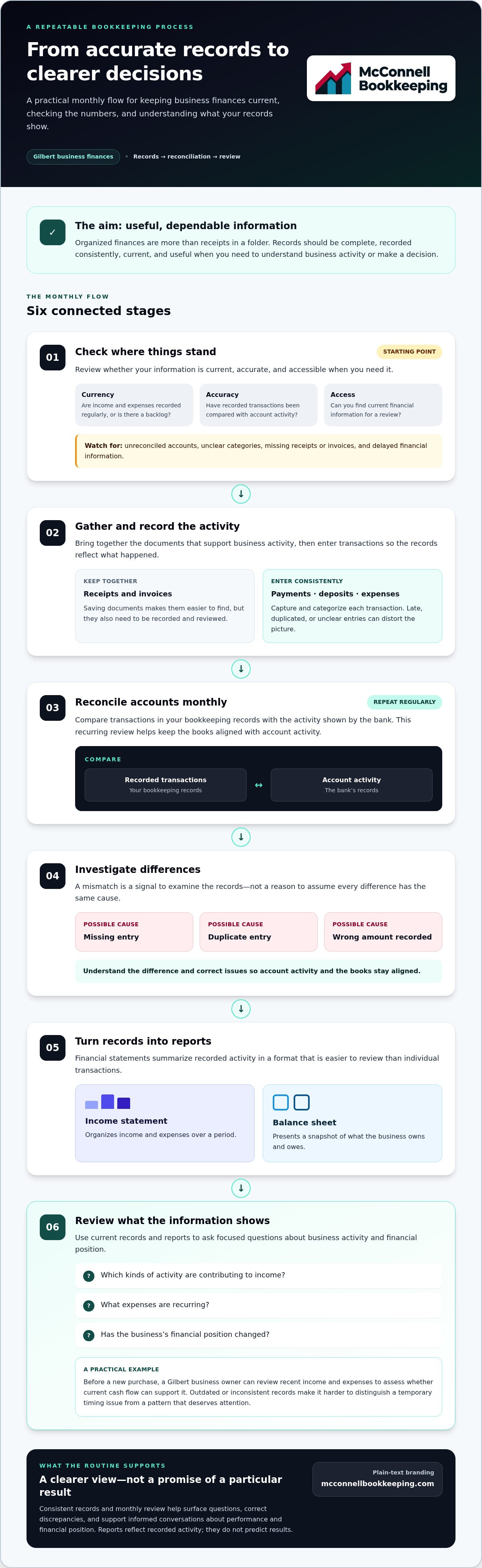
Use this monthly workflow to keep Gilbert business finances organized
A monthly routine works best when each step has a clear purpose and a natural next action. Whether you manage the books yourself or share the work with a bookkeeper, move from gathering source records to reviewing the updated information. Set a recurring time that fits your operations, then keep the same sequence so missing items and questions are easier to spot.
Set up a reliable recordkeeping rhythm
Choose a regular point in your business calendar to gather records and check bookkeeping progress. Keep invoices, receipts, statements, and other supporting documents organized by period so transactions can be reviewed against their source. McConnell Bookkeeping uses QuickBooks Online in its Monthly Bookkeeping workflow, providing a consistent platform for recording and reviewing business activity.
Use this sequence as a starting point, adjusting it to the way your business receives and pays money:
Gather records. Collect the statements and supporting documents for the period, including invoices, receipts, and payment details.
Record activity. Enter transactions and assign clear categories. An owner can provide missing documentation or context, while a bookkeeper can handle precise, ongoing transaction recording.
Reconcile accounts. Compare recorded transactions with account activity. Flag unfamiliar items and investigate differences as part of the monthly review.
Review information. Look at current financial information and note changes or questions. The owner uses the information to guide decisions, and Financial Analysis can help make business data more useful for planning.
Review the books and decide what needs follow-up
Once the records are updated, review the process rather than just filing away the documents. Confirm that accounts have been reconciled and make a note of any remaining differences. Then look at the available financial information: do the entries reflect the activity you expected, and are there categories or transactions that need clarification? This check helps turn routine bookkeeping into a practical review, without assuming every unexpected figure signals a problem.
Keep a short checklist for each cycle. Assign each item to yourself or to bookkeeping support so responsibilities stay clear:
Owner: Gather source records, provide context for transactions, and identify questions about business activity.
Owner or bookkeeper: Record and categorize transactions, based on how you’ve divided the work.
Bookkeeping support, when useful: Complete monthly reconciliations and help organize financial information for review.
Owner: Review the updated information and decide which questions need follow-up.
If your review reveals a backlog or unresolved differences, note the issue and include it in the next step of your bookkeeping process rather than letting it disappear into a folder. A steady routine can help you get my business finances organized Gilbert by making record review part of regular operations, not an occasional catch-up effort. For help maintaining that cycle, explore bookkeeping support for your business.
Get your business finances organized in Gilbert with McConnell Bookkeeping
McConnell Bookkeeping serves Gilbert businesses from Mesa, AZ across the Phoenix business community, including Mesa, Phoenix, Gilbert, Tempe, Chandler, and Scottsdale. Its bookkeeping support helps small businesses move from scattered records toward a consistent process, with services that address both ongoing recordkeeping and past transactions that need attention. If you’re searching “get my business finances organized Gilbert,” matching the support to your current challenge is a useful place to start.
Match the bookkeeping support to the problem you need to solve
For regular bookkeeping needs, Monthly Bookkeeping includes precise transaction recording and monthly bank reconciliations using QuickBooks Online. The recurring process helps keep activity recorded and accounts reviewed, so you have a more consistent basis for understanding your business finances.
If older records contain gaps or discrepancies, Book Clean-up provides a comprehensive review and organization of past transactions. Addressing historical records can help clarify what needs correction and create a more orderly foundation for ongoing bookkeeping. For owners who want to use financial information in planning, Financial Analysis provides strategic data and insights to support informed, long-term profitability decisions. These services address different needs, from maintaining current records to reviewing past activity and considering what the numbers mean.
Move from scattered records to a dependable process
A dependable financial routine is built through recurring work. Consistent transaction recording, monthly reconciliations, and review of financial information can help you understand business activity more clearly. They don’t guarantee a particular profit or outcome, but they give you a more organized foundation for decisions and follow-up.
McConnell Bookkeeping’s website describes an annual profit increase of up to $7,000 or an annual profit surplus of over $7,000. Those statements are not a guaranteed result for every business. The practical value of bookkeeping is in creating organized, useful information that supports your own review of performance and future decisions.
You don’t have to wait until every record is perfectly organized to establish a better process. Whether you need ongoing transaction recording, reconciliation, or help reviewing older records, the next step can be a conversation about the bookkeeping support that fits your business. Explore bookkeeping support with McConnell Bookkeeping and take a steady step toward clearer finances for your Gilbert business.
Make your next financial decision with greater clarity
A useful next step is to decide what you want your financial records to help you understand. Perhaps you want to feel more prepared before changing how you operate, taking on a new commitment, or reviewing business performance. Keeping that question in view can help you build a financial routine around the decisions that matter to your business, rather than treating bookkeeping as paperwork to finish and forget.
If you’ve been searching “get my business finances organized Gilbert,” start by choosing one practical improvement you can sustain. You don’t need to fix every record or create a perfect system all at once. A clear priority and consistent follow-through can help you move forward with more confidence.
McConnell Bookkeeping can help you identify bookkeeping support that fits your business and its needs. Explore bookkeeping support for your Gilbert business and take a manageable next step toward financial clarity. Your records can become a stronger foundation for the decisions ahead.
Frequently Asked Questions
How do I organize my small-business finances?
Start by separating business transactions from personal activity and choosing one consistent place to maintain your records. Establish categories that make sense for your business, then keep source documents, such as invoices and receipts, connected to the transactions they support. If you’re searching “get my business finances organized Gilbert,” focus first on making each transaction understandable and easy to trace, rather than trying to create a perfect system all at once.
What financial records should a small business keep organized?
Keep records that explain money coming in and going out, including sales invoices, customer payment details, expense receipts, supplier bills, bank and credit card statements, and payroll records if you have employees. Organize them by date or accounting period and make sure the transaction descriptions are clear. For example, a receipt labeled only “supplies” may be harder to understand later than one that identifies what the purchase was for.
How often should I review my business bookkeeping?
Review your bookkeeping at least monthly so you can work with recent information and notice questions before they become a larger backlog. A brief weekly check can also help you catch missing receipts or transactions that need context, especially during a busy period. Set a recurring time that fits your operations, then use the monthly review to look at the full period and note anything that needs further attention.
Can QuickBooks Online organize my business finances automatically?
QuickBooks Online can serve as a platform for maintaining bookkeeping records, but software alone doesn’t ensure that every transaction is entered, categorized, or reviewed correctly. Check the information recorded in your books against supporting documents and account activity, and follow up on entries you don’t recognize. McConnell Bookkeeping uses QuickBooks Online for Monthly Bookkeeping, including precise transaction recording and monthly bank reconciliations.
When should a small business consider professional bookkeeping support?
Consider support if bookkeeping regularly gets postponed, you’re unsure how to interpret your records, or preparing information for business decisions takes more time than you can consistently spare. The need may also grow as transactions become harder to track or you want regular financial insight. McConnell Bookkeeping provides Monthly Bookkeeping and Financial Analysis for small businesses in Gilbert and the Phoenix business community.
Can bookkeeping help if my business records are behind?
Yes. Book Clean-up can help address records that have fallen behind by reviewing and organizing past transactions to resolve discrepancies. Before the review, gather the account statements and available transaction documents for the periods involved. Even if some records are incomplete, identifying what’s available and what needs follow-up gives the cleanup process a clearer starting point. Once past activity is organized, ongoing Monthly Bookkeeping can help maintain the records.
How do monthly bank reconciliations help organize business finances?
Monthly bank reconciliations help you check whether the transactions in your bookkeeping records agree with activity shown by your bank. If something doesn’t match, you can investigate the difference, such as an entry that was missed or recorded incorrectly. This review gives you a clearer basis for trusting the account information in your books. McConnell Bookkeeping performs monthly bank reconciliations as part of its Monthly Bookkeeping service.


Comments