5 Small Business Bookkeeping Practices for Managing Money

Unmatched bank activity can turn a manageable bookkeeping task into a confusing cash-flow picture. The most useful small business bookkeeping best practices include downloading transactions regularly, recording them accurately, and reconciling bank statements monthly. That routine helps surface missing entries and discrepancies while they’re easier to investigate.
Bookkeeping challenges often stem from scattered records, mixed personal and business spending, and limited time to keep accounts current. A consistent process makes the numbers easier to trust and gives you a clearer view of money coming in and going out.
This guide covers five practical areas: choosing an accounting method, separating finances, deciding when to get bookkeeping help, addressing common recordkeeping challenges, and downloading transactions and reconciling statements. You’ll learn what each practice involves and how to build a manageable routine that supports financial visibility as your business grows.
Table of Contents
1. Choosing a cash, accrual, or modified cash accounting method
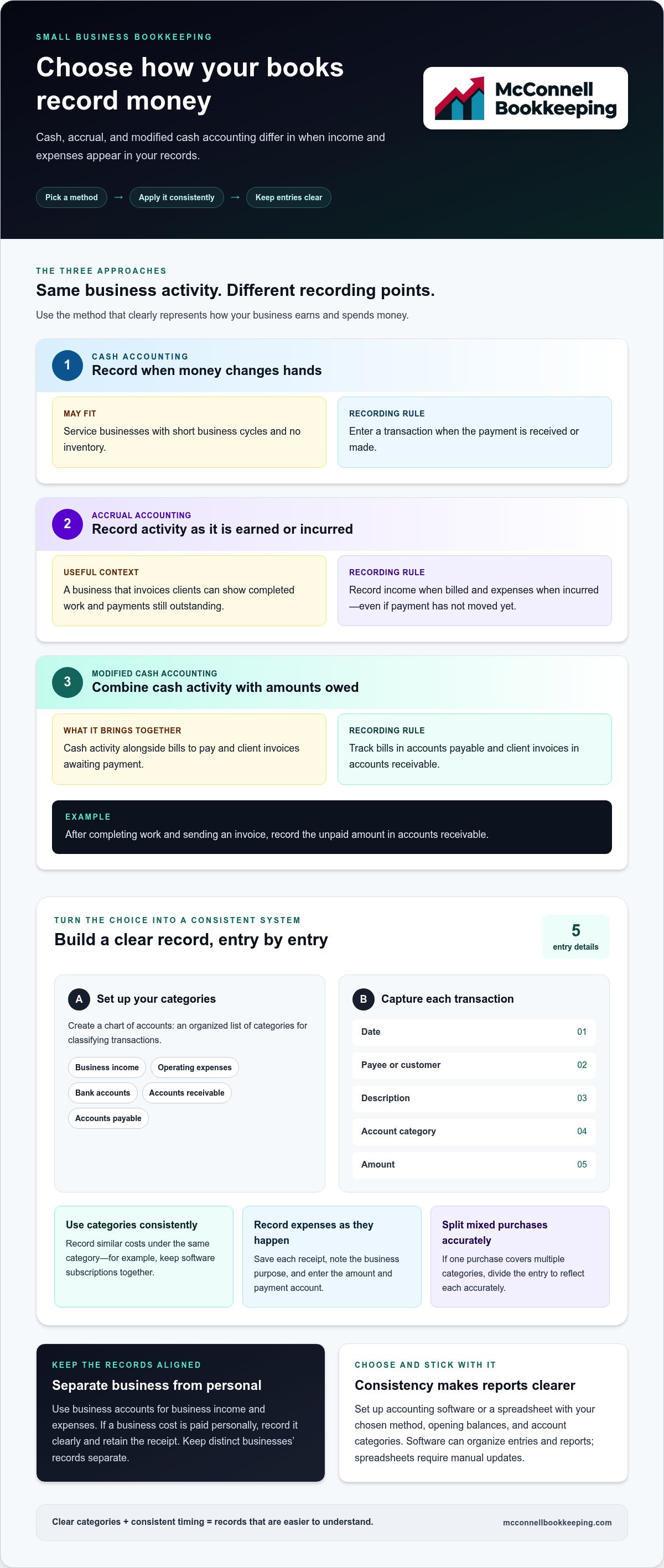
Choose an accounting method before recording transactions to give your books a consistent starting point. Among small business bookkeeping best practices, selecting a method that reflects how you earn and spend money helps reports show activity clearly. Consider how your business bills customers, pays expenses, manages inventory, and tracks amounts owed. Then apply the method consistently.
Cash accounting records transactions when money changes hands. It may suit service businesses with short business cycles and no inventory. Accrual accounting records income when billed and expenses when incurred, even if payment hasn’t arrived or left the bank. A business that invoices clients may prefer accrual records because they show completed work and outstanding payments.
Modified cash accounting combines elements of both methods. It records bills in accounts payable and client invoices in accounts receivable, showing amounts owed alongside cash activity. For example, after completing work and sending an invoice, record the unpaid amount in accounts receivable. Choose the approach that clearly represents your transactions, and record sales and expenses consistently.
A chart of accounts is an organized list of categories for classifying transactions in your books. Set one up with categories for business income, operating expenses, bank accounts, accounts receivable, and accounts payable. Assign each transaction to the closest match so similar activity appears together in reports.
Set up accounting software or a spreadsheet with your chosen method, opening balances, and account categories. For each entry, record the date, payee or customer, description, account category, and amount. Use the same category for similar costs. For example, record every software subscription under one software expense category rather than creating a separate account for each vendor. Software can organize entries and reports, while spreadsheets require manual updates.
Record expenses as they happen. Save each receipt, note the business purpose, and enter the amount and payment account. If one purchase covers multiple categories, split it accurately. This creates a useful record for reporting and filing, rather than leaving an unexplained month-end total.
Keep business accounts separate from personal bank and credit card accounts. Pay business expenses with business funds, and don’t mix personal purchases into the company ledger. If you operate distinct businesses, maintain separate records for each. According to the Internal Revenue Service, each separate and distinct business must maintain a complete and separate set of books and records. Consistent categories, account separation, and transaction timing are small business bookkeeping best practices that make your financial records easier to understand.
2. Separating personal and business finances
Separate business bank and credit card accounts make company activity easier to identify. Use business accounts for business income and expenses, and keep personal purchases out of the business ledger. If you pay a business cost personally, record it clearly and retain the receipt. If you operate distinct businesses, keep each business’s records separate.
According to the Internal Revenue Service, each separate and distinct business must maintain a complete, separate set of books and records. For U.S. recordkeeping, keep clear records of income, expenses, sales, purchases, payroll costs, receivables, payables, loans payable, and inventory. Seven years is a general rule of thumb for retaining tax returns and records, though actual requirements vary.
Reduce bookkeeping fraud risk by documenting transactions and separating payment duties where staff size allows. One employee can write a check, another can reconcile the bank account, and a third can authorize payment. If one person handles all three tasks, review statements against receipts and transaction records yourself. Investigate unfamiliar payees, duplicate charges, missing check numbers, and expenses without supporting documents.
Build a monthly routine around records, not memory. Match receipts to entries, review unpaid invoices and bills, then examine the balance sheet, profit and loss statement, and cash flow statement. Compare actual income and spending with your budget, noting differences and their causes. These checks help clarify whether cash flow reflects operations, delayed customer payments, or upcoming obligations.
Complete these monthly reviews once a month, and organize the year’s records at year-end. Confirm that transactions are categorized, receipts are stored with supporting details, and financial statements reflect the final recorded activity. Review the annual totals for income, expenses, payroll, receivables, and payables before using the records for filing or planning. A consistent close makes the next year’s opening records easier to prepare.
Tax budgeting starts with a forecast of expected income and business expenses. Set aside funds based on current estimates, then revisit them as sales, costs, and outstanding invoices change. Keep current with tax regulation changes that affect estimates or deductions, and retain records supporting each entry. Clear documentation helps explain how a reported amount was calculated.
Use monthly statements and reports to track useful measures, such as sales trends, overdue receivables, and expense changes. A rising sales total can still conceal cash pressure if customer payments arrive late or bills are coming due. Record the cause of major variances beside your report, so the next review can distinguish a one-time expense from a continuing pattern. For help turning organized records into readable reports, explore financial reporting support.
3. Should you hire a bookkeeper?
Handle bookkeeping yourself while transactions remain manageable and you can keep records accurate without delaying other responsibilities. Consider getting support when invoices, bills, payroll entries, or account reviews regularly pile up. The key question is whether bookkeeping is taking attention away from managing the business or creating gaps in your financial records.
A bookkeeper can record transactions, organize supporting documents, track receivables and payables, and prepare financial reports. These may include income statements, balance sheets, and cash flow statements. Current records help you see whether customers owe money, bills are due, and the business has enough cash for planned expenses.
Before deciding, map the work your business needs. List recurring tasks such as entering transactions, following up on invoices, recording bills, reviewing account balances, and preparing reports. Note which tasks you complete accurately and which fall behind. Repeatedly correcting categories or searching for missing receipts can signal that bookkeeping help would be useful.
Doing it yourself can work when your transactions are straightforward and you have a reliable routine. Set a recurring time to update records, review unpaid invoices, and compare recorded activity with statements. If you use accrual accounting, track income when invoiced and expenses when incurred, even if cash hasn’t moved. This gives you a fuller view of amounts owed, but requires consistent follow-through.
Contract bookkeeping support is one option for small businesses that need help without assigning the work to an employee. Define responsibilities first: for example, you might retain daily transaction entry while a bookkeeper reviews records and prepares financial reports. Clear boundaries establish who records bills, follows up on invoices, and checks account balances.
Keep business funds separate, including savings set aside for business reserves. Provide organized statements, receipts, and explanations for unusual transactions so your books can be maintained accurately. Review the resulting reports yourself. A bookkeeper prepares useful information, while you make business decisions such as when to purchase and how to prioritize cash.
Track the effect of bookkeeping on your workweek. If recurring recordkeeping keeps you from managing customers, operations, or staff, hiring help may free up time for those responsibilities. If you can keep transactions current and understand your reports, a self-managed system may remain practical. Reassess when invoices increase, payment timing becomes harder to track, or your process no longer provides a clear view of cash and obligations.
4. What are some of the challenges of small business bookkeeping?
Income and expenses can be difficult to track when sales, bills, and customer payments follow different schedules. An invoice records a sale, but it doesn’t mean cash has reached your business bank account. Likewise, a bill may be due before a customer pays. Track receivables and payables alongside cash to see both available funds and upcoming obligations.
Build a routine that captures each transaction close to when it occurs. Record business revenue weekly and enter expenses daily when practical, or at least weekly. For every expense, save the receipt and note the purchase date, vendor, business purpose, amount, and payment method. For example, record each software subscription under the same expense category. Consistent entries make monthly reviews clearer.
Unrecorded small purchases can distort totals just as much as a missed customer payment. Review card activity alongside receipts, then match each purchase to its bookkeeping entry. Separate recurring costs, such as rent or software, from occasional purchases, such as equipment. If a transaction has no clear business purpose, flag it for review instead of guessing at a category.
Manage expenses by comparing actual spending with your plan. Prepare a quarterly expense report to identify changes in recurring costs, supplier charges, and discretionary purchases. Review subscriptions and cancel services the business no longer uses. When a cost rises, record why and assess whether it supports revenue or operations. This gives you a practical basis for adjusting spending.
Payroll adds another set of dates and amounts to track. Organize wage expenses, payroll-related tax withholdings, and employee payments by pay period. Confirm that recorded totals match payroll records and the money leaving the business bank account. If a customer pays late, update the receivable status and follow up promptly. Include upcoming payroll payments in cash-flow planning.
Use a weekly or biweekly review to catch missed entries before they accumulate. Check recent deposits, card charges, unpaid invoices, and upcoming bills. Then review monthly reports for changes in income, expenses, and available cash. If sales increase without improving cash flow, investigate delayed payments or rising costs. Note explanations alongside the numbers to distinguish a temporary dip from a recurring bookkeeping issue.
5. Downloading bank transactions and reconciling statements
Download banking transactions daily and review imported entries before assigning categories. A bank feed or file import can streamline data entry, but it doesn’t confirm that each transaction is accurate or correctly recorded. Check the date, payee, amount, and account for each item. For example, a business credit card charge should appear in the correct account and expense category, not as income or a duplicate purchase.
Reconcile each business bank account monthly by comparing your books with the bank statement for the same period. Match deposits, withdrawals, fees, transfers, and payments one transaction at a time. Compare the statement’s opening and closing balances with the corresponding book balances, accounting for transactions recorded on different dates. The goal is to explain every difference, not simply force the balances to match.
Start with the statement period and account, then mark each matching transaction in QuickBooks or your accounting system. Look for entries in your books that don’t appear on the statement, such as outstanding payments. Also identify bank charges, deposits, or automatic payments that haven’t been entered. Record valid missing items and note timing differences for the next review.
Investigate discrepancies promptly. A duplicate purchase, unfamiliar withdrawal, or deposit recorded for the wrong amount can distort cash-flow reports. Check the source document, payment confirmation, or customer record before changing an entry. Correct the record only when you understand the cause, and document the adjustment so it’s clear during a later review.
Businesses that sell through ecommerce platforms can compare orders, platform payouts, and bank deposits in a three-way reconciliation. A sales total may differ from a payout because platform deposits and recorded orders are separate parts of the transaction trail. Match each stage, identify unexplained differences, and record related details. This makes sales easier to trace from customer order to funds reaching the bank.
Once reconciled, review the reports generated from the updated records. Check whether recorded income and expenses align with the statement activity, and whether unresolved differences carry into the next period. Save statements and reconciliation notes with the supporting transaction records. If QuickBooks Online workflows are slowing your routine, learn how QuickBooks Online Training can help you manage entries and reports more confidently.
McConnell Bookkeeping: Monthly Bank Reconciliations
McConnell Bookkeeping provides Monthly Bank Reconciliations to keep recorded transactions aligned with bank activity. Turn to this support when statement differences are difficult to resolve, entries have fallen behind, or you need a consistent month-end process. Matching and reviewing transactions helps clarify account balances and provides a more dependable foundation for financial decisions.
If older records need attention before routine reconciliations, McConnell Bookkeeping’s Book Clean-up can organize past transactions and resolve discrepancies. Financial Analysis can provide strategic insights, while monthly bookkeeping and financial statement preparation help you understand business performance. Together, these services bring structure to your records and make the numbers easier to use.
Contact McConnell Bookkeeping for support keeping your records current and easier to review.
Make Your Bookkeeping Work for What Comes Next
Reliable records are more than an administrative task. They provide a clearer foundation for decisions about spending, growth, and how you use your time to run the business. Applying small business bookkeeping best practices consistently can make financial information a useful part of planning, rather than a scramble to understand past activity.
If maintaining that consistency has become difficult, McConnell Bookkeeping can support the next step with Monthly Bank Reconciliations, Financial Statement Preparation, or Books Cleanup. These services can help bring structure to financial records and make them easier to use as you plan ahead. Choose the support that fits the bookkeeping task currently taking the most attention, and move forward with a clearer view of your business finances.
Contact McConnell Bookkeeping to discuss bookkeeping support for your business. A steadier process can help you focus with greater confidence on what you’re building next.
Frequently Asked Questions
What are some of the challenges of small business bookkeeping?
Delayed customer payments, incomplete records, and irregular expense entry can make cash-flow planning difficult. A business may show strong sales yet lack cash to cover a supplier bill because invoices remain unpaid. Compare receivable and payable due dates, then flag potential shortfalls early. Briefly note unusual transactions so you can understand changes during later reviews.
Should you hire a bookkeeper?
Hire a bookkeeper when routine records are falling behind or bookkeeping distracts you from managing the business. Contract support can help with transaction records and financial reports without adding a permanent role. Before delegating, decide which tasks you’ll retain and which need support. For instance, you might approve payments yourself while assigning transaction entry and account reviews to a bookkeeper.
What bookkeeping records should a small business keep, and for how long?
Keep records that explain business income, expenses, purchases, sales, payroll costs, receivables, payables, loans, and inventory. Retain receipts, invoices, bank statements, and other documents that support those entries. Seven years is a general rule of thumb for keeping tax returns and records, though actual requirements vary. Organize documents by year and transaction type so purchases and customer payments are easier to trace.
How often should small businesses reconcile bank and credit card accounts?
Reconcile business accounts monthly by comparing each statement with the transactions in your books. Include credit card accounts in the same close routine, matching purchases and payments to their records. If you spot a duplicate charge or unfamiliar withdrawal, investigate it while the statement period is current. Keep a short list of unresolved timing differences, such as a payment recorded before it clears, for the next reconciliation.
What bookkeeping method is best for a small business: cash or accrual?
The right accounting method depends on how your business earns revenue and handles payments. Cash accounting records activity when money changes hands, while accrual accounting records income when billed and expenses when incurred. A business that invoices customers may find accrual records more useful for tracking unpaid amounts. Whichever approach you choose, apply it consistently so reports use the same timing throughout your books.
How should small businesses track income, expenses, receipts, and mileage?
Record each sale and purchase with its date, amount, customer or vendor, and category. Store the receipt with the transaction, then review entries against bank and card activity. For business mileage, keep a log showing the trip date, starting point, destination, business purpose, and distance. Consistent records help distinguish work travel from personal trips without relying on memory during later expense reviews.
When should a small business hire a bookkeeper or accountant, and what are typical prices?
Get bookkeeping help when transaction entry, unpaid invoices, or account reviews are regularly delayed. Consider an accountant for broader financial analysis or advice beyond day-to-day recordkeeping. Service costs depend on the work involved; relevant factors include transaction volume, record condition, reporting needs, and assigned tasks. Small businesses in Mesa, Phoenix, Gilbert, Tempe, Chandler, and Scottsdale can turn to McConnell Bookkeeping for monthly bookkeeping, reconciliations, and financial reporting support.


Comments