ROI of Professional Bookkeeping: 2026 Practical Guide

Bookkeeping’s return isn’t measured by its cost alone. The ROI of professional bookkeeping services can also show up in time returned to the owner, more dependable financial reports, and a clearer view of cash flow. When transactions go unrecorded or reconciliations fall behind, it’s harder to know what the numbers are really saying.
It makes sense to question whether professional support will deliver more value than it costs. DIY bookkeeping may seem like the simplest option, but time spent sorting records and correcting errors is time not spent serving customers or managing operations. Without reliable books, important business decisions can also feel like guesswork.
This guide offers a practical way to estimate bookkeeping ROI using your own figures, compare DIY, software-supported, and outsourced approaches, and identify tasks you could delegate. You’ll also see how monthly bank reconciliations, books cleanup, and financial statement preparation can support clearer reporting and cash-flow visibility, helping you make decisions with greater confidence.
Table of Contents
What Is the ROI of Professional Bookkeeping Services for a Small Business?
The ROI of professional bookkeeping services is the value a business receives from dependable bookkeeping compared with service fees and internal effort. That value can include owner and staff time redirected to core work, more accurate records, clearer cash-flow awareness, and financial reports that better support planning. Some returns can be estimated in dollars or hours; others, such as greater confidence in a decision, require careful judgment.
Bookkeeping involves recording and organizing financial activity, not simply entering data. A foundational overview of Bookkeeping explains its role in maintaining financial records. For a business owner, the practical question is whether those records are current and useful enough to guide day-to-day choices.
To see how accounting tasks connect with useful business information, watch this overview:
Which business benefits belong in an ROI assessment?
Start with the work bookkeeping currently takes from you and your staff. Estimate the time spent collecting receipts, categorizing transactions, following up on missing records, reconciling accounts, and preparing reports. Then consider what that time could be redirected toward, such as customer service or operations. The value depends on how your business uses those hours, so base estimates on your actual workflow rather than broad assumptions.
Assess usefulness, too. Dependable records make financial statements more meaningful for reviewing income and expenses or planning upcoming spending. Organized receivables and payables can help you see what customers owe and which bills are approaching, improving cash-flow awareness. These benefits support better-informed decisions, but they don’t guarantee a particular financial result.
Why accurate books can matter beyond data entry
Regular bank reconciliations compare recorded activity with bank records, helping identify discrepancies and keep account balances current. When transactions are consistently categorized and records are organized, reports offer a clearer view of where money comes from and where it goes. That visibility can help owners spot questions to investigate before relying on a report for a decision.
Bookkeeping ROI measures the value of time, accurate records, and clearer financial visibility relative to the resources invested; it is not a promise of higher profits or business growth. Some effects can be tracked directly, such as hours spent on routine tasks or whether reconciliations are complete. Confidence in reports and improved decision support are valuable, but assess them thoughtfully rather than counting them as guaranteed savings.
How to Calculate the ROI of Professional Bookkeeping Services
A useful calculation starts with your own baseline, not an industry average. Use the same time period before and after a bookkeeping change, and include the same tasks in each comparison. The SBA's guide to managing business finances also explains how financial records and statements support small-business management.
For a service-only estimate, use this formula:
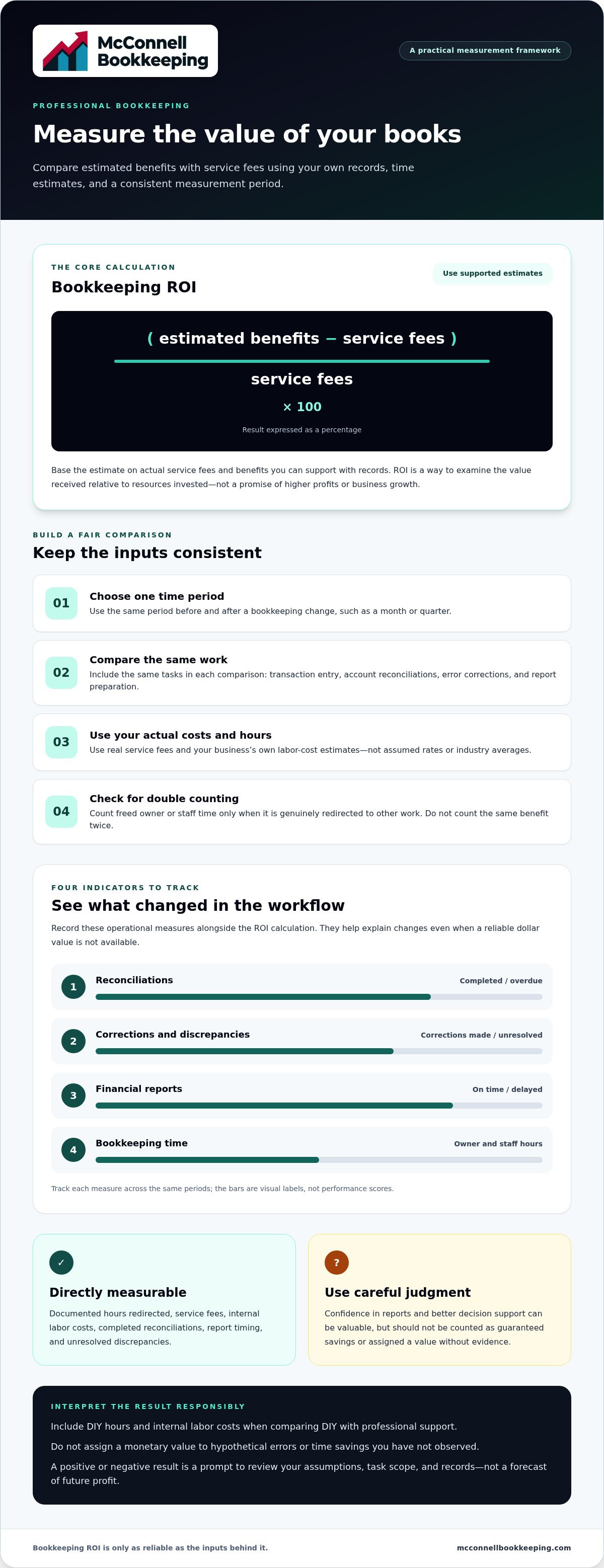
ROI = (estimated benefits − bookkeeping service fees) ÷ bookkeeping service fees × 100
Keep the calculation grounded in benefits you can support with records. If you include the value of owner or staff time, estimate it from hours actually freed and internal labor costs. Count that value only when the capacity is genuinely redirected to other work, and avoid counting the same benefit twice.
Which inputs should business owners include?
Choose a consistent period, such as a month or quarter, and list the tasks included. Track time spent entering transactions, reconciling accounts, correcting errors, and preparing reports. Use actual service fees and your business’s own labor-cost estimates, not assumed rates. Record operational indicators alongside the calculation:
Reconciliations completed or still overdue
Corrections made and discrepancies left unresolved
Reports delivered on time or delayed
Owner and staff hours spent on bookkeeping
These indicators help explain what changed, even when you can’t assign a reliable dollar value to every improvement.
How can you interpret the result responsibly?
A short-term comparison may miss the value of steadier processes or reduced administrative strain. Separate directly measurable returns, such as documented hours redirected, from less certain benefits, such as making a better-informed decision. Don’t assign a monetary value to hypothetical errors or time savings you haven’t observed. If you compare DIY with professional support, include DIY hours and internal labor costs in the baseline so the alternatives are evaluated fairly.
Bookkeeping ROI is only as reliable as the inputs and the fairness of the comparison behind it. A positive or negative result is a prompt to examine your assumptions, task scope, and records, not a promise of future profit or growth. For a practical way to improve the quality of the records used in your assessment, explore McConnell Bookkeeping support.
Professional Bookkeeping vs. DIY: Compare the Real Business Trade-Offs
The right approach depends on transaction volume, workflow, and how much time the owner can consistently devote to the books. DIY keeps the work in-house, but the owner handles data entry, reconciliations, and report preparation. Software-supported DIY can organize transactions and simplify routine steps, yet someone still needs to review entries and resolve mistakes. Outsourcing recurring tasks can create a more consistent process, while the owner remains involved in providing records and using reports to guide business decisions.
Consider the trade-offs across three common approaches:
DIY: Direct control, but bookkeeping competes with customer and operational responsibilities. Consistency depends on the owner’s time and habits.
Software-supported DIY: Tools can organize workflows and generate reports, but they don’t automatically ensure accurate categorization, complete records, or reconciled balances.
Outsourced bookkeeping: Delegating agreed recurring tasks can support a steadier process and reporting, while requiring the owner to share records and review the information.
When can handling bookkeeping in-house make sense?
DIY may be manageable when transaction volume is limited and the owner can set aside regular time to keep records current. The approach still requires consistent data entry, account reconciliations, and report review. If you use QuickBooks Online and want to improve your own workflow, explore QuickBooks Online training for business owners.
As activity grows or bookkeeping slips behind, the trade-off can change. The useful question is not simply whether software is in place, but whether records are maintained and reviewed reliably.
What changes when bookkeeping tasks are delegated?
Delegating recurring work, such as monthly bank reconciliations or financial statement preparation, can establish a regular rhythm for organizing records and reviewing balances. The owner still supplies relevant business records, answers questions about transactions, and considers what reports mean for operating decisions. Delegation shifts defined bookkeeping tasks; it doesn’t remove the owner’s role in running the business.
For businesses that want recurring reconciliation support, see professional monthly bank reconciliations for Mesa and Phoenix businesses. Comparing these approaches can help you assess the ROI of professional bookkeeping services against your actual workload, process consistency, and reporting needs. Outsourcing isn’t automatically the best fit for every business; the aim is to choose a workflow you can maintain and trust.
Which Metrics Show Whether Bookkeeping Is Delivering Value?
Use a simple scorecard to see whether bookkeeping processes are becoming more consistent and useful. Record a baseline before changing your workflow, then review the same indicators over comparable periods afterward. Keep the measurement method steady, such as tracking owner time the same way each month, so the comparison reflects process changes rather than different counting methods.
Build a practical bookkeeping scorecard
Choose indicators that connect directly to the tasks in your workflow. A monthly review could note whether reconciliations are complete, whether discrepancies remain unresolved, when financial statements are available, and how much time the owner spends on routine bookkeeping. If receivables or payables management is part of the process, include whether records clearly show amounts due from customers and upcoming bills.
Reconciliation status: Are accounts reconciled consistently, and are identified differences followed up?
Open discrepancies: What remains unresolved, and for how long?
Report timeliness and use: When are statements ready, and does the owner review them to inform planning?
Owner bookkeeping hours: How much time goes to recurring tasks, measured with the same approach each period?
Receivables and payables visibility: Can you readily review outstanding customer balances and scheduled obligations?
Look for patterns rather than expecting every measure to improve at once. For example, reports may arrive more consistently while the owner still needs time to address older record issues. Note what changed in the process and which tasks were included, so the scorecard stays meaningful.
Connect clearer records to everyday decisions
Accurate financial statements help owners review income, expenses, and account balances using organized information. Clear receivables and payables records can also make it easier to consider incoming payments alongside upcoming obligations when planning cash flow. These records support decisions, but they don’t determine outcomes on their own. Sales, customer payment patterns, costs, and other operating conditions can also affect results.
For an operational example, explore accounts receivable services in Mesa and cash-flow management. Use your scorecard to assess the ROI of professional bookkeeping services alongside these broader business factors, rather than crediting bookkeeping for every change in performance.
To explore how recurring bookkeeping support could fit your workflow, view McConnell Bookkeeping services.
How McConnell Bookkeeping Supports Measurable Business Clarity
Bookkeeping support is most useful when it addresses a specific gap in your process. If bank activity and recorded transactions don’t line up, monthly bank reconciliations provide a recurring comparison that helps identify discrepancies and keep account balances current. More dependable balances give financial statements a clearer foundation, so owners can review business activity with better-organized information.
For businesses with older or disorganized records, books cleanup can address historical accounting errors and organize records before ongoing bookkeeping processes begin. This creates a clearer starting point for reviewing current transactions and maintaining records. The goal is reliable financial information and a workable process, not a promise of tax outcomes, savings, profits, or growth.
What ongoing bookkeeping support can help organize
After records are organized, ongoing support can focus on the tasks that fit your business needs. Financial statement preparation presents recorded activity for review. Accounts receivable management helps organize customer balances, while accounts payable management supports tracking bills. Payroll management helps keep payroll records organized. These services address distinct administrative needs, and the right scope depends on which tasks are creating delays or uncertainty in your workflow.
Owners remain central to the process: you provide relevant records, clarify business transactions, and decide how to act on the information. Regular reconciliations and well-organized statements can make those reviews more grounded, but they don’t replace business judgment or guarantee a particular result.
A clear next step for owners evaluating bookkeeping ROI
Before discussing support, note the tasks you currently handle, where work tends to fall behind, and which reports you need to review your business. Include how often accounts are reconciled, whether historical records need cleanup, and whether receivables, payables, or payroll tasks are taking attention from other responsibilities. This baseline can help define a practical service scope and make later comparisons more meaningful.
McConnell Bookkeeping supports small businesses in Mesa, Phoenix, Gilbert, Tempe, Chandler, and Scottsdale. Use your current workload and reporting needs to assess where ongoing help could improve consistency and clarity, then compare that scope with the value you can reasonably measure. Explore bookkeeping support from McConnell Bookkeeping to identify a practical next step for your records and reporting.
Build a Clearer Picture of Your Bookkeeping’s Value
The ROI of professional bookkeeping services is best judged with your own numbers: the time spent on routine tasks, the consistency of your records, and the usefulness of your financial reports. Compare the same indicators over consistent periods, and distinguish measurable changes from benefits that are harder to value, such as greater confidence in a decision.
The right approach depends on your workload and capacity. Some owners can maintain their books with a steady routine, while others benefit from delegating recurring tasks. Monthly bank reconciliations and financial statement preparation can support dependable balances and clearer reporting. Books cleanup can organize historical records, while operational bookkeeping and QuickBooks Online training can help address other workflow needs.
Start by identifying which tasks take your time, where records fall behind, and what financial information you need to run the business. That baseline can help you decide what support makes sense and how to assess its value without expecting bookkeeping to guarantee profits or growth.
Explore bookkeeping support from McConnell Bookkeeping and take a practical next step toward clearer records and more confident business decisions.
Frequently Asked Questions
How do you calculate the ROI of professional bookkeeping services?
Calculate it by subtracting bookkeeping service fees from estimated benefits, then dividing the result by the fees. Multiply by 100 to express the result as a percentage. Use actual fees and business records, and include measurable benefits such as documented owner hours redirected to other work. Compare the same tasks over consistent periods, and keep less certain benefits, such as improved decision-making, separate from direct financial estimates.
Is professional bookkeeping worth it for a small business?
It may be worthwhile if bookkeeping regularly takes time from core operations, records fall behind, or financial reports are difficult to rely on. Assess your actual workload, reporting needs, and internal capacity rather than assuming outsourced support is best for every business. McConnell Bookkeeping serves small businesses in Mesa, Phoenix, Gilbert, Tempe, Chandler, and Scottsdale. Bookkeeping can improve clarity, but it can’t guarantee higher profits or growth.
Can a bookkeeper help improve cash flow?
A bookkeeper can help improve cash-flow awareness by organizing records of customer balances, bills, and business transactions. Accounts receivable management can clarify what customers owe, while accounts payable management helps organize upcoming obligations. This information can help you plan and spot items that need follow-up. A bookkeeper doesn’t control when customers pay or guarantee a stronger cash position, but current records make it easier to understand the figures.
How does monthly bank reconciliation create value for a business?
Monthly bank reconciliation compares recorded transactions with bank activity to help identify discrepancies and keep account balances current. Resolving differences can give financial statements a more dependable foundation and help owners review income, expenses, and balances with greater clarity. Reconciliation is a bookkeeping process, not a certified audit or guarantee that every business record is error-free. Its value comes from making account information more organized and useful for regular review.
What metrics should I track to measure bookkeeping ROI?
Track reconciliation completion, unresolved discrepancies, when financial statements are available, and owner hours spent on routine bookkeeping. If relevant to your workflow, monitor how clearly you can review receivables and upcoming payables. Compare the same measures over consistent periods before and after a process change, using the same tracking method. These indicators can show whether recordkeeping is becoming more consistent, but don’t attribute every business change to bookkeeping alone.
Does bookkeeping software replace a professional bookkeeper?
Bookkeeping software can organize transactions, support data entry, and produce reports, but it doesn’t automatically ensure accurate records or resolve discrepancies. Someone still needs to review entries, reconcile accounts, and follow up on missing or unclear information. Owners who want to manage their own books may benefit from QuickBooks Online training to use the software more effectively. Whether you handle the work or delegate it depends on your capacity and workflow.
How much does professional bookkeeping cost?
Professional bookkeeping costs depend on the scope of work and the records that need attention. Monthly reconciliations, financial statement preparation, books cleanup, accounts receivable or payable management, and payroll management involve different tasks. To understand the value for your business, identify the work you need handled, your current bookkeeping hours, and any delays or record issues. Compare the service scope with those needs rather than relying on a general estimate.



Comments