Profit and Loss Statement Analysis: A Strategic Guide for Small Business Owners

Imagine checking your bank account on a Tuesday morning only to find a balance that contradicts the healthy profit shown on your latest report. It's a frustrating disconnect that leaves many law and dental practice owners feeling like they're flying blind. You aren't alone in feeling that financial reports often read like a foreign language filled with confusing jargon. However, performing a regular profit and loss statement analysis is the definitive solution to this administrative stress, turning rows of numbers into a clear roadmap for your success.
We'll guide you through the art of P&L interpretation to help you uncover hidden costs and boost your margins for sustainable growth in 2026. Whether you're aiming for the 35% profit margin typical of high-performing law firms or trying to keep dental overhead below the 60% benchmark, this guide provides the strategic clarity you need. You'll learn how to identify exactly where profit is leaking and how to use real-time data to make confident decisions about expansion or hiring. This article moves you from a state of uncertainty to one of informed confidence, ensuring your business stays in safe, capable hands.
Table of Contents
The Fundamentals of Profit and Loss Statement Analysis in 2026
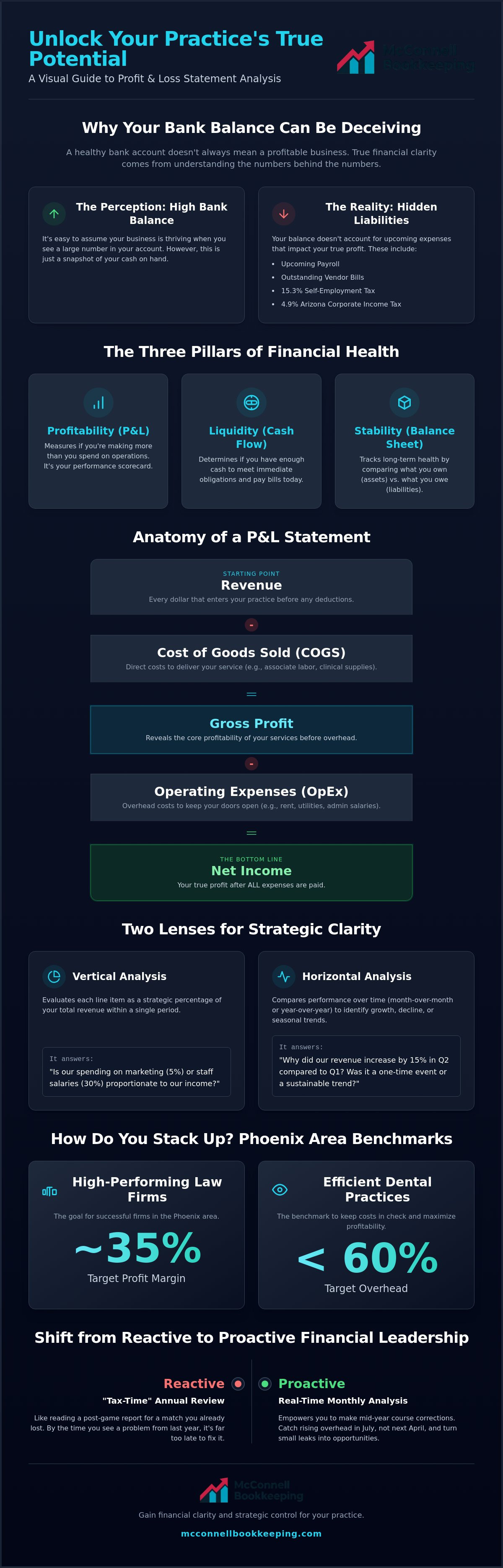
Your financial statements tell a story that goes far beyond the numbers on a screen. A Profit and Loss (P&L) statement, often called an Income Statement, provides a comprehensive summary of your revenue and expenses over a specific period. Conducting a regular profit and loss statement analysis allows you to see exactly where your money originates and, more importantly, where it disappears. Think of this analysis as the "MRI" of your business health. While a glance at your bank account shows you the symptoms, the P&L reveals the underlying cause of your financial stress or success in the 2026 economy.
Many owners in Mesa and Phoenix mistake a high bank balance for high performance. It's a dangerous assumption. Your bank balance doesn't account for upcoming payroll, outstanding vendor bills, or the 15.3% self-employment tax applied to your earnings. By analyzing your P&L, you separate daily cash flow from true profitability. This clarity is essential when applying for business loans in Arizona, as lenders look for consistent margins rather than just a temporary cash surplus. With the Arizona corporate income tax rate sitting at a flat 4.9%, knowing your exact net income ensures you're setting aside the right amount for the Department of Revenue without hurting your operational budget.
The Three Pillars of Financial Health
Profitability (P&L): This measures if you're actually making more than you spend on your daily operations.
Liquidity (Cash Flow): This determines if you have enough physical cash to meet your immediate obligations and pay bills today.
Stability (Balance Sheet): This tracks long-term health by comparing what you own against what you owe to creditors and lenders.
Why Real-Time Analysis Beats "Tax-Time" Analysis
Waiting until April to review your 2025 performance is like reading a post-game report for a match you already lost. Monthly reviews empower you to make mid-year course corrections before small leaks become floods. If your dental practice overhead is creeping above the 65% average, you need to know that in July, not the following year. This proactive approach is especially important in 2026 as software costs continue to shift, with QuickBooks Online Plus and Advanced plans seeing price increases as recently as August 1. Accurate profit and loss statement analysis serves as the vital bridge between raw financial data and your long-term business strategy.
Decoding the Structure of Your P&L Report
Understanding the anatomy of your financial reports is the first step toward true control. According to Cornell Law School's definition, an income statement tracks the net income of a company over a specific time period by subtracting expenses from revenue. When you perform a profit and loss statement analysis, you're looking at four primary layers: Revenue, Cost of Goods Sold (COGS), Operating Expenses (OpEx), and Net Income. Each layer reveals a different aspect of your operational efficiency and helps you pinpoint exactly where your hard-earned money is going.
Revenue vs. COGS: Calculating Your Gross Margin
Revenue represents every dollar that enters your practice before any deductions. For law and dental practices in the Phoenix area, the next line, COGS, is often where confusion begins. While a retail store has clear inventory costs, a service business must account for direct labor and clinical supplies. If you aren't tracking the specific time an associate spends on a case or the cost of dental implants used in a procedure, your gross margin will be inflated. Utilizing monthly bank reconciliations ensures that every deposit and direct expense is categorized correctly, giving you an untainted view of your initial profitability. This accuracy allows you to determine if your pricing is high enough to cover the rising costs of professional talent in 2026.
Operating Expenses: Where Phoenix Businesses Lose Money
Operating expenses are the overhead costs required to keep your doors open in Mesa or Scottsdale. These include your office lease, utilities, and administrative salaries. We often see local business owners struggle with "lifestyle creep," where personal subscriptions or vehicle costs get tangled in business data. This skewing makes it impossible to see if your marketing spend is actually driving a return. Separating fixed costs like rent from variable costs like advertising allows you to see where you can trim without hurting service quality. Identifying these hidden leaks is a primary benefit of consistent profit and loss statement analysis, as it highlights expenses that no longer serve your growth goals.
The final destination of your report is Net Income, or the "bottom line." This is the actual profit available for reinvestment or owner draws after all costs, including the flat 4.9% Arizona corporate tax, are accounted for. If your bottom line feels thinner than it should, a professional books cleanup can untangle your accounts and provide the clarity needed to reclaim your margins. Mastering this structure transforms your P&L from a static document into a proactive tool for sustainable expansion.
Advanced Analysis Techniques: Horizontal vs. Vertical
Moving beyond basic calculations allows you to transform raw data into a strategic roadmap for your firm. While simply reading your totals is a start, a sophisticated profit and loss statement analysis utilizes horizontal and vertical techniques to expose the "why" behind your numbers. These methods serve as the primary tools for spotting expense creep before it erodes your hard-earned margins. By mastering these views, you gain the clarity needed to set a realistic budget for 2027 and ensure your growth remains sustainable.
Spotting Trends with Horizontal Analysis
Horizontal analysis compares your financial performance across different time periods to reveal growth trajectories and seasonal patterns. Comparing Q1 2026 to Q1 2025 provides a true measure of growth that accounts for the natural fluctuations of the business cycle. In the Phoenix area, this technique is particularly valuable for identifying the inevitable summer slowdown. When you see a consistent 15% dip in revenue during the hottest months, you can proactively build a cash reserve to maintain stability. Analyzing these year-over-year trends empowers you to predict future cash flow needs with precision, moving you from reactive management to proactive leadership.
Benchmarking Efficiency with Vertical Analysis
Vertical analysis expresses every line item as a percentage of your total revenue, creating a clear picture of your operational efficiency. This method is the definitive way to determine if your overhead is out of alignment with your income. For instance, if your rent suddenly jumps from 7% to 12% of your revenue, the vertical view flags this immediately even if the dollar amount stayed the same. It also helps you monitor your largest expense: payroll. If your labor costs are climbing while your revenue plateaus, your practice is becoming less efficient. Utilizing dental practice financial metrics allows you to compare your percentages against high-performing peers who maintain overhead below the 60% mark.
Combining these two perspectives provides the expert oversight necessary to protect your bottom line. Horizontal analysis shows you where you've been, while vertical analysis shows you how efficiently you're operating right now. Together, they form a comprehensive profit and loss statement analysis that identifies exactly where profit is leaking. This level of detail ensures your business is in safe, capable hands as you prepare for the challenges and opportunities of the coming year.
Industry-Specific P&L Insights for Arizona Law and Dental Practices
A generic financial report often fails to capture the unique operational realities of professional service firms. For specialized practices in Mesa and Phoenix, a standard profit and loss statement analysis must be tailored to track industry-specific KPIs like utilization rates and collection ratios. High overhead and specialized equipment costs can quickly erode your margins if they aren't categorized with meticulous precision. By refining your reporting structure, you gain the strategic clarity needed to manage these costs effectively and drive your business toward sustainable growth.
P&L Nuances for Phoenix Law Practices
Law firms face the unique challenge of managing case costs and reimbursable expenses that can easily skew profitability data. If you aren't tracking these costs separately, your revenue figures may appear artificially inflated, leading to unexpected tax liabilities. Proper IOLTA management is also crucial; these funds must never be confused with earned income on your P&L statement. Well-managed small to mid-size firms in Arizona target a 35-45% profit margin. Achieving this requires analyzing the profitability of different practice areas, such as comparing the margins of family law versus criminal defense. This insight allows you to shift your firm's focus toward the most lucrative work while maintaining your 4.9% Arizona corporate tax obligations.
Analyzing Profitability in Dental Clinics
Dental practices operate with high fixed costs, making "Cost Per Chair" a vital metric for vertical analysis. The average overhead for a dental practice is 60-65% of collections, but top-performing clinics achieve net margins of 35-40% by keeping overhead below the 60% mark. Tracking dental supply costs as a percentage of production ensures your clinical spending stays in line with your actual output. Additionally, you must account for PPO adjustments that can significantly reduce your top-line revenue. Seeing these adjustments clearly on your P&L helps you evaluate which insurance contracts are truly profitable for your Mesa clinic. While general dentists see an average net income of 22% of billings, specialists often reach 30%, highlighting the need for specialized reporting.
Strategic accounts receivable services play a direct role in boosting your P&L revenue by ensuring earned income actually reaches your bank account. If your collections are lagging, your profit exists only on paper and cannot be used for expansion or payroll. Our specialized Law Practice Bookkeeping and Dental Practice Bookkeeping services provide the meticulous oversight needed to protect your firm's prosperity and ensure your business is in safe, capable hands.
Turning Analysis into Action: The Role of Professional Bookkeeping
Data integrity serves as the non-negotiable foundation of any successful financial strategy. If your underlying records are disorganized, your profit and loss statement analysis becomes a liability rather than a strategic asset. This is the "Garbage In, Garbage Out" rule of financial reporting. When your reports are based on incomplete or un-categorized data, the decisions you make regarding hiring or expansion are built on a shaky foundation. If you've fallen behind on your record-keeping, seeking backlogged bookkeeping help is the essential first step toward restoring your financial clarity. Clean data allows you to see the true trajectory of your firm, while QuickBooks Online training empowers you to understand the "why" behind every number on your screen.
The "Clean Books" Prerequisite
Un-reconciled accounts are the primary reason many P&L reports fail to match the reality of a bank balance. When transactions aren't meticulously matched to bank statements, duplicate entries and missing expenses distort your profit margins. This distortion makes it impossible to know if you can actually afford that new piece of dental equipment or an additional legal associate. Securing professional bookkeeping services provides the expert oversight necessary to eliminate these errors. Meticulous reconciliation ensures that every dollar is accounted for, providing the relief and clarity you need to lead your practice with absolute confidence.
Partnering with a Mesa Bookkeeping Expert
A local financial partner should act as a strategic mentor who looks ahead to identify opportunities rather than just a reactive service provider. When choosing an expert in Mesa, prioritize a partner who understands the specific nuances of law and dental practice accounting. McConnell Bookkeeping bridges the gap between raw data entry and strategic insight by providing the specialized oversight your practice deserves. We serve as a diligent guardian of your prosperity, ensuring your books are always ready for a deep profit and loss statement analysis. This proactive approach transforms your accounting from a source of stress into a powerful engine for growth.
Moving from reactive bookkeeping to proactive partnership is a transformative step for any practice owner. It liberates you from administrative burdens and allows you to focus on the high-level work that drives your success. Your next step is to schedule a diagnostic review of your 2026 books. This comprehensive assessment identifies exactly where your records need attention and provides a clear path forward for the coming year. Let us handle the complexities of your financial statements so you can reclaim your time and lead your business toward a prosperous future.
Take Control of Your Practice’s Financial Future
Mastering your profit and loss statement analysis is the definitive step toward moving from administrative stress to strategic leadership. You've seen how horizontal and vertical reviews expose hidden costs; however, these insights only matter if they're built on a foundation of reconciled, accurate data. Whether you're navigating the 60% overhead benchmarks of a dental clinic or the complex case costs of a Phoenix law firm, you don't have to manage these numbers alone. Clarity is the prerequisite for growth, and it starts with a commitment to meticulous record-keeping.
McConnell Bookkeeping provides the local Arizona support you need to turn confusing reports into clear growth opportunities. As a QuickBooks Online ProAdvisor with specialized experience in legal and dental bookkeeping, I'm here to ensure your practice remains in safe, capable hands. Get a Professional Diagnostic Review of Your Books to reclaim your margins and lead your business toward a prosperous 2026. Your journey to financial liberation and informed confidence starts with a single, proactive decision. We're ready to partner with you in driving your firm toward its full potential.
Frequently Asked Questions
How often should a small business owner analyze their P&L statement?
You should perform a profit and loss statement analysis at least once every month. Monthly reviews empower you to identify seasonal trends and make proactive adjustments before small leaks become major financial drains. Waiting until tax season to review your performance leaves you reactive; frequent oversight ensures your business stays on a sustainable path toward its 2026 growth goals.
What is the difference between a P&L statement and a Balance Sheet?
A P&L statement tracks your financial performance over a specific period, while a Balance Sheet provides a snapshot of your business health at a single point in time. Your P&L reveals if you are making more than you spend on daily operations. The Balance Sheet shows your stability by detailing what you own versus what you owe to creditors and lenders.
Why does my P&L show a profit but my bank account is empty?
A disconnect between your profit and your bank balance often stems from non-expense cash outflows like loan principal payments or owner draws. It can also occur if your accounts receivable are high, meaning you've earned the money but haven't collected the cash yet. Meticulous monthly bank reconciliations are essential to untangle these discrepancies and reveal where your physical cash is actually tied up.
Can I perform a P&L analysis if my QuickBooks isn’t reconciled?
You cannot perform an accurate profit and loss statement analysis if your QuickBooks Online file isn't fully reconciled. Un-reconciled accounts often contain duplicate entries or missing expenses that distort your true margins. Starting with a professional books cleanup ensures your data is reliable; this prevents you from making dangerous expansion decisions based on faulty information.
What are the most important ratios to look at in a P&L analysis?
The most critical ratios include your gross margin and your net profit margin relative to industry benchmarks. For specialized practices, tracking your overhead as a percentage of total revenue is vital for maintaining efficiency. Law firms should target a 35% to 45% profit margin, while dental practices aim to keep overhead below the 60% mark to maximize their take-home earnings.
How does horizontal analysis help with business budgeting?
Horizontal analysis compares your performance across different months or years to highlight growth trajectories and seasonal dips. This technique is particularly useful for Phoenix business owners who must budget for the annual summer slowdown. By identifying these patterns, you can set a realistic budget for the coming year that accounts for fluctuating cash flow needs throughout the seasons.
What is a "good" net profit margin for a service-based business in Arizona?
A healthy net profit margin varies by industry, but well-managed small law firms typically target 35% to 45%. General dental practices in Arizona often see average net margins around 22%, though top-performing specialists can reach 30% or higher. Comparing your practice to these local benchmarks helps you determine if your pricing and overhead are properly aligned for the Phoenix market.
Do I need a CPA or a bookkeeper to help with P&L analysis?
While a CPA is essential for tax filing, a specialized bookkeeper provides the monthly operational insight needed for daily decision-making. A bookkeeper acts as a proactive partner who cleans your data and prepares accurate financial statements throughout the year. This ongoing oversight ensures you have the clarity to manage payroll and expansion without waiting for an end-of-year tax appointment.


Comments