The Ultimate 2026 Payroll Compliance Checklist for Arizona Small Businesses

What if a single administrative oversight in your record-keeping could trigger a penalty three times the amount of the original wage? In Arizona, the legal landscape for employers is shifting rapidly, and you likely feel the weight of these responsibilities every time you process a paycheck. It's natural to worry about the complexities of employee classification or the administrative burden of tracking sick leave accruals. You want to support your team and protect your hard-earned profit, yet the fear of an unexpected state audit often lingers in the background.
This 2026 payroll compliance checklist provides the structural roadmap you need to master these regulations with total confidence. By following this local-focused guide, you'll ensure your administrative records are meticulous and audit-ready. We'll cover the latest 2026 updates, including the $15.15 statewide minimum wage and specific municipal requirements for businesses in Tucson and Flagstaff. This clarity doesn't just prevent costly errors; it liberates you to focus on growing your business in Mesa or Scottsdale while maintaining the peace of mind that your operations are on solid ground.
Table of Contents
Understanding the Core Pillars of Payroll Compliance
Payroll compliance serves as the critical intersection where federal, state, and local labor laws meet. It involves much more than just cutting checks; it requires a deep understanding of core payroll processing and withholding fundamentals to stay aligned with evolving legal standards. For a Phoenix business owner, this means balancing complex IRS mandates with specific Arizona Department of Revenue (ADOR) rules. When you view these regulations as a framework for stability rather than a hurdle, you set your business up for long-term scalability and success.
Think of accurate record-keeping as the "diligent guardian" of your company's profit. When your data is organized and transparent, you build a protective barrier against the financial and reputational risks that often plague the Phoenix Metro area. Non-compliance leads to more than just heavy fines; it erodes employee trust and invites unnecessary scrutiny from state agencies. By utilizing a comprehensive payroll compliance checklist, you transform a complex administrative burden into a source of audit-proof confidence. This "service-to-benefit" approach ensures that every hour spent on documentation results in a stronger, more resilient business.
To better understand how these pieces fit together, watch this helpful guide on maintaining compliance:
The Difference Between Payroll Management and Tax Filing
Compliance starts with the daily and monthly integrity of your financial data. While your CPA handles the final year-end filings, payroll management focuses on the ongoing accuracy of entries and record maintenance throughout the year. We provide monthly bank reconciliations that validate every payroll disbursement against your actual bank activity. This operational precision ensures that when tax season arrives, your records are already verified and clean. It bridges the gap between administrative tasks and strategic financial oversight, making your accountant's job much simpler and more efficient.
Regulatory Trends for Arizona Businesses in 2026
The regulatory environment in 2026 continues to evolve, especially as remote work complicates local tax nexus and labor law applications. Staying proactive is the only way to avoid the reactive stress of a surprise audit or a wage claim. Arizona employers must now navigate shifting minimum wage thresholds and strict E-Verify protocols with a heightened attention to detail that wasn't required a decade ago. This section establishes the groundwork for the specific state requirements we'll explore next. It ensures your payroll compliance checklist remains a living document that adapts to new local challenges in Scottsdale, Mesa, and beyond.
Federal Payroll Requirements: Your Mandatory Obligations
Establishing a robust administrative foundation starts with mastering federal mandates. These requirements act as the baseline for your entire payroll compliance checklist, ensuring that your Scottsdale or Chandler business operates with transparency and integrity. While state laws vary, federal standards provide the universal framework for employee rights and employer responsibilities. Staying current with these rules protects your assets and reinforces the professional trust you've built with your team.
Adhering to the IRS Publication 15 Employer's Tax Guide is essential for managing withholdings and deposit schedules accurately. For 2026, the Social Security taxable wage base has increased to $184,500. This means you must monitor high-earner thresholds closely to avoid under-withholding. Beyond tax rates, you're responsible for timely filings of Form 941 every quarter and Form 940 annually to report federal unemployment taxes. Organized records ensure these deadlines never become a source of seasonal stress.
Employee Onboarding Documentation
Compliance begins the moment a new hire joins your team. Every employee must complete a W-4 form to dictate federal income tax withholding, and you must maintain these records to justify your payroll calculations. Equally critical is the I-9 Form for employment eligibility verification. Federal law requires this document to be completed within three business days of the hire date. Storing these in secure, accessible digital folders allows you to respond to documentation requests with immediate confidence, proving that your business is meticulous and audit-ready.
Classification Accuracy: Employee vs. Contractor
Misclassifying workers is a primary target for audits in the Phoenix Metro area, often leading to significant back-tax liabilities. The IRS uses the "Right to Control" test to determine if a worker is a W-2 employee or a 1099 contractor, focusing on three specific categories:
Behavioral Control: Does the business direct how the worker performs the task?
Financial Control: Are the business aspects of the worker’s job controlled by the payer?
Type of Relationship: Are there written contracts or employee-type benefits?
If you've struggled with these distinctions in the past, seeking backlogged bookkeeping help can help you identify and resolve historical classification errors before they attract regulatory attention. Correcting these records now provides the clarity needed for future growth.
Finally, the Fair Labor Standards Act (FLSA) sets the standard for minimum wage and overtime. As of 2026, the federal salary threshold for overtime exemption remains at $684 per week. Tracking hours for non-exempt staff isn't just a chore; it's a strategic necessity that prevents wage claims and keeps your labor costs transparent. If you feel overwhelmed by these administrative layers, professional payroll management can provide the expert oversight your business deserves.
Arizona-Specific Payroll Regulations for 2026
Arizona's regulatory landscape requires a level of precision that goes beyond standard federal expectations. For local business owners, your payroll compliance checklist must account for the state's unique mandates, including the 2026 minimum wage increase to $15.15 per hour. Unlike states that follow federal minimums, Arizona demands proactive adjustments every January to stay aligned with the Consumer Price Index. Ensuring your hourly rates are updated on time isn't just a legal requirement; it's a commitment to the prosperity of your local workforce and the stability of your operations.
Compliance in the Grand Canyon State also hinges on the Fair Wages and Healthy Families Act. Under this law, every employee earns one hour of paid sick time for every 30 hours worked. If you have 15 or more employees, you must provide at least 40 hours of sick leave annually, while smaller teams must provide at least 24 hours. Adhering to these Industrial Commission of Arizona wage and labor requirements ensures your team feels supported while protecting your business from treble damage claims. Additionally, Arizona remains one of the few states where E-Verify is mandatory for every employer. Verifying employment eligibility through this system within three days of hire is a non-negotiable step for maintaining your business license in good standing.
Don't forget to display current labor law posters in a conspicuous location. Phoenix, Mesa, and surrounding Valley businesses must show both federal and state notices to remain fully compliant with notification requirements. These posters act as a "diligent guardian," keeping your employees informed and your business audit-ready.
Arizona State Withholding (A-4 Form)
The Arizona A-4 form is a distinct requirement that operates differently than the federal W-4. While the state maintains a flat income tax rate of 2.50%, employees must choose a specific withholding percentage ranging from 0.5% to 3.5%. If a new hire fails to submit this form within five days, you're legally required to apply a default withholding rate of 2.0%. Keeping these records updated ensures your state tax deposits are accurate, preventing the stress of unexpected year-end corrections. Accurate data entry at this stage transforms a potential administrative headache into a streamlined process.
Arizona Unemployment Insurance (SUTA)
Managing your State Unemployment Tax Act (SUTA) obligations involves registering with the Arizona Department of Economic Security (DES). For 2026, the taxable wage base is set at $8,000 per employee. New employers typically start with a flat 2.00% rate for the first two years, while experienced employers see rates fluctuate based on their reserve ratio. Utilizing outsourced payroll processing simplifies this state reporting by ensuring your SUTA contributions are calculated and submitted with meticulous accuracy. This professional oversight provides the clarity you need to focus on strategic growth rather than administrative minutiae.
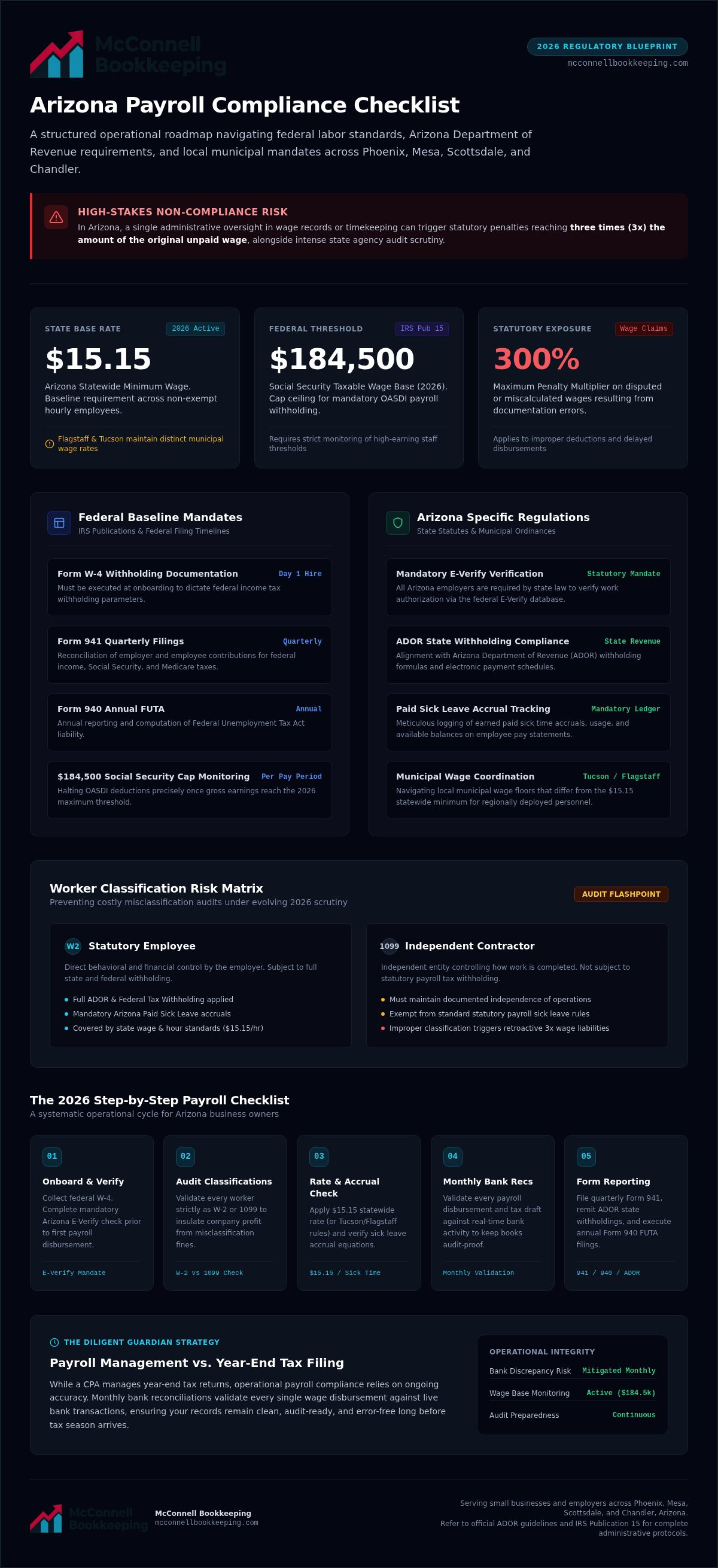
The 2026 Payroll Compliance Checklist: A Step-by-Step Guide
Maintaining a precise payroll compliance checklist is the most effective way to safeguard your Phoenix business against administrative slip-ups. This step-by-step roadmap turns vague regulations into concrete tasks, giving you the confidence that your records are always audit-ready. By following a structured process, you transform the burden of documentation into a strategic asset that supports your long-term stability.
Step 1: Verify all employee and contractor data for accuracy. Confirm that Social Security Numbers and current residential addresses are updated in your system. Accurate data entry prevents delivery issues with year-end forms and ensures your tax reporting is valid.
Step 2: Audit timekeeping records against payroll disbursements. Match physical hours worked to the total pay issued to ensure FLSA compliance. This step confirms you're adhering to the $684 weekly salary threshold for overtime exemptions and the $15.15 Arizona minimum wage.
Step 3: Reconcile payroll bank accounts monthly. Regular oversight catches duplicate entries or bank errors before they snowball into larger financial discrepancies.
Step 4: Review state and federal deposit schedules. Staying ahead of IRS Form 941 and 940 deadlines, along with Arizona state withholding timelines, protects you from steep late-payment penalties.
Step 5: Confirm all required labor law posters are updated for 2026. Displaying the latest Industrial Commission of Arizona notices keeps your team informed and your facility compliant.
Monthly Reconciliation: The Safety Net
Consistent oversight acts as your first line of defense against internal errors and external threats. When you match your QuickBooks Online records with actual bank statements, you ensure every transaction is legitimate and authorized. Monthly bank reconciliations identify discrepancies such as double-payments or ghost employees before they compromise your financial integrity. This proactive habit provides the transparency needed to maintain a clean set of books, making it much easier to identify opportunities for growth.
Quarterly and Annual Review Procedures
Comparing your quarterly 941 filings to the general ledger ensures your reported wages match your internal records perfectly. This consistency is vital when preparing for year-end W-2 and 1099 issuance, as it removes the traditional stress of January deadlines. If you find these reports confusing, you can seek QuickBooks training for business owners to master these essential financial tools. Taking control of your data today empowers you to lead your business with strategic insight rather than administrative fear. To ensure your business remains fully protected, schedule a payroll management consultation to review your current processes.
Empowering Your Business with Professional Payroll Management
Moving beyond a manual payroll compliance checklist involves transitioning from a reactive administrative posture to a proactive, growth-oriented strategy. DIY payroll often feels like a safe way to save costs, but the hidden price of administrative stress and potential errors can be steep. McConnell Bookkeeping serves as a strategic mentor for your team, providing the meticulous oversight needed to ensure every record is accurate and every deadline is met. This partnership doesn't just manage your tasks; it empowers you with the clarity to lead your business with confidence.
For Scottsdale clinics and law firms, the ROI of outsourced payroll management is measured in liberated time. Instead of losing hours to manual data entry or tracking sick leave accruals, you can dedicate your energy to patient care or case strategy. As a neighborly expert in the Phoenix Metro area, we understand the local nuances that general software might miss. We ensure your documentation is robust and your processes are streamlined, acting as a diligent guardian for your business profit.
How McConnell Bookkeeping Streamlines Your Payroll
We specialize in integrating your payroll activity directly with QuickBooks Online to create seamless financial reporting. This integration ensures that your labor costs are reflected accurately in your general ledger, providing the verified data your CPA requires for tax season. By focusing on operational accuracy, we provide the peace of mind bookkeeping services small businesses deserve. You'll enter every audit or tax meeting with a clean set of books that tells a story of transparency and professional discipline.
Next Steps: Securing Your 2026 Financial Health
Securing your financial health for the upcoming year starts with a diagnostic review of your current payroll records. We invite you to enter a collaborative partnership where we look ahead to identify opportunities for efficiency and risk mitigation. Our team is ready to help you transition from uncertainty to informed confidence, ensuring your business is prepared for whatever 2026 brings. Reach out today to schedule your consultation and take the first step toward a more organized, profitable future.
Securing Your Arizona Business Legacy for 2026
Mastering your administrative obligations is the essential first step toward long-term prosperity in the Phoenix Metro area. By implementing a rigorous payroll compliance checklist, you protect your profit from avoidable penalties and ensure your team remains supported through every growth phase. We've explored the necessity of accurate worker classification and the specific 2026 Arizona mandates, such as the minimum wage increase and E-Verify protocols, that require your immediate attention. This meticulous approach transforms a potential liability into a stable foundation for your future success.
As a QuickBooks Online ProAdvisor with specialized expertise in law and dental practice bookkeeping, we understand the unique pressures local business owners face. Our local Arizona presence allows us to act as your strategic mentor, ensuring every record is audit-ready and every disbursement is verified. You deserve the relief that comes from knowing your administrative records are in capable hands. It's time to move beyond the stress of DIY oversight and embrace a partnership built on transparency and reliability.
Schedule a Consultation for Professional Payroll Management and let's secure your financial health together. We look forward to helping you achieve the clarity and confidence your business needs to thrive in the coming year.
Frequently Asked Questions
What are the federal payroll record-keeping requirements for 2026?
Federal law requires you to maintain records for at least four years for tax purposes. This includes employee names, addresses, Social Security numbers, and dates of employment. You must also track amounts and dates of all wage payments and tax withholdings. Keeping these documents organized ensures you're ready for any federal audit. Organized digital folders for Scottsdale or Phoenix businesses help maintain this administrative clarity throughout the year.
Does Arizona require E-Verify for all small businesses?
Yes, Arizona law mandates that every employer in the state use E-Verify to confirm the employment eligibility of all new hires. This process must be completed within three business days of the hire date. Failing to comply can lead to the suspension or revocation of your business license in cities like Mesa or Gilbert. It is a non-negotiable step for any local payroll compliance checklist to avoid legal complications.
How long should I keep payroll records for my Mesa-based business?
You should maintain payroll records for at least four years to satisfy both federal and Arizona state requirements. While the Fair Labor Standards Act suggests three years for basic records, the IRS and Arizona Department of Economic Security often look back further. Keeping these files secure in your Mesa office protects your business against historical wage claims or tax inquiries. Strategic record retention is a pillar of professional administrative oversight for any small firm.
What is the penalty for misclassifying employees as contractors in Arizona?
Arizona courts can award treble damages, which is three times the amount of unpaid wages, if a worker is found to be misclassified. Employers are also liable for unpaid Social Security, Medicare, and unemployment taxes, along with interest and late fees. Phoenix and Scottsdale businesses often face these audits when a contractor applies for unemployment benefits. Misclassification is a high-risk error that meticulous record-keeping and professional guidance help you avoid.
Can I manage payroll compliance myself using QuickBooks Online?
While QuickBooks Online provides powerful tools for automation, the software still requires accurate data entry and professional oversight to ensure total compliance. Many Chandler business owners use our QuickBooks Online Training to master these features. However, complex local rules like Arizona's paid sick leave accruals often benefit from expert management. Professional oversight ensures your setup remains correct as labor laws evolve throughout the Phoenix Metro area, providing the relief you deserve.
What Arizona-specific forms do new employees need to sign?
Every new hire must complete Arizona Form A-4 within five days of starting work to designate their state withholding percentage. If an employee doesn't submit this form, you must apply the mandatory default rate of 2.0%. You also need to report new hires to the Arizona Department of Economic Security within 20 days. These local forms are vital for accurate state reporting for businesses in Scottsdale, Tempe, or Gilbert.
How does monthly bank reconciliation help with payroll compliance?
Monthly bank reconciliation acts as a vital verification step by matching your actual bank activity to your payroll records. This process identifies discrepancies such as double-payments, bank errors, or unauthorized transactions before they become major liabilities. For Phoenix small businesses, this practice ensures that your financial statements reflect the truth of your labor costs. It's the primary way to validate that your payroll compliance checklist is working effectively and protecting your business profit.
What is the minimum wage in Arizona for 2026?
The Arizona statewide minimum wage is $15.15 per hour, effective January 1, 2026. If your business operates in specific jurisdictions, you must follow those local rates, such as $15.45 in Tucson or $18.35 in Flagstaff. Tipped employees in Mesa and Scottsdale may be paid $12.15 per hour if tips cover the remaining $3.00 tip credit. Staying updated on these thresholds is essential for maintaining labor law compliance and supporting your team.


Comments