Managing IOLTA for Law Offices in Arizona: A 2026 Compliance Guide

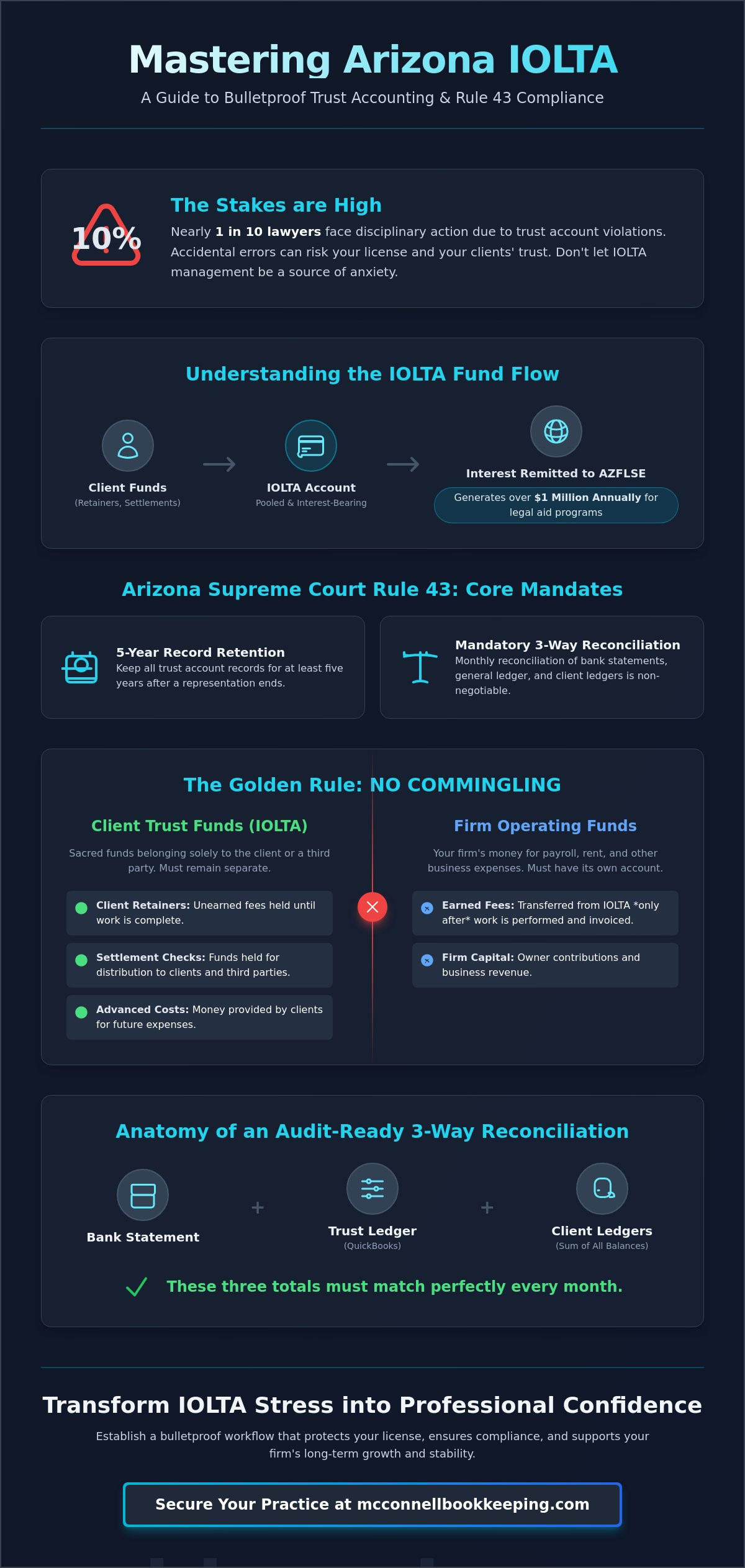
Did you know that nearly 10% of lawyers have faced disciplinary action due to trust account violations? For many attorneys, the simple act of opening a trust ledger brings a wave of anxiety, as the fear of an accidental Rule 43 violation or a State Bar audit looms in the background. Successfully managing IOLTA for law offices in Arizona is about more than just following rules; it's about building a bulletproof workflow that protects your hard-earned license and your clients' peace of mind.
You deserve to feel total confidence in your audit-readiness rather than wondering if your books will pass muster. This guide empowers you to master the complexities of Arizona trust accounting by implementing expert bookkeeping strategies that streamline your firm's operations. We'll walk through the specific requirements for 2026, including how to execute flawless three-way reconciliations and maintain clear separation of funds within QuickBooks Online. By the end of this article, you'll have a clear roadmap to transform your IOLTA management from a source of stress into a professional process that supports your firm's long-term growth and stability.
Key Takeaways
Identify the critical role of the Arizona Foundation for Legal Services & Education to ensure your interest remissions meet all state requirements.
Protect your practice from the "Bank Fee Trap" by implementing safeguards that prevent firm expenses from ever touching client trust funds.
Implement a rigorous three-way reconciliation workflow for managing IOLTA for law offices in Arizona to eliminate discrepancies between your bank balance and client ledgers.
Optimize your QuickBooks Online setup to create a transparent accounting environment that simplifies monthly reporting and daily fund management.
Gain peace of mind by establishing a documentation system that keeps your records organized and ready for any potential State Bar audit.
Table of Contents
Understanding IOLTA Requirements for Arizona Law Firms
Compliance is the bedrock of a successful legal career. In our state, Interest on Lawyers' Trust Accounts (IOLTA) programs serve as a vital mechanism for funding legal aid and law-related education. An IOLTA account is a pooled, interest-bearing account for nominal or short-term client funds. When you're managing IOLTA for law offices in Arizona, you aren't just handling money; you're acting as a fiduciary guardian for your clients' resources. The interest earned on these accounts doesn't benefit the firm or the client. Instead, it's remitted directly to the Arizona Foundation for Legal Services & Education (AZFLSE), a program that has historically generated over $1 million annually for community legal programs.
To better understand this concept, watch this helpful video:
Choosing the right bank is your first step toward total compliance. Arizona lawyers must use "Approved Financial Institutions" that have agreed to report any overdrafts to the State Bar's chief bar counsel. This oversight provides a safety net that protects your license from accidental errors. Additionally, your firm must distinguish between earned and unearned fees with absolute precision. Unearned fees, such as initial retainers or advanced court costs, must remain in the IOLTA account until the work is actually performed. Transferring these funds prematurely is a common error that can lead to severe disciplinary action. By maintaining this clear boundary, you demonstrate the transparency and integrity that the Arizona Supreme Court expects from every practitioner.
Arizona Supreme Court Rule 43 and Your License
Rule 43 dictates the strict record-keeping standards you must follow to maintain your standing. It requires you to keep all trust account records for at least five years after a representation ends. If the State Bar initiates an investigation, "ignorance of the books" isn't a valid defense. Meticulous documentation transforms a stressful audit into a routine verification of your firm's excellence. Monthly three-way reconciliations aren't just a suggestion; they're a mandate that ensures every cent is accounted for across your bank statements, general ledger, and individual client ledgers.
Which Funds Must Go Into Your Arizona IOLTA?
Determining which funds belong in your trust account is a daily task for Phoenix law practices. You should deposit client retainers, settlement checks, and advanced costs into the IOLTA. Arizona guidelines define "nominal or short-term" funds as those that wouldn't earn enough interest to cover the bank fees if held in a separate account. You might also handle third-party payments, such as those for medical providers in personal injury cases. Keeping these funds segregated ensures that every stakeholder is paid correctly and on time, reflecting the high professional standards of your practice.
The Mechanics of Arizona Trust Account Compliance
The "No Commingling" rule is the most fundamental principle of legal accounting. It ensures that your firm's operating capital and your clients' trust funds never intersect, even for a moment. Maintaining this absolute separation protects you from the most common cause of disciplinary action in our state. When you're managing IOLTA for law offices in Arizona, you must treat every dollar in that account as a sacred obligation that belongs solely to the client or a third party. This disciplined approach builds a foundation of trust that supports your firm's professional reputation.
Compliance requires you to maintain a specific set of documents with meticulous precision. According to Arizona Supreme Court Rule 43, your firm must keep a comprehensive internal register, individual client ledgers, and monthly bank statements. The State Bar of Arizona enforces a five-year record retention rule, which means every transaction must be archived and easily accessible long after a case concludes. Maintaining a rigorous internal register provides a chronological history of every movement of money, which ensures you can answer any auditor's question with total certainty. If you find these administrative requirements taxing, professional IOLTA management can provide the expert oversight needed to keep your firm safe.
Establishing the Client Ledger System
Every client matter needs a dedicated sub-ledger within your accounting software. This structure prevents funds from mixing between different cases and ensures that one client's money is never used to cover another's expenses. You should record every deposit and disbursement with specific matter-related details, such as case numbers or unique identifiers. Before you close any file, perform a "zero-balance" check to confirm no funds remain. This proactive step prevents the lingering small balances that often trigger audit flags during State Bar reviews.
Electronic Banking and IOLTA Security
Modern law firms rely heavily on wire transfers and electronic disbursements to move funds quickly. While these tools offer efficiency, they also introduce risks that require strict internal controls. You must understand the specific delay between a deposit and when funds are actually "cleared" to avoid accidentally spending money that isn't yet available. Implementing security measures, such as dual-factor authentication and limited access permissions, safeguards your IOLTA from unauthorized transactions. This vigilant stance transforms your electronic banking from a potential liability into a secure, streamlined asset for your practice.
Proactive management is the only reliable way to stay safe in an increasingly regulated environment. Waiting until an audit notice arrives to organize your books is a recipe for unnecessary stress and potential disaster. Monthly oversight identifies minor errors while they're still easy to correct, preventing them from snowballing into serious compliance violations. This methodical approach builds a culture of transparency and informed confidence, allowing you to focus on practicing law while your finances remain in safe, capable hands.
Common IOLTA Pitfalls for Law Offices in Phoenix
Even the most meticulous attorneys can fall into the "Bank Fee Trap." A simple $15 service charge deducted from your trust account can trigger a technical commingling violation. This happens because the bank is essentially using client funds to pay your firm's administrative costs. To avoid this, ensure your bank pulls all service fees from your firm's operating account instead. Reviewing the Arizona Bar Foundation IOLTA guidelines provides clarity on how to structure these banking relationships to remain compliant. This proactive setup protects your reputation and keeps your focus on client results.
Timing is everything when handling large settlement checks. Issuing a disbursement before the check has fully cleared at the bank is a high-stakes gamble. If the incoming check is delayed or returned, you risk "bouncing" a trust check, which triggers an automatic report to the State Bar. Vigilance in managing IOLTA for law offices in Arizona means waiting for confirmed fund availability before writing any checks. This patient approach eliminates the risk of accidentally using other clients' money to cover a temporary shortfall. It's a disciplined practice that ensures every client's funds remain secure and untouched.
The Danger of Commingling Firm and Client Funds
Accidental commingling often surfaces during a comprehensive books cleanup. These errors frequently occur when attorneys attempt to "borrow" from Client A’s ledger to pay a filing fee for Client B. This practice is a direct violation of trust accounting rules. Every client ledger must stand on its own. You must also move earned fees to your operating account promptly. Leaving earned money in the IOLTA account for too long turns your trust account into a firm savings account, which is a common form of commingling that auditors watch for closely.
Merchant Processing and Trust Accounts
Credit card processing introduces unique challenges to trust accounting. When a client pays via credit card, the processing fee must never be deducted from the IOLTA deposit. If a $1,000 retainer results in a $970 deposit because of a 3% merchant fee, you've technically used client money to pay for your firm's processing services. Using specialized legal payment tools ensures that the full $1,000 hits your IOLTA while the $30 fee is pulled from your operating account. Reconciling these "gross" vs. "net" deposits daily ensures your records remain transparent and audit-ready.
Adopting a "strategic mentor" mindset allows you to identify these pitfalls before they become disciplinary issues. By proactively monitoring your accounts, you catch small discrepancies before the State Bar ever sees them. This level of oversight provides the clarity you need to lead your firm with confidence and professional pride. Your commitment to financial integrity is the ultimate shield for your law license.
Best Practices for Daily IOLTA Management in QuickBooks
Managing IOLTA for law offices in Arizona requires more than just high-level oversight; it demands a precise digital architecture within QuickBooks Online. By mapping your accounts correctly, you transform your financial software into a proactive tool for compliance rather than just a digital ledger. The most critical component of this setup is the "Trust Liability" account on your Balance Sheet. This account must always mirror the exact balance of your IOLTA bank account, ensuring that client funds are never mistaken for firm revenue. Leveraging consistent monthly bank reconciliations allows you to catch data entry errors before they compromise your reporting integrity.
A three-way reconciliation must match the bank balance, the book balance, and the sum of individual client ledgers to meet Arizona's strict standards. This process serves as the ultimate proof that your firm is handling every dollar with the care the State Bar requires. When these three figures align to the penny, you gain the informed confidence needed to face any audit with ease. If your current system feels disorganized, our specialized QuickBooks Online training can help you establish a workflow that eliminates administrative stress.
The Three-Way Reconciliation Workflow
Step 1: Reconcile your bank statement to the QuickBooks bank register to ensure all transactions are accounted for and cleared.
Step 2: Compare the total in your bank register to the sum of all individual client ledgers to verify that every dollar is assigned to a specific matter.
Step 3: Generate a comprehensive report that proves all three figures match perfectly, providing a clear audit trail for your records.
QuickBooks Training for Law Office Managers
Precision in your bookkeeping starts with mastering the essential features of QuickBooks Online. Arizona legal administrators should focus on setting up "Products and Services" to track trust disbursements with absolute clarity. This prevents the common mistake of miscategorizing client costs as firm expenses. Professional training reduces the time you'll spend on a complex books cleanup later, allowing you to maintain a clean, transparent system from day one. Investing in these skills empowers your team to act as diligent guardians of your firm's financial health.
A well-maintained QuickBooks file is your firm's best defense against compliance risks. By following a methodical daily and monthly routine, you ensure that your records are always current and accurate. This disciplined approach doesn't just satisfy regulatory requirements; it provides the strategic insight you need to manage your firm's growth with total clarity. Your commitment to these best practices reflects the professional authority and reliability that your clients expect.
How Professional Bookkeeping Protects Your Arizona Practice
Professional oversight transforms your financial records from a source of anxiety into a strategic asset. While specialized software provides the necessary tools, it cannot replace the meticulous eye of a diligent guardian who understands the specific nuances of our state's regulations. At McConnell Bookkeeping, we monitor your IOLTA health with a level of precision that ensures your firm remains audit-ready at all times. This proactive approach allows you to lead your practice with the informed confidence that your license is protected by experts who are deeply invested in your success. Managing IOLTA for law offices in Arizona shouldn't be a solo burden that keeps you away from your clients in Mesa and Scottsdale; it should be a streamlined process that supports your firm's professional reputation.
Facing a State Bar audit is a high-stakes event that demands total transparency and organized records. When your books are managed by a neighborly expert, you can provide auditors with flawless three-way reconciliations and clear audit trails without a moment of hesitation. This level of preparation eliminates the panic often associated with regulatory reviews. We provide the reliability and calm you need to navigate complex financial requirements, ensuring that every client ledger and bank statement is beyond reproach. Your commitment to financial integrity becomes a visible strength of your practice, reinforcing the trust your clients place in your legal expertise.
The ROI of Outsourced Legal Bookkeeping
Attorneys often find that their time is far better spent on billable hours than on complex trust reconciliations. If a partner’s hourly rate is $350, spending several hours each month on administrative bookkeeping represents a significant opportunity cost for the firm. Outsourcing these tasks provides a clear return on investment by freeing you to focus on high-value legal work and business development. Additionally, maintaining clean books facilitates strategic accounts receivable services, which optimizes your cash flow and ensures your Phoenix law firm remains financially robust. You gain more than just compliance; you gain the strategic insight needed to grow your practice with clarity.
Getting Started with McConnell Bookkeeping
Our specialized approach to Arizona law practice bookkeeping begins with a comprehensive trust account diagnostic review. This initial step identifies potential discrepancies and entry errors before they escalate into serious compliance issues. We walk you through the results with a collaborative spirit, offering a clear path forward to a stress-free management system. What you can expect is a partnership defined by high-level competence and a genuine desire to see your practice thrive. Taking this first step toward a professional IOLTA management system liberates you from administrative stress and positions your firm for sustainable growth in 2026 and beyond.
Securing Your Firm's Financial Future
Mastering the nuances of trust accounting is the ultimate safeguard for your professional reputation. By implementing a rigorous three-way reconciliation workflow and maintaining absolute separation between firm and client funds, you eliminate the risks that lead to State Bar investigations. Successfully managing IOLTA for law offices in Arizona requires constant vigilance, but it also provides the clarity you need to lead your practice with informed confidence. You've worked hard to build your firm; don't let a simple bookkeeping error jeopardize everything you've achieved.
We act as your diligent guardian, providing the meticulous oversight required to keep your records flawless. As QuickBooks Online ProAdvisor Certified experts specializing in Arizona Law Practice Bookkeeping, we bring local Mesa and Phoenix expertise to every ledger. Our proactive approach transforms administrative stress into operational strength, freeing you to focus on the legal work that matters most. This partnership provides the reliability and calm you need to scale your firm with total peace of mind.
Take the first step toward a more secure and streamlined practice today. Protect your law license with expert IOLTA management from McConnell Bookkeeping. We're here to help you thrive in an increasingly complex regulatory environment.
Frequently Asked Questions
What is the "Three-Way Reconciliation" required by the State Bar of Arizona?
A three-way reconciliation is a mandatory verification process where you match your bank statement balance against your firm's general ledger and the sum of all individual client ledgers. This rigorous check ensures that every cent is accounted for and assigned to the correct matter. By identifying discrepancies early, you maintain the transparency required by the State Bar and protect your firm from technical violations.
Can I keep my firm’s own money in my Arizona IOLTA account to cover bank fees?
You may keep a small, nominal amount of firm funds in your IOLTA account specifically to cover bank service charges. This proactive measure prevents the bank from accidentally deducting fees from client funds, which would constitute a commingling violation. Most financial institutions approved by the Arizona Foundation for Legal Services & Education waive these fees, but maintaining a small buffer ensures your account remains compliant.
How long do I need to keep my IOLTA records in Arizona?
Arizona lawyers must retain all trust account records for a minimum of five years after the termination of the representation. This requirement includes bank statements, cancelled checks, and detailed client ledgers. Keeping these records organized and accessible transforms a potential audit into a routine verification of your firm's diligent financial management and adherence to Rule 43.
What happens if I accidentally commingle funds in my trust account?
If you discover accidental commingling, you should correct the error immediately and document the specific steps taken to resolve the discrepancy. Approved financial institutions are required to report any overdrafts to the State Bar of Arizona's chief bar counsel. Managing IOLTA for law offices in Arizona with professional oversight helps you identify these risks before they trigger a formal investigation or disciplinary action.
Does the interest from an Arizona IOLTA account go to the attorney or the client?
The interest generated on an Arizona IOLTA account is remitted directly to the Arizona Foundation for Legal Services & Education. These funds support legal aid and law-related education programs throughout the state. The program is designed to be at no cost to the lawyer or the client, as the interest funds the initiative while many banks waive related service fees.
Can I use QuickBooks Online to manage my Arizona IOLTA compliance?
QuickBooks Online is an effective tool for trust accounting when it's configured with a proper legal chart of accounts. While no specific software is mandated, integrating QuickBooks with legal-specific practice management software is highly recommended to ensure full compliance. This setup allows for seamless tracking of client funds and simplifies the monthly three-way reconciliation process required for Arizona practitioners.
What is a "Certified Financial Institution" for Arizona IOLTA accounts?
An approved or certified financial institution is one that has entered into an agreement with the Arizona Foundation for Legal Services & Education to report all IOLTA overdrafts. You must use an approved bank to maintain compliance with Rule 43. These institutions often offer competitive rates; for example, Vantage West Credit Union offered a 2.15% APY on IOLTA accounts as of May 1, 2026.
How often should I reconcile my law firm trust account?
You are required to perform a three-way reconciliation of your IOLTA account on a monthly basis. Regular reconciliations empower you to catch entry errors or bank discrepancies before they become systemic issues. This disciplined routine ensures that your firm remains audit-ready and provides the clarity needed for managing IOLTA for law offices in Arizona with total confidence.


Comments