The Essential Internal Controls for Accounts Payable Checklist for 2026

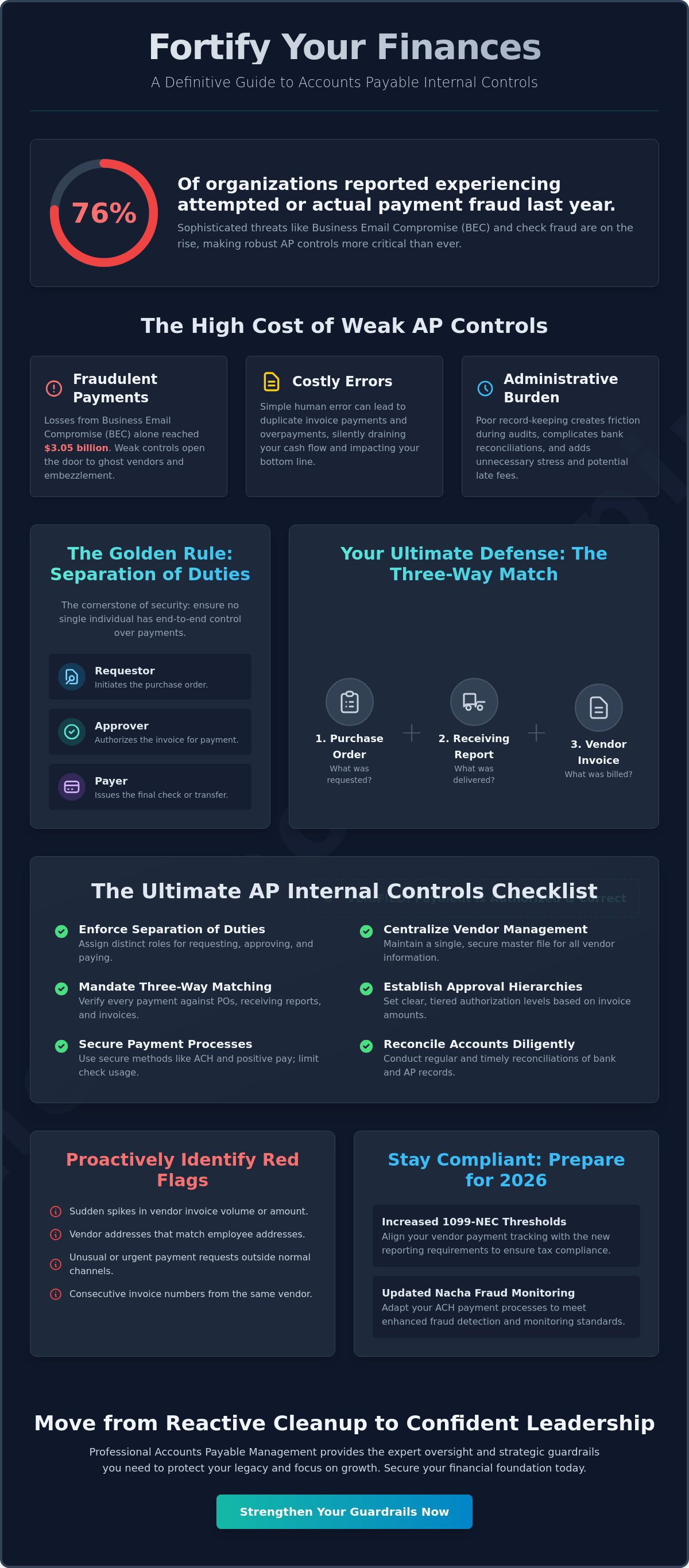
Did you know that 76% of organizations reported experiencing attempted or actual payment fraud last year? This startling statistic highlights a growing reality where business email compromise and check fraud have become sophisticated threats to your hard-earned capital. You likely started your company to build a legacy, not to lose sleep over duplicate invoices or the fear that a messy paper trail might make your next audit a nightmare. It's understandable to feel protective of your cash flow, especially as 2026 brings new regulatory shifts like the increased 1099-NEC reporting thresholds and updated Nacha fraud monitoring requirements.
Establishing rigorous internal controls for accounts payable is the most effective way to transform this anxiety into informed confidence. By mastering these protective guardrails, you don't just prevent errors; you empower your team to operate with precision and professional authority. This article provides a definitive, step-by-step checklist designed to secure your AP process and ensure your financial records remain impeccable. We will explore how to eliminate payment mistakes, deter embezzlement, and strengthen your vendor relationships through a system that prioritizes clarity, transparency, and strategic oversight.
Establish a robust system of internal controls for accounts payable to serve as a strategic guardrail that protects your cash flow and ensures absolute financial accuracy. Precision in your records creates the freedom you need to grow your business with confidence. By implementing these checks and balances, you transform a routine administrative task into a powerful tool for strategic oversight and long-term stability.
Implement the "Three-Way Match" principle by comparing purchase orders, receiving reports, and invoices to verify that every outgoing payment is authorized and correct. This methodical approach eliminates the risk of duplicate payments and prevents costly administrative errors. Assigning distinct roles for requesters, approvers, and payers further secures your environment by ensuring no single individual has total control over your capital.
Align your verification processes with the 2026 Nacha fraud monitoring rules and updated 1099-NEC reporting thresholds to ensure your business remains secure and compliant. Staying ahead of these regulatory shifts protects your reputation with vendors and tax authorities alike. Identifying critical red flags, such as sudden vendor volume spikes or address matches, allows you to proactively stop potential fraud before it impacts your business legacy.
Leverage professional Accounts Payable Management to transition from the stress of manual entry to a proactive strategy that fosters growth. Expert oversight provides the clarity and transparency required to move from reactive cleanup to informed, confident leadership. With the right guardrails in place, you can focus on your strategic vision while knowing your financial foundation is in safe, capable hands.
Table of Contents
Understanding Internal Controls for Accounts Payable in 2026
Your business represents a significant personal investment and a commitment to your community. To protect that legacy, you need a robust system of Internal control. This isn't about creating bureaucracy or slowing down your operations. Instead, internal controls for accounts payable serve as a sophisticated framework that manages every outgoing payment with precision. In 2026, where digital transactions move at lightning speed and fraud schemes are increasingly complex, these controls provide the essential oversight needed to ensure your capital is used exactly as intended.
Three primary objectives drive this protective system. First, it acts as a shield against fraud, which is critical given that Business Email Compromise (BEC) losses reached $3.05 billion in 2025 according to verified industry data. Second, it ensures absolute accuracy in your financial records, eliminating the human errors that lead to overpayments. Finally, it optimizes your cash flow. When you know exactly when and where your money is going, you gain the strategic insight to make bolder business decisions. These clean records also directly improve the accuracy of your balance sheet for business loan application, as lenders prioritize businesses with verifiable, error-free liabilities.
The Consequences of Weak AP Controls
Without clear guardrails, small businesses often fall victim to invisible leaks. Duplicate invoice payments are a common culprit, frequently occurring because a vendor sends a reminder that your team accidentally processes as a new bill. Ghost vendors can also drain your margins if an unauthorized party creates a fictitious company to funnel payments. Beyond direct theft, poor record-keeping creates massive friction during tax season and complicates your monthly bank reconciliations, leading to unnecessary administrative stress and potential late fees that eat into your profits.
The "Neighborly Expert" Approach to Financial Security
We view these controls as a way to support your team, not just watch them. By creating a culture of transparency in your Mesa or Phoenix office, you protect your staff from suspicion and provide them with clear guidelines for success. A professional bookkeeper acts as a diligent guardian, offering the proactive oversight that transforms your financial department. This partnership allows you to stop reacting to crises and start leading with a sense of informed confidence. You deserve the peace of mind that comes from knowing every transaction is verified and every dollar is accounted for by a partner invested in your growth.
The Golden Rule: Separation of Duties and Authorization
Separation of duties is the cornerstone of any secure financial environment. It ensures that no single individual holds enough power to manipulate records or issue payments without detection. By dividing responsibilities, you create a natural system of checks and balances that protects both your capital and your employees from the temptation of fraud. In the context of internal controls for accounts payable, this means the person who approves an invoice should never be the same person who signs the check or initiates the digital transfer.
The "Three-Way Match" serves as your primary defense against overpayments and billing errors. This methodical process involves comparing the Purchase Order (what was requested), the Receiving Report (what was actually delivered), and the Invoice (what is being billed). When these three documents align, you gain the certainty needed to release funds. Implementing this practice eliminates the risk of paying for goods that never arrived or being overcharged by a vendor. To maintain this momentum, assign specific roles to different team members: a Requester to identify the need, an Approver to authorize the spend, and a Payer to execute the transaction.
Establishing clear dollar-amount thresholds further refines your oversight. You might allow a department manager to approve expenses up to $1,000, while requiring your personal signature for anything above that mark. This structure provides your team with the autonomy to keep operations moving while you retain control over significant capital outlays. Most importantly, the individual writing the checks must never be the one who performs the monthly bank reconciliation. This final separation ensures that every transaction is verified by a second pair of eyes, providing a level of transparency that is essential for long-term growth.
Implementing Separation of Duties in Small Teams
Many Mesa small businesses operate with lean teams where separating duties feels difficult to achieve. You can solve this challenge by bringing in an outsourced partner to handle specific stages of your workflow. Utilizing peace of mind bookkeeping services provides that critical third-party check without the overhead of a full-time hire. This strategic partnership ensures your records are verified by a diligent guardian who is deeply invested in your success. If your internal staff is limited, our Accounts Payable Management can act as the necessary "third-party" check to keep your business secure.
Formalizing the Approval Workflow
Formalizing your approval process moves your business away from the risks of verbal agreements. Use documented digital signatures to create a permanent audit trail for every transaction. You should also maintain a Master Vendor List to prevent the unauthorized creation of new vendor accounts, which is a common tactic in embezzlement schemes. Reviewing Accounts Payable Process Controls can help you refine these authorization levels to match industry best practices. Periodic reviews of your signature authorizations ensure your internal controls for accounts payable remain robust as your team evolves.
The Ultimate Accounts Payable Internal Controls Checklist
Moving from the organizational structure of your team to the daily mechanics of your workflow requires a clear, actionable roadmap. A comprehensive checklist for internal controls for accounts payable ensures that every invoice is treated with the same level of scrutiny, regardless of who is handling the paperwork. This methodical approach starts before a single dollar is spent and follows a specific sequence to protect your capital:
Vendor Verification: Cross-reference new vendor W-9 forms and tax IDs against IRS records to prevent the creation of fictitious "ghost vendors" designed to siphon funds.
Invoice Stamping: Use digital timestamps or "paid" markers to identify every invoice as received and processed. This simple act prevents a single bill from being entered into your system twice.
Dual Authorization: Require two signatures or digital approvals for high-value ACH transfers or checks. This ensures a second authorized leader has reviewed the transaction before funds leave your account.
Reconciliation: Perform a monthly matching of your AP aging reports to the general ledger. This confirms that your reported liabilities perfectly align with your actual bank activity.
Record Retention: Maintain a secure digital archive of all payment records for seven years. This long-term storage provides the transparency needed to satisfy tax authorities or banking partners during an audit.
Execution of these steps provides the relief and clarity that come from expert oversight. By following this list, you don't just find errors; you build a culture of reliability that vendors respect. Clean records lead to better relationships and more favorable terms, directly contributing to your business's long-term prosperity.
Digital Controls in QuickBooks Online
Cloud-based accounting software offers powerful tools to automate your security and streamline your workflow. By using specific user permissions in QuickBooks Online, you can restrict access to the bank register while still allowing staff to enter bills. You can also establish automated bill approval workflows that route invoices to the correct manager based on the department or dollar amount. Mastering these settings is easier with QuickBooks training for business owners, which empowers you to use the software as a strategic asset for growth.
The Month-End Review Process
Your month-end routine serves as the final verification of your internal controls for accounts payable. Take the time to analyze your AP Aging report to identify overdue liabilities or balances that seem unusual. Ensure that all bank feeds are reconciled and matched to specific invoices rather than being categorized as generic expenses. This level of detail confirms that vendor credits are applied correctly, which reduces your outgoing cash and protects your bottom line. Consistent reviews turn your financial data into a proactive management tool rather than a reactive cleanup task.
Identifying Red Flags: Common AP Fraud and Errors
Vigilance is the natural partner of prosperity. While your system of internal controls for accounts payable provides the essential structure, active monitoring allows you to identify anomalies before they impact your bottom line. Fraud often leaves a trail of subtle clues that a busy business owner might overlook. By training your eye to recognize these red flags, you move from a state of uncertainty to one of strategic oversight. This proactive stance protects your capital and reinforces the integrity of your entire financial department.
Keep a close watch on vendor volume and billing patterns. A sudden spike in payments to a single vendor without a corresponding increase in your production or sales is a classic warning sign. Pay attention to invoice aesthetics as well. Professional vendors rarely send invoices with rounded numbers or missing contact information. If you notice frequent "emergency" or "rush" payment requests, be cautious. These requests are often designed to bypass your standard approval workflow, creating a vulnerability that bad actors can exploit. You should also periodically cross-reference vendor addresses against your employee records. A match between a vendor and an employee's home address is a definitive signal that requires immediate investigation.
The Danger of the "Trusted Employee" Myth
Trust is a wonderful component of a healthy workplace, but it's not a substitute for financial security. Statistics suggest that the most trusted employees are often given the most opportunity to bypass controls precisely because their actions are rarely questioned. Normalizing regular audits and reviews helps your team understand that these checks are a protective measure for everyone, not an accusation. For example, utilizing outsourced payroll processing adds a critical layer of third-party verification. This external oversight ensures that your internal team remains focused on growth while a diligent guardian monitors for irregularities.
Technical Errors That Drain Your Profit
Not every financial leak is the result of intentional fraud. Simple technical errors can quietly erode your margins over time. Failing to catch sales tax errors on out-of-state vendor invoices can lead to overpayments that are difficult to recover. Slow approval cycles also carry a hidden cost, as you may miss out on "early payment" discounts that could significantly reduce your annual expenses. Verified data shows that manual invoice processing costs between $10 and $22 per document, while automated systems can reduce that cost to under $1. These small inefficiencies add up, but a proactive management strategy can eliminate them. If you suspect your current system is leaking capital, our Books Cleanup services can restore clarity and precision to your ledger.
Strengthening Your Guardrails with Professional Oversight
Implementing a checklist is a powerful first step toward securing your business. However, the true strength of your internal controls for accounts payable lies in consistent, professional oversight. A professional bookkeeper does more than just record transactions; they serve as a diligent guardian of your business legacy. By transitioning from a reactive "cleanup" mode to a proactive management strategy, you stop worrying about past errors and start focusing on future opportunities. This shift provides the relief and clarity you need to lead with confidence, knowing that every dollar leaving your account has been verified by an expert partner.
Your time is your most valuable asset. When you utilize dedicated accounts payable management, you offload the meticulous tasks of verifying tax IDs and cross-referencing W-9s. This strategic partnership protects your schedule from the administrative friction of manual data entry and vendor disputes. A professional diagnostic review of your current AP processes can identify hidden vulnerabilities that even the most careful business owner might miss. This oversight ensures your financial foundation remains unshakable as you scale your operations.
Partnering for Strategic Growth
Moving beyond basic data entry allows you to gain genuine strategic financial insight. Expert oversight transforms your ledger from a list of expenses into a roadmap for growth. For specialized industries, this precision is even more critical. For instance, clean AP records directly lead to more accurate dental practice financial metrics, providing the transparency needed to optimize profitability. Having a strategic mentor in your financial corner means you are never navigating complex regulatory changes or fraud threats alone.
Your 2026 Action Plan
Securing your business requires a methodical approach. Follow these steps to reinforce your internal controls for accounts payable and protect your cash flow:
Step 1: Audit your current user permissions in QuickBooks Online. Ensure that the person entering bills does not also have the authority to reconcile the bank register.
Step 2: Define a formal three-person approval chain. Assign clear roles for the Requester, the Approver, and the Payer to eliminate any single point of failure.
Step 3: Reach out to McConnell Bookkeeping for a professional consultation. We can perform a comprehensive review of your current systems and implement the strategic guardrails your business deserves.
The path to financial peace of mind starts with a single, proactive decision. You have built something remarkable; now is the time to protect it with the professional oversight that ensures long-term prosperity and stability.
Securing Your Financial Legacy Through Strategic Oversight
Mastering your accounts payable process is about more than just avoiding errors; it's about building a foundation of transparency that supports your long-term vision. By implementing rigorous internal controls for accounts payable, you protect your cash flow from fraud and ensure every vendor relationship is built on a bedrock of accuracy. Remember that the "Three-Way Match" and a clear separation of duties are your strongest defenses against the sophisticated threats of 2026. These methodical steps transform your financial department from a source of administrative stress into a proactive engine for growth.
You don't have to navigate these complex regulatory changes alone. Since 2020, we've served the Mesa, Phoenix, and Scottsdale communities with specialized experience in Legal and Dental practice bookkeeping. Our expert QuickBooks ProAdvisor guidance provides the meticulous oversight your business deserves, allowing you to step away from the ledger and back into your role as a leader. Secure your business finances today with McConnell Bookkeeping and experience the relief that comes from having a diligent guardian in your corner. Your success is our priority, and we're ready to help you thrive with informed confidence.
Frequently Asked Questions
What is the most important internal control for accounts payable?
Separation of duties is the most critical component. It prevents a single individual from controlling the entire lifecycle of a transaction from start to finish. Without this check, the risk of undetected errors or intentional fraud increases significantly. By ensuring that the person who enters a bill is not the same person who releases the funds, you create a natural barrier that protects your capital.
How can a small business with only one office manager implement separation of duties?
Small teams can involve the business owner in the final approval or bank reconciliation process. If you only have one manager, you should personally review the bank statements or sign the high-value checks. Outsourcing specific tasks like internal controls for accounts payable to a professional partner also creates the necessary third-party verification. This partnership ensures that a second pair of eyes monitors your outgoing cash flow.
Does using QuickBooks Online automatically provide internal controls?
QuickBooks Online is a sophisticated tool, but it doesn't create security on its own. It's a platform that requires careful configuration to be effective as a defensive measure. You must actively set user permissions, restrict access to sensitive bank registers, and establish digital approval workflows. Without these intentional settings, the software remains a neutral ledger rather than a proactive guardian of your business funds.
What is a "Three-Way Match" and why is it necessary for my law firm?
A Three-Way Match is a verification process that compares the purchase order, the receiving report, and the invoice. For law firms, this practice is essential for maintaining accurate records of client-related expenses. It ensures that you only pay for services or supplies that were actually requested and received. This level of precision is vital when managing IOLTA accounts or preparing detailed billing for your clients.
How often should I review my master vendor list for errors or fraud?
Reviewing your master vendor list should happen at least quarterly to maintain a clean and secure environment. This proactive check ensures no duplicate entries exist and that every vendor on the list remains legitimate. Regular reviews help you spot "ghost vendors" or unauthorized address changes that could signal internal fraud. Keeping this list updated also streamlines your year-end 1099 reporting and simplifies your tax preparation.
Can I outsource my accounts payable while still maintaining internal control?
Yes, outsourcing often strengthens your internal controls for accounts payable by introducing an external layer of oversight. It inserts a neutral expert into your daily workflow, making it much harder for internal errors or unauthorized payments to go unnoticed. A professional bookkeeping firm acts as a strategic mentor, ensuring that your approval processes are followed precisely while freeing up your internal team to focus on growth.
What should I do if I suspect an internal payment error or fraud?
If you suspect an issue, immediately secure your financial records and pause further payments to the vendor in question. You should perform a detailed review of all recent transactions to identify the scope of the problem. A professional books cleanup can help uncover the extent of the error and restore your ledger's integrity. Taking swift, methodical action protects your remaining capital and prevents the situation from escalating.
Is a digital approval process as secure as a physical signature on a check?
Digital approvals are actually more secure than physical signatures in a modern business environment. They provide a permanent, encrypted audit trail that shows exactly who authorized a payment and the precise time it occurred. Unlike physical checks, which can be altered or forged, digital workflows are protected by multi-factor authentication and user-specific permissions. This technology offers a level of transparency and reliability that traditional paper processes simply cannot match.


Comments