How to Read a Profit and Loss Statement: A Strategic Guide for Mesa Business Owners

What if your financial reports weren't just a tax season chore, but a strategic GPS that told you exactly when to hire your next employee or open a second location in Mesa? Many local entrepreneurs struggle with the disconnect between their QuickBooks data and their bank balance, often because they haven't been shown how to read a profit and loss statement in a way that actually guides their daily decisions. It's frustrating to see a profitable bottom line on paper while navigating an 8.3% total sales tax and a $15.15 hourly minimum wage, only to wonder why your actual cash reserves feel so thin.
Mastering your financial data is the first step toward reclaiming control and building a business that thrives under expert oversight. This guide will teach you to translate your numbers into a clear roadmap for growth, profitability, and total financial clarity. We'll explore how to distinguish profit from cash flow, use industry benchmarks for law and dental practices to secure bank loans, and organize your records to eliminate the stress of messy books forever. By the end, you'll have the confidence to make expansion decisions based on facts rather than intuition.
Key Takeaways
Clean bookkeeping provides the foundation for reliable data, ensuring your financial reports reflect the true health of your Mesa business.
Discover how to read a profit and loss statement to clearly distinguish between your total market reach and your actual operational efficiency.
Use horizontal and vertical analysis to identify spending trends, allowing you to compare current performance against previous years and scale with confidence.
Uncover industry-specific nuances for law and dental practices to ensure your financial statements align with the unique overhead demands of your profession.
Implement a disciplined monthly review routine to verify that every transaction is reconciled, providing the clarity needed for stress-free expansion decisions.
Table of Contents
The Foundation of Financial Clarity: Why Your P&L Depends on Clean Books
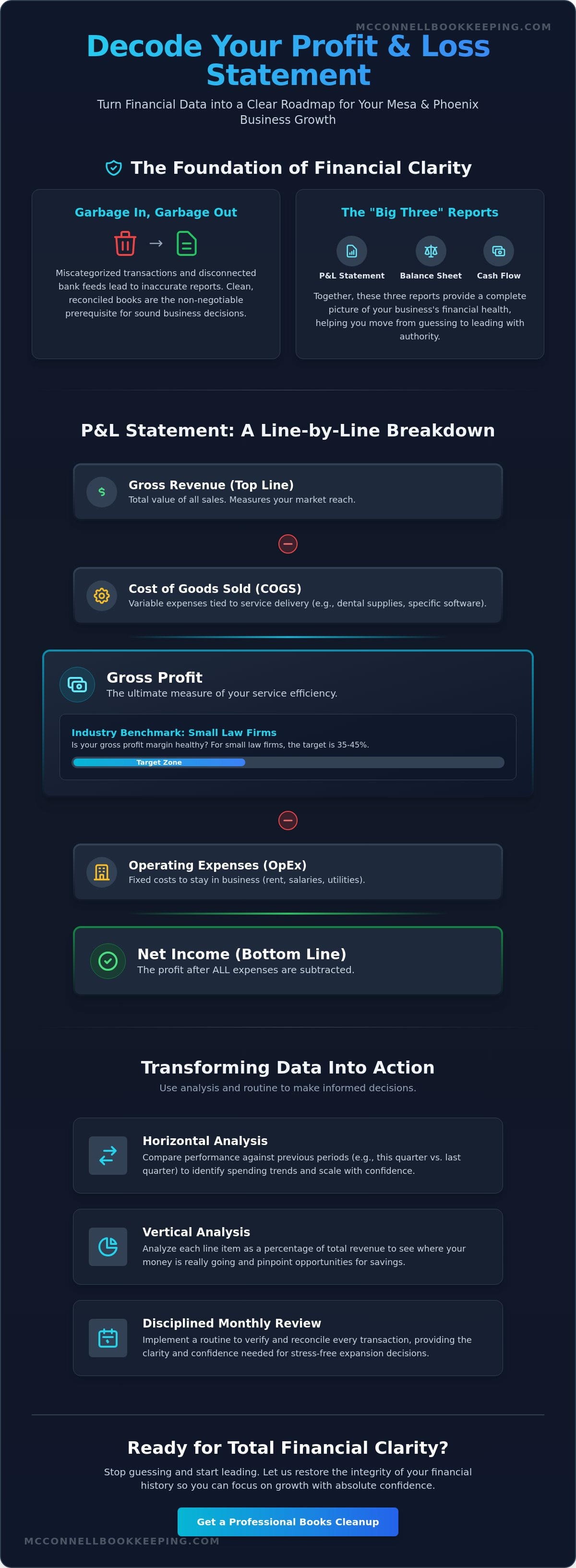
A Profit and Loss (P&L) statement, frequently referred to as an income statement, serves as a comprehensive summary of your business's revenue and expenses over a specific period. It's one of the "Big Three" financial reports, standing alongside the Balance Sheet and the Cash Flow Statement to provide a complete view of your operational health. Learning how to read a profit and loss statement is the first step toward transforming your Mesa business from a source of stress into a predictable engine for wealth. When you understand these numbers, you stop guessing and start leading with professional authority.
Many online guides assume the data you see in your software is already 100% accurate, but that's rarely the case for busy entrepreneurs. In the world of small business accounting, we live by the "Garbage In, Garbage Out" principle. If your transactions are miscategorized or your bank feeds are disconnected, your reports will lead you astray. Accurate data is the non-negotiable prerequisite for any strategic decision, whether you're considering a new hire or evaluating a lease in downtown Mesa.
To better understand this concept, watch this helpful video:
The Critical Role of Monthly Bank Reconciliations
Consistency creates confidence. Performing monthly bank reconciliations ensures that your QuickBooks records match your actual bank activity to the penny. This diligent process catches missing expenses that could lower your tax liability and identifies duplicate income entries that might cause you to pay more than necessary. Making hiring decisions based on uncleared transactions is a dangerous gamble that can lead to cash crunches. Beyond internal management, remember that Mesa lenders and credit officers always ask for reconciled books as the first step in any commercial loan application.
When to Perform a Books Cleanup
Messy books often accumulate slowly until they become an overwhelming administrative burden. You might notice signs of trouble like uncategorized expenses, old hanging balances from previous years, or "Ask My Accountant" folders that never seem to shrink. These historical errors in your records don't just cause confusion; they actively distort your understanding of how to read a profit and loss statement by showing profit where none exists. A professional books cleanup restores the integrity of your financial history. Starting a new quarter with a verified, clean financial slate provides immediate relief and allows you to focus on your 2026 growth targets with absolute transparency.
Decoding the Profit and Loss Statement: A Line-by-Line Breakdown
Your P&L begins with Gross Revenue, often called the "top line." This number represents the total value of services or products sold before any costs are subtracted. It's a powerful indicator of your market reach in the Phoenix metro area. Beneath this, you'll find the Cost of Goods Sold (COGS). These are the variable expenses directly tied to producing your service, such as dental supplies or specific software for a law firm. Subtracting COGS from Gross Revenue gives you your Gross Profit. This metric is the ultimate measure of your service efficiency. If your Gross Profit margin is lower than the 35-45% target typical for small law firms, it's a signal to review your pricing or production costs.
Operating Expenses (OpEx) follow, covering the fixed costs of staying in business regardless of your sales volume. Finally, you reach Net Income, the famous "bottom line." For owners looking toward a future exit or expansion, EBITDA (Earnings Before Interest, Taxes, Depreciation, and Amortization) offers a clearer view of operational profitability by stripping away non-cash items and tax structures. Understanding how to read a profit and loss statement at this level allows you to see the business through the eyes of a lender or a potential buyer.
Revenue vs. Cash Flow: The Great Misconception
Revenue on your P&L represents the value of work performed, but it doesn't guarantee the funds are available to spend. This is the core difference between the "top line" and your actual bank balance. Utilizing accounts receivable services in Mesa helps bridge this gap by ensuring earned revenue actually transforms into liquid cash. Accrual accounting records income when you send the invoice, while cash accounting waits until the money actually hits your bank account.
Analyzing Operating Expenses (OpEx)
Fixed costs like Mesa office rent, payroll for your team, and local marketing campaigns form the bulk of your OpEx. Identifying discretionary spending, such as non-essential subscriptions or luxury office perks, gives you the flexibility to protect your margins during slower months. Proactive monitoring helps you spot "expense creep" before small, recurring costs erode your hard-earned profits. If you feel overwhelmed by these details, professional financial statement preparation can provide the clarity you need to stay in control. This level of oversight ensures your business remains a source of prosperity rather than a source of administrative stress.
Beyond the Numbers: Analyzing Trends to Scale Your Phoenix Business
Scaling a business in the Phoenix metro area requires more than just looking at a single month's performance. It demands a deep dive into trends that reveal the true trajectory of your growth. When you master how to read a profit and loss statement through the lens of horizontal analysis, you compare your current figures against the same period in 2025. This historical perspective is vital for Mesa entrepreneurs navigating the unique "snowbird" economy. Revenue typically surges during the cooler months when the population peaks, while the summer heat often brings a predictable dip in local service demand. Recognizing these cycles prevents you from panicking during July and helps you prepare for the busy winter rush.
Vertical analysis adds another layer of strategic insight by expressing every expense as a percentage of your total revenue. This method allows you to spot inefficiencies that a raw dollar amount might hide. For instance, if your utility costs jump from 2% to 6% of revenue during a record-breaking Arizona summer, you can proactively adjust your cash reserves. Using this trend data helps you predict the optimal time for major equipment purchases, ensuring you invest when your margins are healthiest rather than when your bank balance feels temporarily inflated. This proactive approach transforms your bookkeeping from a reactive task into a powerful tool for liberation.
The Budget vs. Actual Comparison
Your P&L acts as a real-time scorecard for your 2026 growth plan. By comparing your actual spending against your projected budget, you can identify variances before they become crises. If your "Marketing" line item is 30% over budget this month, you can investigate if that's a strategic investment in a new Mesa-based campaign or simply undisciplined spending. Adjusting your strategy mid-year based on this real-time performance data ensures you stay on track for your year-end goals. It's about having the clarity to pivot when the market shifts.
Benchmarking Your Profit Margins
Understanding your numbers in a vacuum is helpful, but comparing them to industry standards is transformative for your bottom line. For small to mid-size law firms, a healthy profit margin typically sits between 35% and 45%, while solo dental practices often aim for 35% to 42%. If your payroll expenses are climbing due to the $15.15 per hour minimum wage effective January 2026, you must determine if your production is increasing at a similar rate. A 20% margin might be a success in high-volume retail, but it could signal a failure in a specialized law practice. Knowing how to read a profit and loss statement against these benchmarks empowers you to make expansion decisions with absolute certainty.
Industry-Specific P&L Nuances for Law and Dental Practices
Standard financial templates often fall short for specialized service providers because they fail to capture the unique operational workflows of professional practices. For legal and dental professionals in Mesa, learning how to read a profit and loss statement involves more than just looking at a bottom line; it requires a nuanced understanding of industry-specific variables. Compliance serves as a primary driver for this accuracy. Regulatory bodies and professional boards expect meticulous reporting that reflects the true nature of your transactions. When your financial statements are tailored to your specific field, they transform from a simple report into a strategic mentor that guides your expansion.
Law Firms: Trust Accounting and IOLTA Impacts
Trust and IOLTA funds must never appear as revenue on your P&L. These funds are fiduciary responsibilities held for clients, not earned income for the firm. Misclassifying these as revenue inflates your perceived profitability and creates significant compliance risks. Managing case costs also requires professional precision. You must determine if these are advanced client costs held as assets on your balance sheet or immediate expenses. Treating these costs correctly ensures your P&L reflects the true profitability of different practice areas, such as family law versus personal injury. This level of detail allows you to identify which services generate the highest margins after accounting for the typical 45% to 50% law firm overhead.
Dental Practices: PPO Adjustments and Lab Fees
Dental practices face the unique challenge of PPO write-offs, which can significantly distort your gross revenue numbers if not tracked properly. Distinguishing between production and actual collections is essential for maintaining a realistic view of your financial health. Production represents the total value of work performed, while collections show the actual cash recovered from patients and insurance providers. Learning how to read a profit and loss statement through the lens of a dental practice means monitoring lab fees and dental supplies as a percentage of production to keep overhead within the industry-standard 60% range. Additionally, tracking multi-provider payroll ensures that each associate or hygienist remains a profitable asset to your practice. If you're ready to gain this level of clarity, our dental practice bookkeeping services provide the expert oversight your practice requires to thrive.
Transforming Data into Action: Your Monthly Financial Review Routine
Consistency transforms a static report into a dynamic growth strategy. Establish a "Date with Your Data" on the 10th of every month to ensure you remain the proactive leader your business deserves. This routine moves you beyond simply knowing how to read a profit and loss statement; it allows you to apply those insights to real-world operations. By dedicating this focused time, you replace administrative anxiety with a state of informed confidence and strategic momentum.
Your review should follow a methodical four-step process to ensure no detail is overlooked. First, verify that all bank accounts are reconciled to the penny. Without this step, your data is a guess rather than a verified fact. Second, compare your current P&L to the prior month and the prior year. This horizontal view reveals if your 2026 growth is on track or if seasonal shifts are impacting your margins more than expected. Third, review your Accounts Receivable (AR) Aging report. Identifying slow-paying clients in Scottsdale or Gilbert early allows you to protect your cash flow before it stagnates. Finally, identify one "Leaky Bucket" expense to reduce or eliminate. Finding just one unnecessary subscription or overcharged vendor each month keeps your overhead lean and your profit margins healthy.
When to Move Beyond DIY Bookkeeping
Professional oversight becomes a necessity as your practice scales and your time becomes more valuable. If you find yourself spending 10 or more hours each month wrestling with QuickBooks Online, it's a clear sign you've outgrown your current DIY system. Hiring a professional to handle reconciliations and payroll offers a significant return on investment by liberating your schedule for high-value client work or patient care. A QuickBooks ProAdvisor can customize your "Chart of Accounts" to match the specific needs of a Mesa law or dental practice. This tailored structure ensures your reporting is precise, transparent, and ready for any bank loan application or expansion opportunity.
Your Roadmap to a Profitable 2026
Financial visibility provides the ultimate peace of mind for any business owner. When you stop guessing about your bank balance and start leading with data, you create a foundation for sustainable prosperity and long-term stability. You deserve to make expansion decisions with clarity and courage rather than hesitation. To ensure your records are truly serving your growth goals, schedule a diagnostic review of your QuickBooks file with McConnell Bookkeeping. Taking this step today secures your roadmap to a stress-free and profitable year ahead.
Steer Your Business Toward Lasting Prosperity
Mastering your financial data is the ultimate catalyst for business transformation. By understanding how to read a profit and loss statement, you move from a state of reactive survival to proactive leadership. You've learned that clean books are the non-negotiable foundation for clarity, and that analyzing vertical and horizontal trends allows you to scale with precision. Whether you're navigating trust account compliance in a law firm or managing PPO adjustments in a dental practice, accurate reporting provides the roadmap your growth requires.
You don't have to manage this complex administrative burden alone. As QuickBooks Online Certified ProAdvisors specialized in law and dental practice bookkeeping, we are dedicated to your success. We proudly serve business owners across Mesa, Phoenix, and the East Valley with meticulous care and strategic insight. Stop flying blind. Get accurate financial reports from McConnell Bookkeeping today. Your business is in safe, capable hands, and we are ready to help you thrive in 2026 and beyond.
Frequently Asked Questions
What is the difference between a Profit and Loss statement and a Balance Sheet?
A Profit and Loss statement measures your business performance over a specific period, such as a month or a year, by summarizing revenue and expenses. In contrast, a Balance Sheet provides a snapshot of your financial position at a single point in time, listing what you own (assets) and what you owe (liabilities). While the P&L tells you if you're making money, the Balance Sheet tells you if your business is solvent and healthy. Both reports are necessary for a complete financial overview.
How often should a Mesa small business owner review their P&L?
You should review your reports at least once a month, ideally by the 10th, to maintain a proactive leadership style. This frequency allows you to identify spending trends and address variances before they become significant problems for your cash flow. Regular reviews ensure you stay aligned with your 2026 growth plan and allow for mid-quarter adjustments. Waiting until tax season to look at your numbers leaves you "flying blind" during critical operational months.
Why does my P&L show a profit but I have no cash in the bank?
This discrepancy occurs because your P&L records revenue when it's earned, not necessarily when the cash hits your bank account. Mastering how to read a profit and loss statement involves recognizing that net profit is an accounting figure, while cash flow is the actual fuel for your daily operations. Expenses like loan principal payments or equipment purchases don't appear as expenses on a P&L, but they definitely drain your available cash reserves.
Can I use my Profit and Loss statement to get a business loan in Arizona?
Arizona lenders require a clean P&L statement to evaluate your business's ability to repay debt and manage growth. A professional report demonstrates that your practice is profitable and that you maintain a disciplined approach to financial oversight. Having reconciled books and accurate financial statements makes you a much more attractive candidate for commercial loans. It proves to the bank that you're a reliable partner with a clear, data-driven strategy.
What are the most common mistakes people make when reading a P&L?
One of the most frequent errors is failing to distinguish between Cost of Goods Sold and fixed Operating Expenses. This mistake makes it impossible to calculate your true Gross Profit margin or identify service inefficiencies. Other common errors include ignoring seasonal Arizona trends or failing to reconcile accounts before running the report. When owners skip these details, they often make expansion or hiring decisions based on incomplete or misleading data.
How do I know if my P&L statement is actually accurate?
The accuracy of your report depends entirely on the quality of your underlying data and reconciliation status. Your books are only accurate if every bank and credit card account has been reconciled to the penny for the period you're reviewing. If you see "Uncategorized Expenses" or large "Ask My Accountant" balances, your P&L is likely distorted. A professional books cleanup can restore the integrity of your records and give you a verified starting point for analysis.
What is a 'good' profit margin for a service-based business in Phoenix?
A healthy margin varies by industry, but specialized service providers in the Phoenix area have specific targets. Small to mid-size law firms typically aim for a 35% to 45% profit margin, while solo dental practices often see margins between 35% and 42%. If your margins are significantly lower, it may indicate that your overhead or payroll costs are too high relative to your production. Comparing your results to these benchmarks helps you identify areas for strategic improvement.
How can QuickBooks Online training help me understand my reports better?
QuickBooks Online training empowers you to navigate your financial software with professional authority and confidence. It teaches you how to organize your Chart of Accounts so that your reports reflect the unique needs of your Mesa law or dental practice. When you understand the logic behind the software, you spend less time on data entry and more time on strategic analysis. This training transforms a complex administrative task into a manageable routine for your business.


Comments