How to Avoid Costly Payroll Mistakes: A 2026 Small Business Checklist

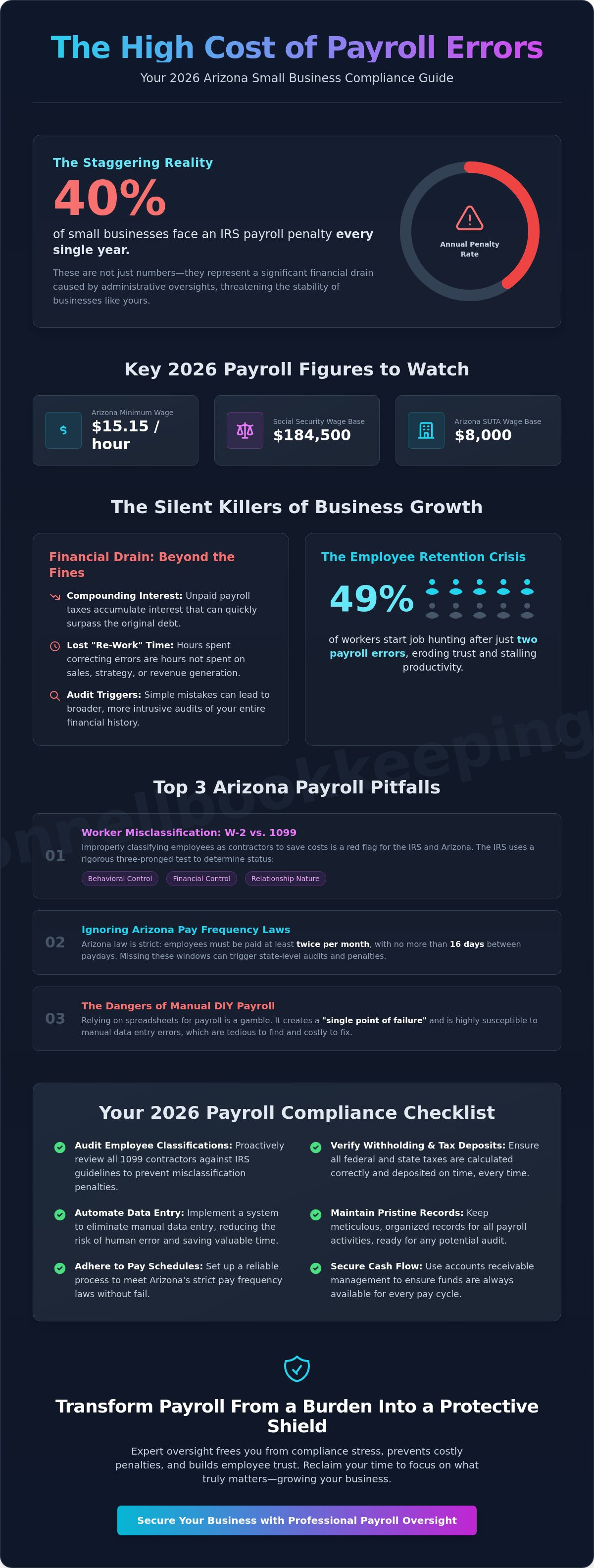
Did you know that the IRS estimates 40% of small businesses pay a payroll penalty every single year? It is a staggering figure that highlights how easily administrative oversight can turn into a financial drain. When you are juggling Arizona's $15.15 minimum wage and the new $184,500 Social Security wage base, the pressure to avoid costly payroll mistakes is higher than ever. You shouldn't have to lose sleep over an IRS audit or wonder if you've misclassified a contractor while wasting hours on manual data entry.
We believe that expert oversight creates the freedom you need to lead with confidence. This comprehensive 2026 payroll compliance guide is designed to protect your business from expensive penalties and prevent the employee turnover that follows incorrect paychecks. We'll walk you through a strategic checklist of Federal and Arizona regulations, ensuring your team stays happy and your books remain pristine. This clarity allows you to reclaim your schedule and focus on the professional growth you deserve.
Key Takeaways
Identify the specific Arizona labor laws and 2026 federal regulations that present the highest risk for compliance audits and financial penalties.
Implement a strategic 10-step checklist designed to help you avoid costly payroll mistakes while ensuring your team remains happy and well-paid.
Understand the hidden opportunity costs of manual data entry and how to eliminate the "single point of failure" risk in your administrative workflow.
Discover why accurate employee classification is the foundation of a healthy business and how to audit your 1099 and W-2 records for total precision.
Learn how professional payroll management transforms a complex back-office burden into a protective shield for your company’s long-term growth.
Table of Contents
Why Payroll Errors are the 'Silent Killers' of Small Business Growth
Payroll is the heartbeat of your business, but it is also a high-stakes compliance web. It sits at the critical intersection of tax law, labor rights, and financial record-keeping. For many local owners, understanding the basics of payroll is the first step toward building a sustainable company. As we move through 2026, the margin for error has vanished. Relying on manual spreadsheets is a dangerous gamble that no longer meets the standard of modern oversight. To avoid costly payroll mistakes, you need a system that adapts to shifting regulations in real time.
When a check is late or incorrect, you pay a "trust tax." This isn't a line item on your ledger, but it's far more expensive than any bank fee. It erodes the confidence your team has in your leadership and creates a distraction that stalls productivity. Accurate payroll management ensures that your data flows seamlessly into your monthly bank reconciliations, providing a clear picture of your cash flow while keeping your team's morale high. This level of organization transforms your back office into a strategic asset.
The Financial Impact: Beyond the IRS Fines
IRS penalties are just the beginning of the financial drain. The true cost of a mistake often compounds through several channels that quietely sap your capital:
Unpaid payroll taxes accumulate interest that can quickly outpace the original debt.
Correcting errors requires "re-work" time that pulls you away from revenue-generating activities.
Inaccurate records can trigger broader audits of your entire financial history.
Every hour you spend digging through old files to correct a mistake is an hour you aren't spending on sales or strategy. To avoid costly payroll mistakes, you must understand how these liabilities affect your overall health. Payroll liability is the total amount of money a business owes to its employees and government agencies for work performed but not yet paid. If this number is inaccurate, your balance sheet is a fiction, making it impossible to plan for future growth.
The Employee Retention Factor
Reliability is your best recruiting tool. Research indicates that 49% of workers start looking for a new job after experiencing just two payroll errors. In the competitive Mesa and Phoenix markets, your reputation as an employer travels fast. If word gets out that your checks are inconsistent, you'll struggle to attract top-tier talent. Professional oversight transforms payroll from a stressful chore into a "culture of reliability." This consistency proves to your team that you value their contribution, which is the foundation of long-term retention and a prosperous business legacy.
The 'Big Three' Payroll Pitfalls in Arizona
Arizona's regulatory environment requires a localized eye that looks beyond federal standards. It isn't enough to follow general IRS guidelines; you must also satisfy the Arizona Department of Revenue and the Industrial Commission of Arizona. To avoid costly payroll mistakes, you need to ensure your cash flow remains predictable and your records stay precise. Maintaining efficient accounts receivable management is the best way to guarantee you have the liquid capital ready for every pay cycle. When your income is steady, you can meet your obligations without the stress of insufficient funds.
Managing a local team involves more than just cutting checks. You're balancing state-specific withholding rates, unemployment insurance (SUTA) wage bases, and strict pay frequency laws. Arizona law mandates that employees be paid at least twice a month, with no more than 16 days between paydays. Missing these windows or miscalculating the 2026 SUTA wage base of $8,000 can trigger audits that disrupt your operations. Strategic oversight prevents these clerical errors from becoming legal liabilities.
Worker Misclassification (W-2 vs. 1099)
Many owners assume hiring contractors is a simpler, more cost-effective path. However, the IRS uses a rigorous three-pronged test focusing on behavioral control, financial control, and the nature of the relationship. If you provide the equipment, set the specific hours, and the work is a core part of your business, the state likely views that person as an employee. Arizona is particularly strict about mislabeling staff. You could face significant back taxes and unpaid workers' compensation premiums if an audit reveals a misclassification. When a freelancer begins working exclusively for your brand or follows your specific daily processes, it's time to transition them to a permanent W-2 role.
Overtime and Minimum Wage Compliance
As of January 1, 2026, the Arizona minimum wage is $15.15 per hour. This is a baseline that every employer must respect to avoid costly payroll mistakes and potential lawsuits. A common "rounding" trap occurs when employers shave minutes off timecards to simplify their math. This practice is a magnet for Fair Labor Standards Act (FLSA) litigation. Additionally, the rise of remote work adds a layer of complexity. If a Phoenix-based employee moves to another state, you might suddenly be responsible for that state's unique labor laws. Proactive tracking of where your work is actually performed ensures you stay compliant across all borders.
Our team acts as a diligent guardian for your business, providing the professional payroll management you need to lead with confidence. By delegating these complexities to an expert partner, you gain the clarity required to focus on your long-term success.
The Hidden Operational Costs of DIY Payroll
DIY payroll often feels like a cost-saving measure, but the hidden drain on your growth is substantial. You must consider the opportunity cost of every hour spent on administrative data entry. If you're handling these tasks yourself, you're sacrificing time that could be spent on strategic expansion or client relationships. To avoid costly payroll mistakes, you need to recognize that your time has a specific dollar value. Offloading this burden to a strategic mentor provides the psychological relief necessary to lead your business with a clear mind and a focused heart.
There is also the risk of a "single point of failure." If only one person in your office understands the manual workarounds used to process pay, your business is vulnerable. If that person leaves unexpectedly, your payroll process collapses, leaving you to scramble through unfamiliar systems. This instability often leads to inaccuracies that eventually require a significant books cleanup project to resolve. Ensuring your payroll is handled by a professional team creates a reliable system that isn't dependent on a single individual's memory.
Data Entry Errors and QuickBooks Sync Issues
Syncing third-party payroll apps with QuickBooks Online is a common source of frustration for many owners. If the mapping isn't perfect, your financial statements will be distorted by duplicate entries or missing tax liabilities. We often see "placeholder" data, such as using "000-00-0000" for Social Security numbers, which triggers immediate red flags with the SSA and IRS. Investing in professional QuickBooks Online Training empowers your team to use the software correctly. This proactive education prevents digital tangles and ensures your data remains transparent and useful for decision-making.
The Audit Trail: Is Your Documentation Defensible?
An IRS auditor looks for more than just proof of payment; they look for a consistent, defensible trail of documentation. You are required to maintain payroll records for at least seven years, including timecards, tax filings, and classification justifications. "Good intentions" aren't a valid defense when you're facing labor law violations. To avoid costly payroll mistakes, your documentation must be meticulous and readily accessible. Having a diligent guardian oversee your records ensures that if an auditor ever knocks, you have the evidence needed to protect your business legacy. This level of preparation turns a potential crisis into a routine confirmation of your integrity.
Your 2026 Payroll Compliance Checklist: 10 Steps to Error-Free Processing
A structured approach is the best defense against administrative chaos. By following a methodical checklist, you transform a reactive chore into a proactive shield for your business assets. To avoid costly payroll mistakes, you must treat compliance as a continuous cycle rather than a once-a-month task. This diligence ensures that your financial records remain transparent and your relationship with the Industrial Commission of Arizona stays positive. Use the following steps to verify your process for the 2026 fiscal year.
Verify Employee Classifications: Audit every 1099 and W-2 annually to ensure workers still meet the IRS "control" criteria.
Update 2026 Tax Rates: Confirm your software reflects the 7.65% FICA rate and the updated $184,500 Social Security wage base.
Implement Digital Time-Tracking: Replace manual logs with a verifiable digital system to eliminate "rounding" errors and potential FLSA disputes.
Review Fringe Benefits: Ensure health insurance premiums and 401k contributions are taxed correctly according to current federal guidelines.
Reconcile Every Cycle: Compare your total payroll liability to actual bank withdrawals immediately after processing to catch discrepancies early.
Check Arizona Minimum Wage: Confirm all staff, including tipped employees, meet the 2026 state minimum of $15.15 per hour.
Monitor SUTA Limits: Track your Arizona unemployment tax payments against the $8,000 wage base for 2026.
New Hire Reporting: Submit required documentation to the state within 20 days of any new hire's start date.
Pay Frequency Audit: Verify that your biweekly or semimonthly schedule never exceeds the 16-day gap mandated by Arizona law.
Secure Record Retention: Organize your digital files to ensure all payroll records are stored safely for the required 7-year period.
Monthly and Quarterly Actions
Consistency is the key to clarity. Every month, you should cross-reference your internal payroll reports with your monthly bank reconciliations to ensure every penny is accounted for. This practice helps you identify uncashed checks or tax deposit timing errors before they trigger an IRS notice. On a quarterly basis, verify that your Form 941 filings align perfectly with your payroll ledger. You should also check for any updated labor posters required by the Arizona Department of Economic Security to keep your physical or digital workspace compliant.
Year-End Preparation
Successful year-end reporting begins in the fall. Confirm employee addresses for W-2 mailing before December 31st to avoid the $340-per-form penalty for incorrect filings. It's also vital to audit PTO accruals to ensure they match your company policy before the new year begins. To avoid costly payroll mistakes during the busiest season of the year, consult with a professional to ensure your QBO file is clean for tax season. If you need a partner to provide the meticulous oversight your business deserves, our payroll management services offer the definitive solution to your administrative stress.
Securing Your Business Legacy with Professional Payroll Oversight
Protecting your business requires more than just reactive record-keeping; it demands a partner who acts as a diligent guardian of your financial health. At McConnell Bookkeeping, we understand that payroll is a strategic shield for your company's reputation and cash flow. Our team provides professional payroll management designed to help you avoid costly payroll mistakes while fostering a culture of reliability for your employees. We utilize a service-to-benefit approach where we handle the intricate complexity of compliance so you gain the clarity and freedom to lead. By entrusting these high-stakes tasks to an expert mentor, you ensure your business legacy is built on a foundation of precision and transparency.
Our expertise is deeply rooted in the Phoenix East Valley, where we serve entrepreneurs in Mesa, Gilbert, Chandler, and Scottsdale. We don't just look backward at history to record what happened in your ledger. We look ahead to identify upcoming regulatory shifts that could impact your bottom line. This proactive partnership transforms your administrative burden into a source of informed confidence, allowing you to focus entirely on the prosperity of your local business. When you have a neighborly expert watching over your books, you can stop worrying about audits and start dreaming about your next stage of growth.
The McConnell Difference: Local Expertise Meets Strategic Insight
National payroll software giants offer automated tools, but they often lack the nuanced local expertise required to navigate Arizona's specific labor landscape. A local partner understands the unique challenges of the Phoenix metro area and provides a level of personal investment that an algorithm cannot replicate. We integrate payroll into your total financial management strategy, ensuring that every pay cycle supports your broader goals. Our meticulous attention to detail protects you from the "silent killers" of growth that we discussed earlier, such as misclassification and documentation gaps. We are committed to the long-term success of our community, treating your business with the same care we give our own.
Take the First Step Toward Peace of Mind
Transitioning from "anxious DIY" to "informed confidence" begins with a thorough review of your current processes. During a payroll process review, we identify existing vulnerabilities and implement the systems needed to avoid costly payroll mistakes before they escalate into legal issues. We help you clean up your digital files and establish a rhythm that guarantees accuracy every single month. This transition liberates you from the mental load of administrative stress, providing the relief that comes from expert oversight. If you are ready to secure your business with a proactive partner, schedule your consultation with McConnell Bookkeeping today and take the first step toward total financial clarity.
Empower Your Growth Through Strategic Compliance
Mastering payroll in 2026 requires more than just accurate math; it demands a deep understanding of Arizona's evolving labor laws and federal requirements. You've learned how worker misclassification and manual data entry errors act as silent killers of small business growth. Implementing a digital, verifiable checklist is the most effective way to protect your cash flow and your professional reputation. By taking these proactive steps today, you can successfully avoid costly payroll mistakes and ensure your employees remain focused, loyal, and well-paid.
You don't have to navigate these administrative complexities alone. McConnell Bookkeeping has served the Mesa, Phoenix, and Scottsdale communities since 2020, providing specialized expertise in QuickBooks Online and Arizona-specific labor compliance. We act as your strategic mentor, handling the technical burden so you can lead with confidence and focus on your business's long-term legacy. Secure your business with professional payroll management from McConnell Bookkeeping. Your path to total financial clarity and peace of mind is just one step away, and we are ready to help your business thrive.
Frequently Asked Questions
What is the most common payroll mistake for small businesses in Arizona?
Misclassifying workers as 1099 contractors instead of W-2 employees is the most frequent error for Arizona employers. This often happens because owners focus on the ease of payment rather than the strict "control" tests mandated by the Industrial Commission of Arizona. Correcting this oversight early helps you avoid costly payroll mistakes that lead to back taxes and unpaid workers' compensation premiums.
How much does the IRS charge in penalties for late payroll tax deposits?
IRS failure-to-deposit penalties range from 2% to 15% of the unpaid tax amount depending on how late the deposit is made. Deposits 1 to 5 days late incur a 2% penalty, while those over 15 days late reach 10%. If you fail to pay within 10 days of receiving an IRS notice, the penalty increases to 15%, potentially costing your business thousands in unnecessary fees.
Can I use QuickBooks Online to handle all my payroll compliance?
QuickBooks Online is a powerful tool for processing, but it requires professional configuration to ensure total compliance with Arizona-specific laws. While the software automates calculations, it doesn't automatically audit your employee classifications or verify that your benefit deductions are taxed correctly. Expert oversight ensures the data within your software remains accurate and defensible during an audit.
What is the difference between a 1099 contractor and a W-2 employee in 2026?
The primary difference lies in the level of behavioral and financial control you exert over the worker. In 2026, the IRS and Arizona authorities look at whether you set the worker's schedule, provide their tools, and if the work performed is a core part of your daily operations. W-2 employees receive benefits and tax withholdings, while 1099 contractors operate as independent businesses responsible for their own taxes.
How long should I keep payroll records for my Mesa-based business?
You should maintain all payroll records for at least seven years to satisfy both IRS and Arizona state requirements. This includes timecards, tax filings, W-2 copies, and proof of deposits. Keeping these documents organized in a digital format ensures you have a defensible audit trail if a government agency ever requests a review of your historical financial data.
Is it cheaper to outsource payroll or do it in-house?
Outsourcing often proves more cost-effective when you factor in the opportunity cost of your time and the potential for expensive penalties. While in-house processing seems cheaper on paper, a single error costs an average of $291 to correct according to industry research. Professional management allows you to reclaim dozens of hours each year, which you can reinvest into revenue-generating activities.
What happens if I accidentally underpay an employee's overtime?
You must correct the underpayment immediately and issue a supplemental check to the employee to avoid potential litigation. Under Arizona law, failing to pay full wages can result in treble damages, meaning you could be forced to pay three times the original amount owed. Documenting the correction process shows a good-faith effort to maintain accuracy and protect your business legacy.
How does Arizona's minimum wage law affect my payroll processing?
Arizona's 2026 minimum wage of $15.15 per hour serves as a mandatory floor that influences your entire pay scale and tax liability. You must ensure all hourly staff meet this requirement, including tipped employees who must earn at least $12.15 per hour. This baseline affects your FICA and SUTA contributions, making precise calculations essential to avoid costly payroll mistakes during your quarterly filings.


Comments