How Bad Bookkeeping Can Kill a Business: 5 Dangerous Myths Debunked

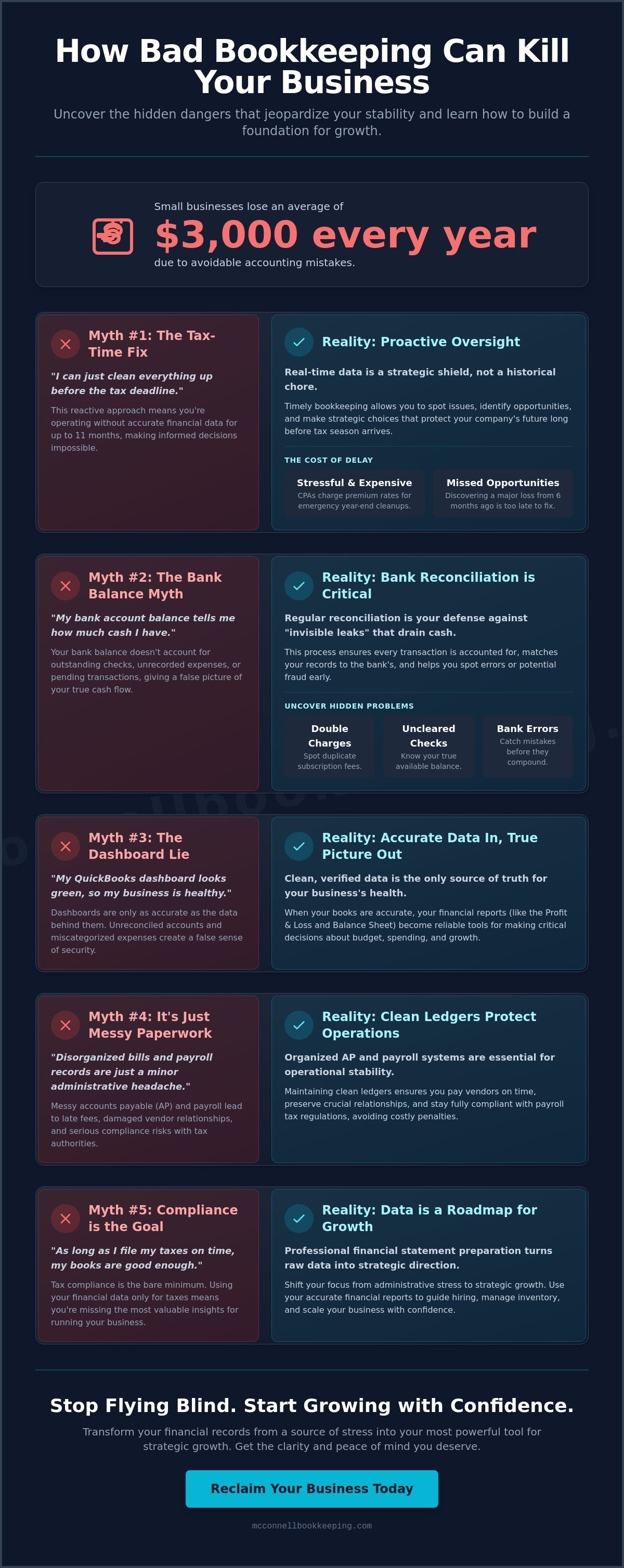
Is your bank balance telling you the whole truth, or is it hiding a silent crisis? It is a sobering reality that small businesses lose an average of $3,000 every year simply due to avoidable accounting mistakes. You likely started your company to pursue a passion, not to spend your weekends untangling QuickBooks errors or dreading a potential IRS audit. It's completely natural to feel a sense of anxiety when your bank statement doesn't align with your actual cash flow, especially as critical tax deadlines loom on the horizon.
Understanding exactly how bad bookkeeping can kill a business is the first step toward reclaiming your peace of mind and protecting your legacy. This article explores how to identify hidden errors that jeopardize your stability and provides a clear path to transform your financial records into a strategic tool for growth. We are debunking five dangerous myths that keep entrepreneurs stuck in a cycle of uncertainty. By shifting from reactive record-keeping to proactive oversight, you can replace confusion with the clarity needed to scale your business with confidence.
Key Takeaways
Waiting for tax season to organize your records leads to reactive management. Learn why real-time data is essential for making strategic choices that protect your company's future.
Monthly bank reconciliations provide a critical defense against hidden cash leaks. This process ensures every transaction is accounted for while helping you spot potential fraud early.
Uncover how bad bookkeeping can kill a business by creating a false sense of security through inaccurate dashboard balances.
Messy accounts payable and payroll records do more than just clutter your desk. Discover how maintaining clean ledgers preserves your vendor relationships and ensures you stay compliant with payroll regulations.
Shift your focus from administrative stress to strategic growth. Professional financial statement preparation turns your raw data into a clear roadmap for long-term success.
Table of Contents
Myth vs. Reality: Why "I’ll Fix It at Tax Time" is a Fatal Strategy
The Invisible Leak: How Poor Bank Reconciliations Drain Your Cash Flow
Debunking the "Bank Balance" Myth: Why Your QuickBooks Dashboard Might Be Lying
Beyond the Ledger: The Operational Impact of Messy Accounts Payable and Payroll
Reclaiming Your Business: How Professional Oversight Turns Financial Data into Growth
Myth vs. Reality: Why "I’ll Fix It at Tax Time" is a Fatal Strategy
Many entrepreneurs treat financial record-keeping as a historical chore rather than a survival system. They believe they can simply "catch up" before the filing deadline, but this delay is a primary reason how bad bookkeeping can kill a business. In reality, bad bookkeeping is defined as the absence of timely, accurate financial data. When you lack a clear view of your numbers for eleven months of the year, you're essentially flying blind. You cannot make informed decisions about hiring, inventory, or expansion if your data is half a year old.
Adopting a proactive mindset is the only way to ensure long-term stability. Instead of viewing your ledger as a box to check for the IRS, see it as a shield that protects your company's future. Accurate bookkeeping provides the transparency needed to identify waste and capitalize on opportunities before they vanish. It moves you from a state of constant administrative worry to a position of strategic authority.
To better understand the specific errors that can lead to a business collapse, watch this helpful video:
The High Cost of Reactive Accounting
Waiting until the end of the year creates a "Tax-Time Cleanup" trap that is both stressful and expensive. CPAs typically charge premium rates for emergency year-end cleanups because they must reconstruct months of data under tight deadlines. It's incredibly disheartening to discover in April that your business suffered a significant loss back in September that could have been corrected with better oversight. Investing in a professional books cleanup now prevents these costly surprises. This service reconciles your past accounts, which immediately transforms your messy records into a reliable foundation for future growth.
Compliance is the Floor, Not the Ceiling
There is a vast difference between simply "doing taxes" and actively managing a business. Compliance is the bare minimum required to stay in operation. In Arizona, the deadlines are strict; S-Corporations and Partnerships must file by March 16, 2026, while C-Corporations and Sole Proprietorships have until April 15. If your records are in disarray, you risk failure-to-file penalties of 5% of the unpaid tax for each month you're late. Beyond avoiding the IRS, bookkeeping serves as a real-time diagnostic tool for growth. It ensures your 1099 reporting is accurate and your payroll tax liabilities are funded, allowing you to focus on your vision without the fear of an unexpected audit.
The Invisible Leak: How Poor Bank Reconciliations Drain Your Cash Flow
Cash flow is the lifeblood of any enterprise, yet many owners operate with a distorted view of their available funds. Understanding how bad bookkeeping can kill a business starts with recognizing the "invisible leaks" that occur when your bank statements don't match your records. In the fast-paced Mesa business environment, where the timing of payments can make or break your week, relying on unverified numbers is a dangerous gamble. Learning how to effectively manage your finances is a core skill that transforms your ledger from a source of stress into a tool for survival.
When you neglect regular reconciliations, unrecorded expenses and "ghost" income begin to cloud your financial reality. You might believe you have a surplus based on your bank balance, only to realize later that several large checks haven't cleared or a recurring subscription has been double-charged. This lack of clarity prevents you from seeing the true health of your company. Utilizing a professional monthly bank rec service ensures that every transaction is verified, which provides the emotional relief of knowing your cash flow is actually what you think it is.
Identifying Fraud and Bank Errors Before They Compound
Errors aren't always internal; banks and vendors make mistakes too. Without a diligent guardian reviewing your accounts, these discrepancies can go unnoticed for months. Common issues that a professional reconciliation process identifies include:
Duplicate vendor charges for a single service or product.
Incorrect bank fees or interest calculations that chip away at your balance.
Unauthorized transactions or fraudulent checks that look legitimate at a glance.
Canceled checks that were accidentally processed by the financial institution.
Timing is everything when it comes to recovery. If you wait 90 days to spot a bank error or a fraudulent charge, the window for disputing the transaction often closes, making recovery nearly impossible. Proactive oversight catches these anomalies within the same month they occur, which protects your capital and keeps your records pristine.
The Strategic Value of Accurate Cash Flow Forecasting
Clean books do more than satisfy the IRS; they empower you to look forward. As a neighborly expert in your corner, a bookkeeper helps you spot spending trends that might otherwise stay hidden. When your books are reconciled, you can create accurate forecasts that allow you to plan for future hiring or new equipment purchases without fear. This level of insight helps Scottsdale businesses scale confidently because they aren't guessing about their runway. Maintaining clear, professional financial statements turns your raw data into a strategic roadmap, ensuring you have the clarity needed to lead your business toward long-term prosperity.
Debunking the "Bank Balance" Myth: Why Your QuickBooks Dashboard Might Be Lying
Your QuickBooks dashboard offers a tempting shortcut to financial awareness, but that "Bank Balance" number is often a dangerous illusion. Many owners mistake their digital balance for their actual spending power, forgetting that the software only knows what has been imported or manually entered. This disconnect is a primary example of how bad bookkeeping can kill a business. If you make a major purchase based on a dashboard number that hasn't accounted for yesterday's payroll run, you risk a cascade of bounced payments and damaged credit. To avoid these pitfalls, you must maintain proper bookkeeping practices that distinguish between what the bank says and what your books prove.
The "Book Balance" represents your true financial standing after accounting for every obligation you've committed to, whether the bank has processed them or not. When these two numbers don't align, you lose the ability to forecast accurately. This is why specialized QuickBooks training for business owners is so vital. Learning to navigate the software correctly ensures that your data entry reflects reality, which empowers you to lead with confidence rather than guesswork.
Outstanding Checks and Pending Deposits
The "available balance" in your banking app doesn't understand your future obligations. It cannot see the check you mailed to a vendor this morning or the tax payment scheduled for next week. Relying on this incomplete data creates a false sense of security. The following table illustrates how dashboard discrepancies can lead to critical errors:
Relying on phantom profit leads to overspending on non-essential assets while your actual liabilities remain unpaid. This cycle of financial "ghosting" eventually catches up to the owner, often at the most inconvenient time possible.
The Danger of Misclassified Transactions
Data entry errors do more than just mess up your balance; they ruin your ability to measure true profitability. A common mistake is classifying a loan principal payment as an expense. While it feels like money leaving the business, it actually belongs on your balance sheet, not your profit and loss statement. Misclassifying these transactions makes your business look less profitable than it is, which can lead to a loan denial when you need capital to grow. For specialized industries, monitoring dental practice financial metrics requires even more precision to ensure overhead is tracked correctly. Clean data entry ensures your financial statements are "bank-ready," allowing you to secure financing with ease whenever an opportunity for expansion arises.
Beyond the Ledger: The Operational Impact of Messy Accounts Payable and Payroll
Messy financial records create friction that extends far beyond your computer screen. When your internal systems are in disarray, the resulting operational chaos can poison your most critical professional relationships. This external fallout is a subtle yet devastating way how bad bookkeeping can kill a business. Trust is hard to earn and easy to lose. If you cannot pay your suppliers on time or if your staff's checks are inconsistent, you aren't just failing an administrative task; you're eroding the foundation of your company.
Operating as a strategic mentor, a professional bookkeeper helps you look past the basic math to see the human and operational costs of disorganization. Meticulous records ensure that every vendor and employee is treated with the respect they deserve. This proactive oversight prevents the "fire drill" mentality that often leads to rushed, expensive mistakes during the 2026 tax season.
Vendor Trust and Credit Worthiness
Maintaining clean accounts payable records allows you to leverage your cash position strategically. When your books are organized, you can easily identify which vendors offer incentives for prompt payment. Missing a 2% discount on a large invoice might seem small at the moment, but these missed opportunities compound over a year into thousands of dollars in lost capital. Furthermore, consistent payment delays damage your business credit profile, which makes it significantly harder to secure favorable terms or future financing in the competitive Phoenix market. Professional AP management keeps your operations running smoothly by ensuring your supply chain remains uninterrupted and your creditworthiness stays intact.
Payroll Accuracy as an Employee Retention Strategy
Payroll accuracy serves as the bedrock of a healthy workplace culture. In the complex Arizona regulatory landscape, guessing at payroll taxes or missing specific filing deadlines can lead to severe penalties. For returns required to be filed in 2026, the IRS failure-to-pay penalty is 0.5% of the unpaid taxes for each month they remain unpaid. Beyond the financial cost, payroll errors destroy employee morale and lead to high turnover. Choosing outsourced payroll processing eliminates this administrative stress, ensuring your team is paid correctly and on time, every time. This precision fosters loyalty and allows you to focus on leading your practice rather than untangling tax forms.
To protect your professional reputation and ensure your team remains focused on growth, consider how professional payroll management can transform your daily operations from a source of stress into a streamlined asset.
Reclaiming Your Business: How Professional Oversight Turns Financial Data into Growth
The journey from administrative stress to informed confidence begins with a single decision to prioritize financial clarity. While understanding how bad bookkeeping can kill a business serves as a vital wake-up call, the ultimate goal is transformation. You didn't start your company to be buried in receipts or to wake up at 3:00 AM wondering if you've missed a tax deadline. Shifting this burden to a professional allows you to reclaim your time and redirect your energy toward the high-level tasks that actually generate revenue. Experience the relief that comes with peace of mind bookkeeping services, where your records are handled with the precision your hard work deserves.
Clean, professional financial statements do more than just sit in a folder; they act as a "service-to-benefit" engine for your company. For example, monthly financial statement preparation provides the actionable insights you need to cut unnecessary overhead, which immediately increases your take-home profit. For law and dental practices, this oversight is even more critical. A bookkeeper acts as a proactive partner, ensuring IOLTA compliance or tracking specific practice metrics that indicate whether your chair time is truly profitable. This level of detail transforms your raw data into a strategic roadmap for the future.
Preparing for Loans and Expansion
When you walk into a bank in Mesa to discuss a line of credit or an expansion loan, the manager looks for one thing: reliability. They want to see a balance sheet and profit and loss statement that are current, reconciled, and accurate. Clean books are the first requirement for any professional business valuation. If your records are a mess, a lender or potential buyer will see your business as a high-risk gamble rather than a solid investment. Accurate reporting enables your bookkeeper to provide strategic mentorship, helping you understand your debt-to-income ratio and your true capacity for growth before you sign a new lease or purchase expensive equipment.
The Path Forward: From Cleanup to Clarity
Moving from messy records to a streamlined system is a methodical process that starts with a thorough review. A diligent guardian looks at your historical data to identify where the leaks are occurring and then implements a structure that prevents them from returning. This transition follows a logical path:
Cleanup: Reconciling backlogged transactions to establish a reliable starting point.
Maintenance: Implementing monthly bank reconciliations to ensure ongoing accuracy.
Reporting: Generating clear financial statements that highlight your strengths and weaknesses.
Growth: Using that data to make informed, proactive decisions for the upcoming year.
You don't have to navigate this transition alone. To secure your company's future and replace uncertainty with clarity, contact McConnell Bookkeeping for a professional bank reconciliation review today. Let us handle the meticulous details so you can focus on the prosperity of your business.
Secure Your Legacy with Financial Clarity
You've seen the risks of reactive accounting and the hidden leaks that emerge when bank reconciliations are neglected. Understanding how bad bookkeeping can kill a business is the first step toward building a more resilient, profitable enterprise. By replacing dashboard myths with reconciled reality, you gain the strategic insight needed to scale with confidence. Whether you're managing a growing law practice or a busy dental office, your financial data should be a source of strength, not a cause for administrative stress.
Since 2020, we've served businesses across Mesa, Phoenix, and Scottsdale with a commitment to meticulous detail and local pride. Our QuickBooks Online ProAdvisor expertise and specialized experience in law and dental practice bookkeeping ensure your records are in safe, capable hands. It's time to stop guessing about your bank balance and start leading with transparency. Your vision deserves a solid foundation; let's build it together.
Frequently Asked Questions
How can bad bookkeeping lead to business failure?
Bad bookkeeping leads to failure by obscuring your actual cash position, which results in missed payroll, unpaid taxes, and poor strategic choices. Without accurate data, you might overspend during a period of phantom profit, only to find your reserves are empty when critical bills arrive. This lack of visibility is a primary reason how bad bookkeeping can kill a business by draining capital before you can react to a crisis.
What are the most common bookkeeping mistakes for small businesses?
The most frequent errors include failing to reconcile bank accounts monthly and mixing personal and business expenses. Many owners also misclassify transactions, such as recording loan principal payments as expenses rather than liability reductions. These mistakes distort your financial statements, making it impossible to judge your true overhead or prepare for expansion with any degree of certainty.
Can I fix my own bad bookkeeping if I use QuickBooks Online?
While you can attempt to correct entries yourself, DIY fixes often create deeper issues like duplicate transactions or broken opening balances. QuickBooks Online is a powerful tool, but it requires professional configuration to ensure data integrity. Most owners find that specialized training or a professional books cleanup is necessary to move from messy records to a reliable, growth-oriented system that actually serves the business.
How do I know if my current bookkeeping is "bad" or just behind?
Your bookkeeping is "bad" if your bank balance doesn't match your book balance or if you cannot produce an accurate profit and loss statement on demand. Being "behind" simply means you have unentered data, but "bad" bookkeeping involves structural errors and misclassifications that hide the truth. If you feel a sense of anxiety whenever tax deadlines approach, it's a clear sign that your system needs professional oversight.
What is the first step to cleaning up messy business books?
The first step is performing a comprehensive bank reconciliation for every account to identify exactly where your records diverged from reality. This process involves comparing your internal ledger against bank statements to catch unrecorded checks, bank fees, and missing deposits. Once you establish a clean starting point, you can implement a structured monthly schedule to maintain that clarity and prevent future disarray.
How much does bad bookkeeping actually cost a business in the long run?
Small businesses lose an average of $3,000 per year due to simple bookkeeping mistakes and missed deductions. Beyond that, the long-term costs include IRS penalties, which can reach 25% for failure to file or pay, and the high price of emergency year-end cleanups. These avoidable expenses represent capital that could have been reinvested into hiring or new equipment to scale your operations.
Do I need a bookkeeper if I already have a CPA for taxes?
Yes, because a bookkeeper manages your daily financial health while a CPA typically focuses on annual compliance and tax strategy. A bookkeeper provides the real-time data you need to run your company, ensuring your records are "tax-ready" before they ever reach your CPA's desk. This partnership significantly reduces your tax preparation fees and gives you a strategic mentor for year-round decision-making.
What are the consequences of poor bookkeeping for an Arizona law practice?
For law practices, poor bookkeeping can lead to severe ethical and legal consequences, particularly regarding IOLTA trust account management. Mismanaging client funds or failing to perform mandatory three-way reconciliations can result in State Bar audits or even the loss of your license. Maintaining meticulous records is the only way to ensure compliance with strict Arizona trust accounting rules while protecting your professional reputation and your clients' interests.


Comments