Full Cycle Bookkeeping for Small Business: The Strategic Guide to Financial Clarity in 2026

Did you know that 60% of small business owners feel they aren't knowledgeable about accounting? This gap in confidence often leads to a feeling of being "blind" regarding actual cash flow, especially when QuickBooks bank feeds don't seem to match the reality of your bank account. Establishing a consistent process for full cycle bookkeeping for small business solves this frustration by creating a transparent record of every dollar. By mastering this complete loop, you turn chaotic daily transactions into strategic insights that empower your growth.
You deserve the clarity that comes from a clean, predictable financial process. We understand that the anxiety of year-end tax readiness can weigh heavily on your mind, but accurate monthly reports can replace that stress with confidence. This guide provides a strategic roadmap to help you achieve financial clarity in 2026. We'll walk through the essential stages of the bookkeeping cycle, ensuring you have the data needed to make informed hiring and spending decisions while keeping your books perfectly tax-ready.
Key Takeaways
Mastering the loop of full cycle bookkeeping for small business provides a continuous flow from daily transactions to reliable financial statements.
Navigating the four strategic phases of financial management allows you to move beyond simple data entry into meaningful growth analysis.
Implementing professional oversight prevents the "garbage in, garbage out" trap often found in automated cloud accounting.
Executing a comprehensive books cleanup restores integrity to your financial history so you can build a predictable future.
Closing the financial loop with expert reconciliations ensures your business remains tax-ready and strategically focused.
Table of Contents
What is Full Cycle Bookkeeping for Small Business?
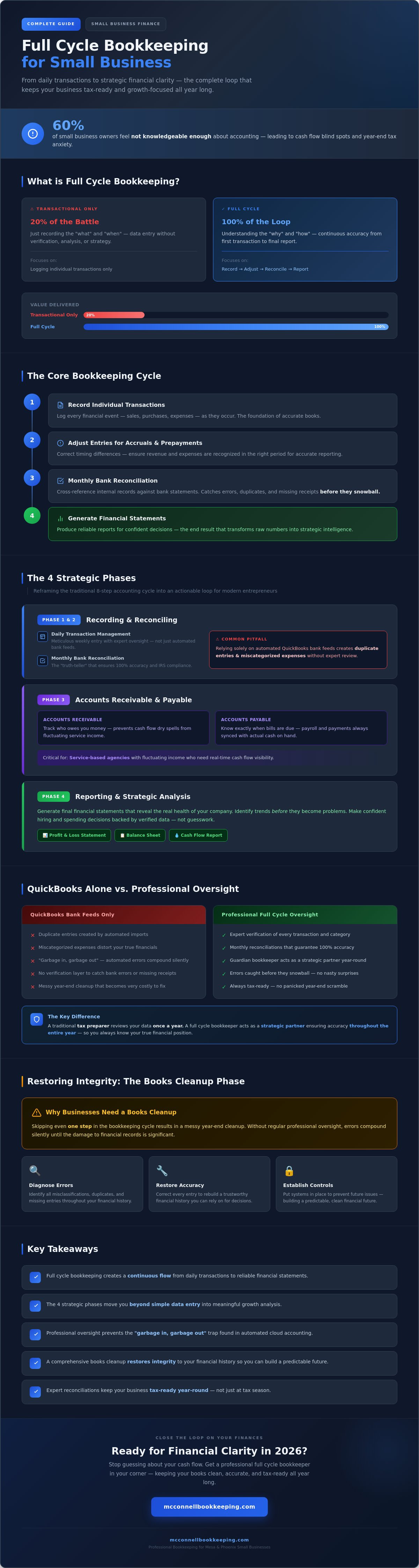
Full cycle bookkeeping for small business represents the complete journey of a financial transaction, from the initial receipt to the final year-end report. It isn't just about logging expenses; it's about maintaining a continuous loop of accuracy. While transactional bookkeeping focuses on the "what" and "when," full cycle oversight prioritizes the "why" and "how." This comprehensive approach ensures every entry supports your long-term business strategy. A standard cycle typically involves:
Recording individual transactions as they occur.
Adjusting entries for accruals or prepayments.
Performing monthly bank reconciliations to verify accuracy.
Generating final financial statements for review.
A diligent guardian bookkeeper does more than just categorize bank feeds. They verify data, manage monthly bank reconciliations, and prepare the financial statements you need to make confident decisions. This differs significantly from a traditional tax preparer who typically looks at your data once a year. By following standard methods of bookkeeping, a full cycle professional transforms raw numbers into a clear roadmap for growth. They act as a strategic partner, ensuring your records are accurate throughout the entire year rather than just during tax season.
To better understand how these financial pieces fit together, watch this helpful breakdown of the process:
The Difference Between Bookkeeping and the Accounting Cycle
Bookkeeping is the essential act of recording daily activity. The accounting cycle, however, includes the critical steps of verification, adjustment, and reporting. For many businesses in Mesa, simply recording a transaction is only 20% of the battle. The real value lies in the remaining 80%, where those records are reconciled and analyzed. When you implement full cycle bookkeeping for small business, you move from simple data entry to genuine financial intelligence. This transition allows you to see the health of your company in real time, making it easier to identify trends before they become problems.
Why "Full Cycle" Matters for Service-Based Agencies
Service agencies often struggle with fluctuating income. Professional accounts receivable and accounts payable management prevents those stressful cash flow dry spells. When you follow the entire cycle, you gain a clear view of who owes you money and when your own bills are due. This level of organization is vital for local Phoenix business growth. Skipping even one step in the cycle usually results in a messy year-end cleanup that could have been avoided with proactive oversight. A complete loop ensures that your payroll management and bill payments are always synchronized with your actual cash on hand.
The 4 Phases of the Small Business Strategic Loop
Traditional accounting textbooks often describe the accounting cycle as a rigid eight-step process filled with trial balances and ledger adjustments. For a modern entrepreneur, this feels overly technical and detached from daily operations. We've reframed these academic steps into four digestible phases that form a strategic loop for your company. This loop ensures that full cycle bookkeeping for small business stays focused on providing clarity rather than just checking boxes.
Phase 1 & 2: Recording and Reconciling
Establishing a solid foundation begins with meticulous daily and weekly transaction management. It's tempting to rely solely on automated QuickBooks bank feeds, but without expert oversight, these feeds often create duplicate entries or miscategorized expenses. Good records serve as the backbone of your financial health and are essential for maintaining IRS compliance. Utilizing professional monthly bank rec services acts as the ultimate truth-teller for your business books. Bank reconciliation is the process of cross-referencing internal records against bank statements to ensure 100% accuracy. This verification step catches bank errors and missing receipts before they snowball into year-end disasters.
Phase 3 & 4: Managing Operations and Generating Reports
Once your foundation is secure, we move into the operational adjustments phase. This stage involves managing your accounts payable and ensuring your customers fulfill their obligations. Integrating accounts receivable services in Mesa ensures you actually get paid for the value you provide. For Arizona teams, payroll management must also fit seamlessly into this monthly cycle to keep your staff satisfied and your tax obligations met. The loop concludes with the financial reporting and closing phase. This produces the "Big Three" reports: the Profit & Loss statement, the Balance Sheet, and the Cash Flow Statement. These documents provide the strategic insight needed to decide when to hire new talent or invest in capital equipment. If your current system lacks this level of detail, our monthly reconciliation support can help restore the precision you need.
QuickBooks Online vs. Professional Oversight: The Reality Check
Many entrepreneurs assume that subscribing to QuickBooks Online means their accounting is automatically handled. This is a dangerous misconception. Software is a powerful engine, but it requires a skilled driver to reach the correct destination. While cloud solutions automate data entry, they don't automate the critical thinking required for full cycle bookkeeping for small business. Relying solely on an automated algorithm often results in the "Garbage In, Garbage Out" phenomenon, where messy data entry leads to unreliable financial reports.
When you're first establishing your company, understanding the basics of how small businesses can set up an accounting system provides helpful context for your operations. However, maintaining that system requires ongoing professional vigilance. A strategic mentor offers insight that software simply cannot replicate, helping you interpret data to drive growth rather than just recording history.
Common QuickBooks Pitfalls for Phoenix Owners
Phoenix business owners frequently fall into the "Ask My Accountant" black hole. This happens when expenses aren't categorized properly, leaving a pile of mystery transactions that create a massive headache at year-end. Another common issue involves duplicate income entries. This occurs when bank feed rules are set up incorrectly, counting both the invoice payment and the bank deposit as separate income events. Perhaps most dangerous is the habit of clicking "reconcile" in QuickBooks without actually comparing the software balance to a physical bank statement. This creates a false sense of security while the actual books drift further from reality.
The ROI of Outsourced Full Cycle Management
The transition from DIY management to professional oversight offers a measurable return on investment. For a typical Mesa business owner, outsourcing these tasks can save between 10 to 20 hours every month. This time is better spent on high-level growth strategies or client acquisition. Beyond time, expert oversight acts as a safety net. A professional catches a misposted expense before it turns into a major tax or cash flow problem. When you commit to full cycle bookkeeping for small business through a professional partner, you aren't just buying reports. You're buying the "relief factor" that allows you to move away from administrative stress and reclaim your role as a focused CEO.
Restoring Integrity: The Essential Books Cleanup Phase
Attempting to implement a strategic loop on a foundation of historical errors is a recipe for continued confusion. You simply cannot launch a successful routine of full cycle bookkeeping for small business if your previous six months of data are inaccurate. Financial clarity requires a clean slate. Historical discrepancies act like anchors, dragging down the accuracy of your current reports and making it impossible to see your true profit margins. Our approach focuses on identifying these legacy issues and rectifying them before they impact your 2026 growth plans.
A meticulous books cleanup transforms your financial records from a source of anxiety into a reliable asset. We look for specific red flags that indicate your QuickBooks file has drifted from reality. This proactive oversight ensures that every transaction is accounted for and correctly categorized. By preparing your data for a clean transition, you establish the integrity needed for monthly reporting that actually means something. This isn't just about fixing old mistakes; it's about liberating your business from the weight of administrative debt.
Signs Your Small Business Needs a Books Cleanup
Identifying the need for intervention early saves significant time and resources. One major red flag is a balance sheet that shows negative amounts in bank accounts that currently hold a positive cash balance. This usually indicates missing deposits or duplicated expenses. Similarly, if your records still show old, un-cleared checks or deposits from 2024, your reconciliation process has likely broken down. A professional cleanup restores the data integrity required for accurate tax-ready financials, providing the diligent guardian oversight your company deserves.
Unreconciled bank accounts spanning multiple months or years.
Large balances sitting in "Uncategorized Expenses" or "Ask My Accountant."
Inconsistent payroll entries that don't match actual bank withdrawals.
The Process: From Chaos to Compliance
Our systematic process moves your business from financial chaos to total compliance. We begin by gathering historical bank statements and vendor records to verify every entry against your ledger. Correcting past categorization errors is vital because it allows for meaningful year-over-year comparisons. Without this historical accuracy, you won't know if your 2026 performance is truly improving or if the numbers are simply skewed. Achieving a "fresh start" in Mesa provides the peace of mind that your books are finally standing on solid ground. If you're ready to clear the fog and regain control, our comprehensive books cleanup service is the definitive first step toward financial liberation.
How McConnell Bookkeeping Closes the Loop for You
McConnell Bookkeeping acts as the diligent guardian of your financial health, ensuring every transaction supports your long-term vision. We move beyond simple data entry to provide a comprehensive system of full cycle bookkeeping for small business that empowers your daily decision-making. Our team focuses on meticulous monthly bank reconciliations to ensure your records remain a definitive source of truth. By managing your accounts receivable and accounts payable, we liberate you from the administrative stress of tracking payments and managing vendor relationships. This methodical approach transforms your raw financial data into a strategic roadmap for sustainable growth.
We understand that some business owners prefer to remain hands-on with their software. To support this, we offer customized QuickBooks Online training designed to help your team maintain high standards between our professional reviews. This collaborative relationship ensures that your daily activities align perfectly with your broader financial goals. Transitioning from messy books to strategic growth requires a partner who proactively looks ahead to identify opportunities for efficiency. We provide the clarity and transparency needed to scale your operations with the confidence that your financial foundation is secure.
A Local Partner for Mesa, Phoenix, and Beyond
Local expertise provides a significant advantage for service-based businesses in the East Valley. We understand the specific operational needs of Phoenix and Mesa entrepreneurs, offering a neighborly expert persona that makes complex financial management feel approachable and personal. While our services do not include income tax return filing or certified audits, we work seamlessly with your tax CPA to ensure they receive clean, accurate data at year-end. This proactive partnership reduces your tax preparation fees and eliminates the anxiety of missing deadlines or discovering errors during tax season.
Your Next Steps to Financial Freedom
Reclaiming your time and focus starts with a clear, logical path forward. Our initial consultation involves a thorough assessment of your current bookkeeping health to identify immediate red flags or gaps in your process. We then implement a structured transition plan that begins with a historical books cleanup to restore data integrity. Once your historical records are accurate, we establish a professional system setup and move into the steady, reassuring rhythm of the monthly cycle. This progression moves you from a state of uncertainty to a state of informed confidence. If you're ready to experience the relief that comes from expert oversight, schedule your QuickBooks consultation with McConnell Bookkeeping today.
Step Into a New Era of Financial Intelligence
Achieving financial clarity requires moving beyond simple data entry and embracing a complete accounting loop. By integrating professional oversight with your daily operations, you transform raw transactions into a powerful roadmap for your company's future. We've explored how a meticulous books cleanup provides the essential fresh start you need to restore integrity to your records. Implementing a consistent system of full cycle bookkeeping for small business ensures that every financial decision you make is backed by accurate, real-time data.
As a QuickBooks Online Certified ProAdvisor specialized in complex books cleanup, we serve as the diligent guardian for entrepreneurs in Mesa, Phoenix, and across the East Valley. We handle the heavy lifting of bank reconciliations, payroll, and operational management so you can reclaim your focus as a CEO. You don't have to navigate the complexities of 2026 alone when you have a strategic mentor in your corner. Ready for financial clarity? Let McConnell Bookkeeping manage your full cycle today.
Your business deserves the peace of mind that comes from expert oversight and clean, predictable financials. We're here to help you turn your bookkeeping into your greatest competitive advantage.
Frequently Asked Questions
What is the difference between full cycle bookkeeping and monthly bookkeeping?
Full cycle bookkeeping for small business encompasses the entire accounting loop, from recording the initial transaction to the final financial statement preparation. Monthly bookkeeping sometimes refers only to periodic check-ins or simple data entry. By managing the full cycle, we ensure that every ledger entry is verified and reconciled, turning raw data into strategic insight for your company.
How long does it take to complete a full accounting cycle each month?
The time required depends on your transaction volume and the complexity of your daily operations. Most owners find that managing the cycle themselves consumes 10 to 20 hours per month. Outsourcing this task to a professional partner liberates that time, allowing you to focus on high-level CEO activities and strategic business growth.
Do I need a CPA for full cycle bookkeeping, or is a bookkeeper enough?
A professional bookkeeper is perfectly equipped to handle the full accounting cycle and daily financial management. While CPAs are essential for income tax return filing and high-level tax strategy, a bookkeeper serves as your daily strategic mentor. This partnership ensures your records are meticulous and ready for your CPA when tax season arrives.
Can I do full cycle bookkeeping myself using QuickBooks Online?
You can use QuickBooks Online to manage your books, but the software doesn't replace the need for professional judgment. Many entrepreneurs find that "automated" bank feeds often create duplicate income or uncategorized expenses. Investing in QuickBooks Online training or professional oversight prevents these common pitfalls and ensures your data integrity remains intact.
What happens if I skip the reconciliation step in the cycle?
Skipping the reconciliation step causes your financial records to drift away from your actual bank balance. This lack of oversight leads to missed expenses and duplicate entries, which eventually results in a messy year-end books cleanup. Closing the loop with monthly bank reconciliations is the only way to guarantee your reports reflect financial reality.
Is accounts payable management included in full cycle services?
Accounts payable management is a vital part of the comprehensive bookkeeping loop we provide. Tracking what you owe and when it's due prevents cash flow dry spells and protects your relationships with vendors. This proactive oversight ensures your business remains a reliable partner in the local Mesa and Phoenix community.
How does full cycle bookkeeping help with my small business taxes?
It transforms tax season from a period of anxiety into a routine administrative step. By maintaining full cycle bookkeeping for small business, you ensure that every deduction is captured and every statement is reconciled. Your CPA receives a clean file, which minimizes their billable hours and maximizes your total tax-readiness.
What information do I need to provide to a bookkeeper for the full cycle?
You should provide access to your bank and credit card statements along with any relevant vendor invoices or payroll reports. Sharing documentation for your accounts receivable ensures that your income is recorded accurately. This transparency allows your bookkeeper to act as a diligent guardian of your overall financial health.


Comments