Financial Systems for a Growing Business: Build a Stronger Foundation

More software won’t fix financial workflows that aren’t repeatable. As transactions multiply, financial systems for a growing business need to do more than collect numbers: they must keep records current and make cash and performance easier to understand. If your books are falling behind or reports don’t feel dependable, identify which process needs attention before buying another tool.
Growth brings more moving parts, but clarity doesn’t have to get lost in the handoffs. A strong foundation starts with consistent routines for recording, reconciling, and reviewing transactions, then adds tools where they genuinely help. For a small business in Mesa, Phoenix, Gilbert, Tempe, Chandler, or Scottsdale, that could mean ensuring sales, payments, payroll, and bank activity are accurately reflected in the books before expanding the software stack.
In this article, you’ll learn how to build repeatable bookkeeping and reporting workflows that keep pace with growth, strengthen your view of cash and business performance, and free up time without giving up oversight. We’ll cover which records and routines to establish first, how reconciliations and financial statements support clearer visibility, and when QuickBooks Online training or ongoing bookkeeping support can help.
Table of Contents
What Financial Systems for a Growing Business Actually Include
A financial system is more than accounting software. It’s the people, routines, records, and tools that work together to keep money-related activity organized and make reliable information available. For financial systems for a growing business, the goal is a consistent path from each transaction to clear, useful reports.
Bookkeeping is a core part of that foundation, but it isn’t the same as financial planning or business strategy. Bookkeeping organizes what has happened; broader areas such as corporate finance include decisions about funding, capital structure, and investment. Keeping those roles distinct helps owners understand what their records can show and where other decisions begin.
Here’s a simple way to picture the core components and what each contributes:
People: The owner or team members responsible for completing and reviewing financial tasks.
Routines: Repeatable steps for recording activity, reconciling accounts, and reviewing results.
Records: Transaction details and supporting documents that show what happened.
Tools: Accounting software and related systems that help organize and process information.
Which parts belong in a small-business financial system?
A working bookkeeping process captures transactions, assigns them to appropriate categories, reconciles accounts against bank and other financial records, and prepares statements from the organized information. Each step supports the next: reports are only as dependable as the transactions behind them. Accounts receivable, accounts payable, and payroll connect those records to daily operations by tracking customer payments, vendor bills, and employee pay activity.
Software can make these workflows easier to manage, but it can’t make incomplete records accurate on its own. The process still needs clear responsibility, timely documentation, and review. QuickBooks Online training can help an owner use the software effectively, while monthly bank reconciliations and financial statement preparation support organized records and a clearer view of the numbers.
What changes when a business starts growing?
Growth can add moving parts: more customer invoices to track, vendors to pay, employees on payroll, or business accounts to reconcile. The pressure point isn’t necessarily higher revenue. It’s whether current routines capture activity consistently and provide useful reports without relying on the owner to remember every step.
An informal process may work when one person handles a few recurring tasks. As responsibilities spread across a team or transactions become more varied, handoffs can create gaps or delays. A small business in Phoenix or the East Valley, for instance, may need to clarify who records customer payments and who checks that activity against the bank. Defining that routine can be a better first move than adding another tool.
Build Reliable Bookkeeping Workflows Before Adding More Tools
Before investing in another app, make sure the steps behind your current records are clear and repeatable. A consistent workflow shows where information comes from, who handles it, and whether it’s ready to support reporting. That foundation matters as you scale your business, because reliable financial information helps you understand how operations are changing.
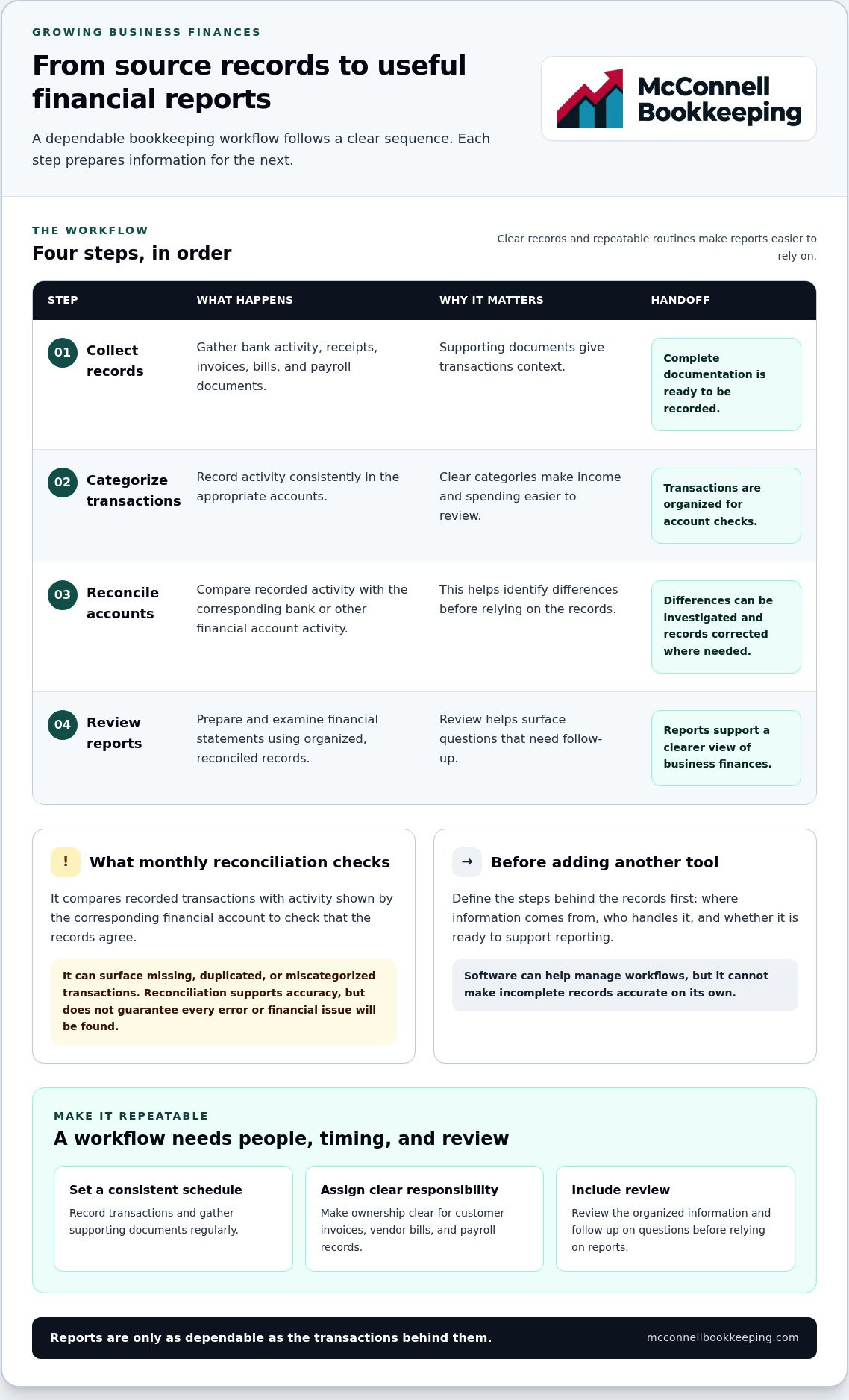
Start with a sequence in which each step prepares useful information for the next:
Collect records: Gather bank activity, receipts, invoices, bills, and payroll documents. Complete documentation gives transactions context.
Categorize transactions: Record activity consistently in the appropriate accounts. Clear categories make income and spending easier to review.
Reconcile accounts: Compare recorded activity with the corresponding bank or other financial account activity. This helps identify differences before relying on the records.
Review reports: Use organized, reconciled records to prepare and examine financial statements. Note questions that need follow-up.
Adding tools before defining this sequence can make it harder to tell whether a problem comes from the software or the underlying process. Strong financial systems for a growing business rely on dependable steps first, with technology supporting the work.
How do monthly reconciliations strengthen the system?
Reconciliation is the process of comparing recorded transactions with activity shown by the corresponding financial account to check that the records agree. A regular review can surface missing, duplicated, or miscategorized transactions, giving you a chance to investigate differences and correct records where needed. Reconciliation supports accuracy, but it doesn’t guarantee that every error or financial issue will be found.
For a practical look at this recurring task, see how professional monthly bank reconciliations support organized bookkeeping.
How should owners organize recurring financial tasks?
Set a consistent schedule for recording transactions and gathering supporting documents, then assign clear responsibility for customer invoices, vendor bills, payroll records, and review. Fit the schedule to the business’s activity. The important thing is that tasks happen reliably and information doesn’t sit unrecorded.
Write the workflow down in a short checklist. Include where records are stored, who completes each task, and what needs review. Documentation helps another responsible person follow the same steps when the usual task owner is unavailable. McConnell Bookkeeping provides recurring bookkeeping support to help businesses keep these routines organized. Learn more about bookkeeping support.
Use Financial Reports to See Whether Your Systems Keep Up
Reports turn organized bookkeeping into a clearer view of business activity. Each can help answer different questions, but none should be read in isolation or treated as a complete verdict on business health. For financial systems for a growing business to support dependable reporting, transactions need to be recorded consistently and accounts reconciled before the numbers are reviewed.
What does each core financial statement tell an owner?
Income statement: Shows revenue and expenses over a period. It helps answer whether the business brought in more than it spent during that timeframe.
Balance sheet: Provides a snapshot of assets, liabilities, and equity at a particular point in time. It helps show what the business owns and owes, alongside the owners’ stake.
Cash flow statement: Summarizes cash moving into and out of the business. It helps clarify how cash activity changed over a period, which can differ from income or expenses recorded for that same period.
Accurate books make financial reports more dependable, giving owners a clearer basis for understanding business activity. Financial statement preparation brings recorded information into a form that’s easier to review, but the usefulness of those statements still depends on the quality of the underlying records. For an industry-specific example of financial measures in practice, explore financial metrics for dental practices.
What are signs your current reporting routine needs attention?
Look at how reliably reports are prepared and whether the records behind them are ready for review. Late reports may mean transactions or supporting documents are arriving too slowly. Unreconciled accounts can leave uncertainty about whether recorded activity matches account activity, while unclear transaction categories can make it harder to understand what the reports show.
Frequent unexplained differences deserve a closer look at the bookkeeping process. Check whether records are complete, categories are applied consistently, and account activity is reviewed regularly. Don’t draw a conclusion from one report or an isolated month. Instead, examine recurring patterns and investigate questions that persist across reporting periods.
For example, a cash balance that looks different from what an owner expected may prompt a review of payment timing, recorded transactions, and account reconciliation. The report points to a question; the supporting records help clarify it. A consistent reporting routine makes that follow-up more practical and helps owners assess whether their bookkeeping processes are keeping pace with daily activity.
Choose the Right Financial Process for Your Business’s Next Stage
The best next step depends on where work gets stuck, not on which financial tool is newest. Look for the bottleneck that delays accurate records or makes reports harder to trust. With financial systems for a growing business, improving one recurring process can create more value than adding software to an unclear workflow.
Start by identifying the pressure point:
Transaction records: Receipts, invoices, or other documents arrive late or are difficult to organize.
Reconciliation: Accounts aren’t reviewed consistently, leaving differences unresolved.
Receivables or payables: Customer invoices or vendor bills lack a clear tracking and follow-up routine.
Payroll: Gathering and recording payroll information takes more effort as responsibilities expand.
Reporting: Statements arrive late or don’t answer the questions you need to review business activity.
Then match the response to the gap: standardize a routine if steps are unclear, improve software use if the process exists but feels cumbersome, or delegate recurring bookkeeping tasks if the workload has outgrown the time available. Revenue growth alone doesn’t determine which change makes sense. The day-to-day workload and reliability of the records offer better clues.
Should you improve your process, software, or bookkeeping support first?
Clarify the workflow and desired outcome before choosing another tool. If you want to manage the accounting software yourself, QuickBooks Online training can help you use it more effectively. If recurring recordkeeping or reconciliation is taking attention away from other responsibilities, bookkeeping support can help manage that workload. Training may suit an owner who wants hands-on control; ongoing bookkeeping support can suit someone who wants help with recurring tasks.
How can an owner keep visibility while delegating tasks?
Delegating work doesn’t mean giving up oversight. Agree on who handles each task, how supporting documents are shared, when reviews take place, and which reports the owner will receive. Regular financial statements help keep the owner informed about recorded business activity, while clear responsibilities make it easier to follow up on questions.
For example, a Mesa business owner might assign invoice tracking and routine recordkeeping while keeping a scheduled review of statements and unresolved items. If the owner prefers to continue managing the software, QuickBooks Online training for business owners can strengthen their ability to work within it. McConnell Bookkeeping also provides recurring bookkeeping support to help put routine tasks on a steadier footing. Read more about bookkeeping support.
Create a Growth-Ready Financial System With Consistent Bookkeeping
A growth-ready financial system doesn’t need to be complicated. It needs to produce organized records and useful reports through routines your business can maintain. Start by assessing the current state of your books, stabilizing the workflows that keep transactions current, reviewing financial statements regularly, and revisiting the process as your operations change. This sequence helps financial systems for a growing business adapt without adding complexity before it’s needed.
What should a simple monthly financial routine include?
Use a consistent schedule to gather transaction records and supporting documents, then move through the core bookkeeping tasks in order. Categorize activity, reconcile accounts, and review outstanding customer invoices and vendor bills. Once the records are organized, prepare and review financial statements, noting questions or unusual items that need follow-up. Monthly bank reconciliations and financial statement preparation provide a dependable foundation for this review. A routine like this gives owners a regular opportunity to see how recorded activity appears in their reports.
When can bookkeeping support make growth easier to manage?
Recurring backlogs, delayed reconciliations, or reports that are difficult to interpret can signal that the current process needs attention. If historical records have fallen behind or contain errors, books cleanup can help restore order before a consistent routine takes hold. With organized records and recurring tasks handled reliably, owners can spend less time chasing information while retaining a clear view of the numbers.
To put the approach into practice, begin with what exists today. Identify missing or outdated records, decide who will handle each recurring task, and set a consistent review schedule. Then use the reports to see what’s working and adjust the workflow as transaction volume, staffing, or payment activity changes. The right system supports current operations and can be revisited as the business evolves.
For help establishing dependable bookkeeping routines, explore bookkeeping support for your growing business.
Build a Clearer Financial Foundation for What Comes Next
Growth is easier to manage when your bookkeeping keeps pace. Strong financial systems for a growing business rely on consistent routines, accurate records, and reports you can use to understand recorded activity. Before adding another tool, identify the process that needs attention and make that step more dependable.
Monthly bank reconciliations and financial statement preparation can support organized records and clearer oversight. If past transactions or errors have left the books behind, books cleanup can help restore order. If you prefer to manage your own accounting software, QuickBooks Online training can help you use it more effectively. Recurring bookkeeping support can also take routine recordkeeping tasks off your plate while you retain visibility into the numbers.
Choose the kind of support that fits your current workload and working style. Discuss bookkeeping support for your growing business and take a practical next step toward more reliable financial routines. With a steadier foundation, you can give your business’s growth the attention it deserves.
Frequently Asked Questions
What financial systems does a growing small business need?
A growing small business needs clear responsibility, repeatable bookkeeping workflows, organized records, suitable software, account reconciliations, and regular reporting. Together, these parts move transactions from source documents into useful financial statements. The right setup depends on the business’s transaction volume, staffing, payment activity, and reporting needs. Start with reliable routines for capturing and categorizing transactions, then add tools or support where a specific process is difficult to maintain.
How do I know when my business has outgrown its bookkeeping process?
Recurring backlogs, delayed reports, unreconciled accounts, or unclear task ownership can signal that your process needs review. One sign alone doesn’t diagnose the problem. Look for repeated patterns: Are records regularly entered late? Do reports depend on last-minute catch-up? Are responsibilities unclear when tasks move between people? Reviewing where information gets delayed can help you decide whether to clarify a routine, improve software use, or delegate recurring work.
Can QuickBooks Online manage all of my business finances?
QuickBooks Online is accounting software that can help organize transactions and produce financial reports, but its usefulness depends on accurate setup and consistent workflows. Transactions still need to be categorized, supporting records kept, and account activity reviewed. Software doesn’t replace bookkeeping judgment or ensure that every entry is correct. Business owners who want to manage the platform themselves can use QuickBooks Online training to build confidence with its features and reporting tools.
How often should a growing business reconcile its accounts?
Use a consistent recurring schedule that fits the account’s activity and the business’s bookkeeping routine. Monthly reconciliation is a useful practice for reviewing bank activity against recorded transactions and keeping records organized. However, there isn’t one schedule that fits every account or business. If activity is frequent or the records are falling behind, review whether the routine needs adjustment. Regular review helps surface differences for follow-up before relying on reports.
What financial reports should a small-business owner review?
Review the income statement, balance sheet, and cash flow statement because each answers a different question. The income statement summarizes revenue and expenses over a period. The balance sheet shows assets, liabilities, and equity at a particular point in time. The cash flow statement summarizes cash moving into and out of the business. Read them together, and make sure the underlying transactions are recorded and reconciled consistently.
Should I hire a bookkeeper or manage the books myself?
Managing the books yourself can suit an owner who has time to maintain records, follow a consistent process, and review reports. Delegating recurring tasks can free up time while still allowing you to monitor statements, responsibilities, and follow-up items. Business owners in Mesa, Phoenix, Gilbert, Tempe, Chandler, and Scottsdale can choose an approach that fits their workload and preferences. QuickBooks Online training is an option for owners who want to manage the software themselves.
Can bookkeeping services help clean up financial records that have fallen behind?
Yes. McConnell Bookkeeping provides books cleanup to address historical accounting errors and organize records that have become incomplete or difficult to follow. Clearer records create a stronger starting point for consistent transaction entry, account reconciliation, and financial reporting. After cleanup, establish routines for gathering documents, recording activity, and reviewing reports so the books are easier to maintain. McConnell Bookkeeping supports small businesses in Mesa, Phoenix, Gilbert, Tempe, Chandler, and Scottsdale with books cleanup and ongoing bookkeeping services. Contact McConnell Bookkeeping to discuss bookkeeping support for your business.



Comments