Financial Statement Analysis for Small Business: A 2026 Strategy Guide

Why does your bank account often tell a different story than your profit and loss statement? You aren't alone if you feel a sense of "financial blindness" despite having your QuickBooks Online subscription up to date. Many business owners experience persistent anxiety over cash flow gaps because they haven't yet bridged the gap between raw data and actionable insight. Mastering financial statement analysis for small business is the definitive solution to this administrative stress, as it converts your monthly reports into a strategic roadmap for long-term stability.
We understand that you want the confidence to make hiring or investment decisions without second-guessing your bottom line. This guide provides the clarity you need to navigate the 2026 fiscal landscape, including the significant changes introduced by the One Big Beautiful Bill Act (OBBBA). By focusing on real-time data and precise oversight, you can lower your stress through financial predictability. We will explore how to interpret your balance sheets, manage your accounts receivable effectively, and use your financial statements to project your business health with total transparency.
Key Takeaways
Transform your perspective by viewing financial statement analysis for small business as a proactive engine for growth rather than a reactive end-of-month chore.
Gain clarity on your company's health by mastering the "Big Three" reports to distinguish between immediate operational efficiency and long-term net worth.
Protect your cash flow by tracking specific liquidity and profitability ratios that reveal exactly how much of your revenue stays in your pocket.
Ensure reporting accuracy by implementing a professional books cleanup to eliminate the data errors that often skew strategic decisions.
Leverage local expertise to move beyond basic bookkeeping into a partnership that provides the strategic oversight necessary for sustainable scaling.
Table of Contents
Decoding the Numbers: Why Financial Statement Analysis Is Your Growth Engine
The Big Three: Analyzing Your Balance Sheet, P&L, and Cash Flow
Beyond the Bottom Line: Key Financial Ratios Every Small Business Should Track
Turning Data into Strategy: How to Use QuickBooks Online for Real-Time Insights
Strategic Oversight: Why Mesa Businesses Partner with a Professional Bookkeeper
Decoding the Numbers: Why Financial Statement Analysis Is Your Growth Engine
Mastering financial statement analysis for small business allows you to transition from merely recording history to actively writing it. At its core, financial statement analysis is the process of evaluating your company's past, present, and future performance to ensure every dollar works as hard as you do. While bookkeeping keeps you compliant, analysis keeps you profitable. It's the difference between knowing you spent money and understanding why that expenditure didn't result in the expected return. This shift from reactive record-keeping to proactive strategic management is what separates struggling startups from established, scaling enterprises.
To visualize how these foundational reports interact to tell your business story, watch this helpful breakdown:
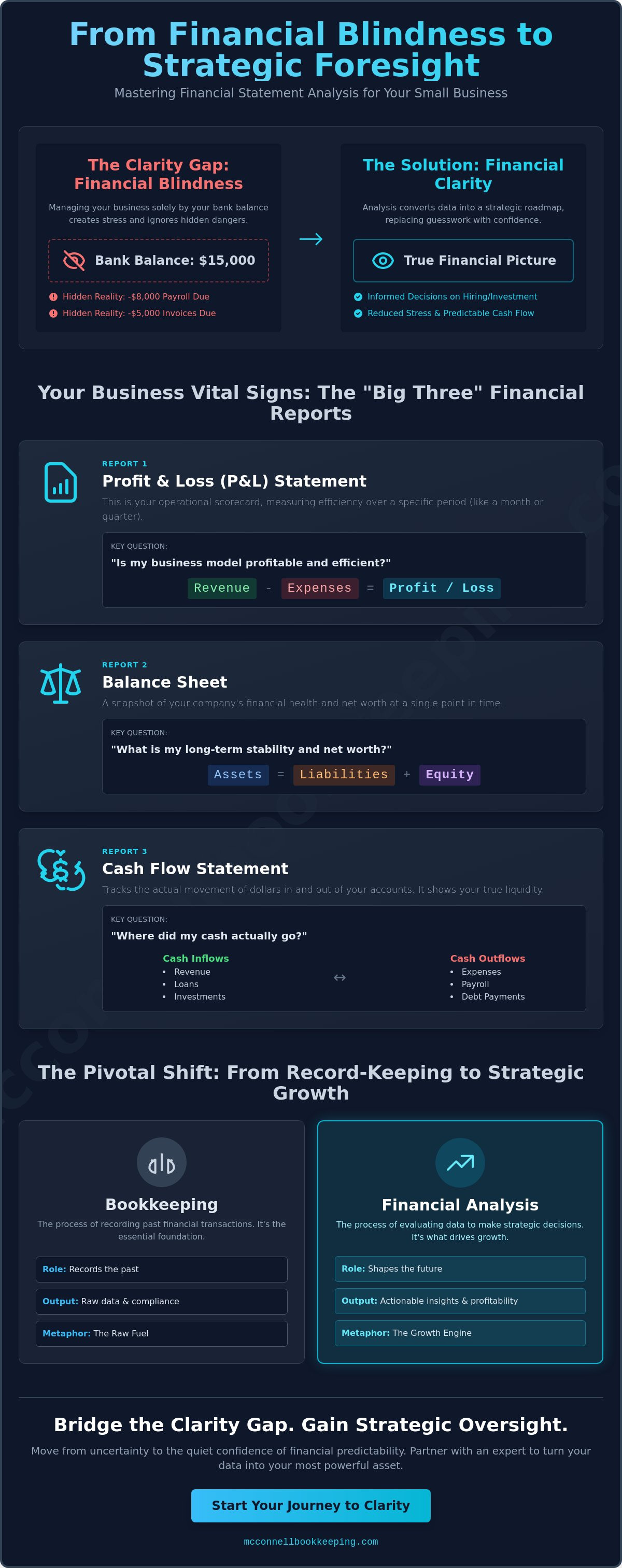
Managing a business solely by checking your bank balance is a dangerous gamble. This approach ignores the reality of timing; your current balance doesn't reflect the funds required for upcoming Payroll Management or the invoices sitting in Accounts Payable Management that are due next week. Professional oversight acts as a shield for your business. By identifying these patterns early, we protect your capital from the unseen leaks that often drain a company's potential before the owner even notices a problem. We look ahead to identify opportunities, serving as a diligent guardian of your financial health.
The Difference Between Bookkeeping and Financial Analysis
Bookkeeping records the past, but analysis predicts and shapes the future. Think of bookkeeping as the raw fuel and analysis as the engine that converts that fuel into forward motion. For Mesa entrepreneurs, the transition from "keeping the books" to "using the books" is a pivotal moment of growth. When you invest in a professional Books Cleanup, you ensure that your data is accurate enough to serve as a reliable foundation for high-level decision making. We also provide QuickBooks Online Training to help you maintain this high-quality data, ensuring every report you pull is a true reflection of your operational reality.
The Emotional ROI of Financial Clarity
Financial clarity offers more than just better margins; it provides a profound sense of relief. Predictable financial reporting through regular Financial Statement Preparation lowers your daily stress by replacing guesswork with certainty. You gain the confidence to say "yes" to new opportunities or "no" to bad debt because you finally see the full picture. The Clarity Gap is the frustrating distance between owning a mountain of accounting data and actually understanding what it means for your company's survival. Bridging this gap allows you to move from a state of uncertainty to a state of informed, quiet confidence.
The Big Three: Analyzing Your Balance Sheet, P&L, and Cash Flow
Effective financial statement analysis for small business requires a holistic view of three specific reports that function as your company’s vital signs. The Profit and Loss (P&L) statement serves as your operational scorecard. It measures your revenue against expenses over a specific month or quarter, telling you if your current business model is actually efficient. While the P&L shows how much you earned, the Balance Sheet acts as a snapshot of your company’s net worth and long-term stability at a single point in time. It lists what you own versus what you owe, providing a clear view of your equity. Finally, the Cash Flow Statement tracks the actual movement of dollars in and out of your accounts. These three reports must be read together because a healthy P&L doesn't always mean a healthy bank account. Using an SBA guide to managing business finances can help you understand these mechanics, but seeing them work together in your own business is where the real strategy begins.
Profit vs. Cash: The Crucial Distinction
A profitable business can still run out of money if its cash flow isn't managed with precision. This often happens when your revenue is tied up in outstanding invoices rather than sitting in your operating account. By analyzing your "Accounts Receivable," you ensure that your hard work translates into actual cash in the bank. If you find your collections are lagging, specialized accounts receivable services Mesa can help optimize your billing cycle and improve liquidity. This proactive oversight prevents the "profit but no cash" trap that often catches growing service-based businesses.
Spotting Trends in Your P&L Statement
Identifying patterns within your P&L requires comparing month-over-month (MoM) and year-over-year (YoY) performance. This comparison reveals "Expense Creep," where small, incremental costs slowly erode your profit margins without being noticed. Consistent Financial Statement Preparation ensures you have these insights ready whenever a strategic decision needs to be made. You can use these trends to:
Identify which services are becoming more expensive to deliver.
Adjust your pricing models to reflect current labor and material costs.
Pinpoint seasonal dips in revenue to better prepare for leaner months.
Evaluate the success of recent marketing investments by tracking revenue growth against specific spend.
Gaining this level of clarity transforms your books from a source of stress into a tool for liberation. When you understand the "Big Three," you stop reacting to your bank balance and start leading your company with informed confidence. If your current reports feel cluttered or confusing, a professional books cleanup can restore the accuracy needed for high-level financial statement analysis for small business.
Beyond the Bottom Line: Key Financial Ratios Every Small Business Should Track
Raw numbers tell part of the story, but ratios provide the context needed for true financial statement analysis for small business. Ratios act as a magnifying glass. They reveal the hidden relationships between your revenue, debt, and assets. By translating large figures into simple percentages or proportions, you can compare your performance against industry standards or your own historical data. This level of insight transforms your balance sheet from a static document into a dynamic tool for strategic growth. We encourage you to move beyond the bottom line and look at the underlying mechanics that determine your company's long-term viability.
As your neighborly expert, we recommend focusing on the three ratios that drive your specific industry. Tracking every possible metric leads to "analysis paralysis," which stalls decision-making. Instead, prioritize liquidity, profitability, and efficiency. This focused approach ensures you spend your energy on the numbers that actually impact your ability to scale. Professional Financial Statement Preparation provides the clean data required to calculate these metrics accurately, giving you a clear view of where you stand today and where you can go tomorrow.
The Current Ratio: Your Safety Net
The Current Ratio is the ultimate indicator of short-term survival. You calculate this by dividing your current assets by your current liabilities using your balance sheet data. A ratio of 2.0 suggests you have twice as much cash and equivalents as you do upcoming bills, providing a comfortable cushion for your operations. Conversely, a ratio of 1.0 means you are just breaking even, leaving you vulnerable to any sudden revenue dips. Maintaining a healthy ratio protects you from the stress of unexpected expenses. It gives you the confidence to navigate seasonal shifts without the constant fear of a cash flow crisis.
Net Profit Margin: The Efficiency Metric
Understanding your net profit margin is essential for evaluating your operational health. While gross margin shows the markup on your services, the net profit margin reveals how much of every dollar earned actually stays in your pocket after all expenses are paid. For small businesses in 2026, a healthy net profit margin is generally considered to be between 7% and 10%. Benchmarking your margin against other Arizona service businesses helps you identify if your overhead is too high. You can improve this margin by refining your Accounts Payable Management or negotiating better vendor terms, allowing you to grow your bank account without necessarily increasing your sales volume.
Efficiency ratios further refine this picture by showing how well you use your assets to generate income. When these metrics are clear, you stop guessing and start leading. Accurate Monthly Bank Reconciliations ensure that the assets listed on your balance sheet are real and ready to be leveraged. This meticulous attention to detail turns your accounting data into a strategic roadmap, liberating you from administrative uncertainty and fueling your business's prosperity.
Turning Data into Strategy: How to Use QuickBooks Online for Real-Time Insights
Sophisticated analysis is impossible without surgical data accuracy. We call this the "Garbage In, Garbage Out" rule. If your transactions are miscategorized or duplicated, your financial statement analysis for small business will lead you toward flawed conclusions. A comprehensive Books Cleanup is the essential first step in transforming your accounting software from a simple digital shoebox into a powerful strategic engine. By optimizing your Chart of Accounts, we provide the granularity needed to see exactly where your capital is deployed. We also leverage QuickBooks Online tags and classes to identify which specific services or projects drive your profit, allowing you to double down on the most lucrative areas of your business.
The Power of Monthly Bank Reconciliations
Unreconciled accounts make your financial analysis worthless. These discrepancies distort your cash flow reality and hide potential bank errors or even fraudulent activity before they become catastrophic. Regular Monthly Bank Reconciliations serve as a vital audit of your data integrity. This is especially critical for the 2026 tax year. With the new reporting requirements under the One Big Beautiful Bill Act (OBBBA), including the $20,000 threshold for 1099-K forms, having pristine records is no longer optional for the diligent owner. Our monthly bank rec service ensures your records match your bank statements to the penny, providing the solid foundation you need for growth.
QuickBooks Training for the Strategic Owner
Moving beyond simple data entry requires a fundamental shift in how you interact with your software. We provide QuickBooks Online Training that empowers you to generate high-level reports with confidence. You can set up automated reporting schedules to receive a "hands-off" financial pulse check every Monday morning, ensuring you stay informed without getting bogged down in the details. This proactive approach allows you to spot trends as they happen rather than waiting for month-end reports to arrive. Expert-led training liberates you from the technical struggle of the software, giving you the clarity to lead your company with precision. If you are ready to master these tools, consider investing in professional QuickBooks Online Training to unlock the full potential of your financial data.
By integrating these tools into your daily operations, you move from a state of uncertainty to a state of informed confidence. You stop wondering if you can afford a new hire and start knowing exactly when the investment will pay off. This transformation is the ultimate goal of expert oversight, as it turns your accounting data into a strategic roadmap for long-term prosperity and stability.
Strategic Oversight: Why Mesa Businesses Partner with a Professional Bookkeeper
Software provides the numbers, but a strategic mentor provides the context. While QuickBooks Online is an exceptional tool for data collection, financial statement analysis for small business requires a human touch to identify the subtle patterns that software often misses. Partnering with a professional bookkeeper allows you to move beyond the technical "how-to" of data entry into the "what now" of strategic growth. By outsourcing the meticulous diligence of day-to-day tracking, you liberate your schedule to focus entirely on the vision that started your company in the first place. This transition from surviving the administrative weight to thriving through expert oversight is the hallmark of a maturing enterprise.
Local expertise in the Phoenix and Mesa area offers a distinct advantage for service-based businesses. Arizona entrepreneurs navigate a specific regulatory environment, including the recent $25 Mesa General Business License renewal requirements. With the Mesa City Council scheduled to consider new fee modifications on June 1, 2026, having a partner who stays informed on local shifts ensures your business remains compliant and prepared. We act as a proactive partner, looking ahead to identify regional opportunities and risks rather than simply reacting to past events. This neighborly approach builds a collaborative relationship where your success is our primary metric of achievement.
The Cost of 'DIY' Financial Analysis
Managing your own financial statement analysis for small business often costs more than it saves. When you calculate the time-value of your own hour, the "savings" of DIY bookkeeping quickly evaporate. If an owner spends ten hours a month on manual entry and reconciliation, they are sacrificing ten hours that could be spent on high-level business development or client acquisition. Beyond the time lost, the risk of misinterpreting data is significant. Making "blind" investments based on flawed reports can lead to cash flow crises that far outweigh the cost of professional Books Cleanup and oversight. Expert oversight pays for itself by identifying operational efficiencies and preventing costly administrative errors.
Your Path Forward: From Messy Books to Strategic Clarity
Transformation begins with a structured three-step process: Cleanup, Reconcile, and Analyze. We start by performing a thorough Books Cleanup to ensure your historical data is accurate and reliable. Once the foundation is set, we implement Monthly Bank Reconciliations to maintain ongoing data integrity. Finally, through regular Financial Statement Preparation, we deliver the clarity you need to make informed decisions. McConnell Bookkeeping acts as your diligent guardian, ensuring every Payroll Management cycle and Accounts Payable entry is handled with meticulous care.
You deserve to lead your business with a sense of informed confidence and calm. We invite you to experience the relief that comes from knowing your finances are in safe, capable hands. Contact us today to discuss how our tailored bookkeeping solutions can turn your accounting data into a strategic roadmap for your business's prosperity.
Leading Your Business with Financial Confidence
Mastering financial statement analysis for small business is the definitive step toward liberating yourself from administrative uncertainty. By integrating the insights from your balance sheet and profit and loss statements, you transform static numbers into a proactive growth engine. Clean data serves as the foundation of this strategy, ensuring that every decision is backed by real-time accuracy rather than guesswork. This clarity allows you to move from a state of survival to a state of informed, quiet confidence.
Our team acts as your diligent guardian and strategic mentor, providing dedicated local support in Mesa, Phoenix, and Scottsdale. We offer expert books cleanup specialist services to restore your data integrity and professional QuickBooks Online training to empower your long-term oversight. This partnership allows you to focus on your vision while we manage the meticulous details of your financial health. Ready to turn your books into a growth strategy? Partner with McConnell Bookkeeping today.
You have the tools and the roadmap to achieve total financial predictability. It's time to replace anxiety with clarity and lead your business toward the prosperity it deserves.
Frequently Asked Questions
What is the most important financial statement for a small business?
The Cash Flow Statement is often considered the most critical report because it tracks the actual movement of dollars in and out of your accounts. While your Profit and Loss statement might show a healthy margin, the Cash Flow Statement reveals if you have enough liquid capital to meet immediate obligations like payroll. Understanding how these reports interact is the core of effective financial statement analysis for small business.
How often should I perform a financial statement analysis?
You should perform a financial statement analysis for small business at least once a month to maintain a clear pulse on your company's health. Reviewing your reports monthly allows you to identify "Expense Creep" and cash flow gaps before they become unmanageable. This regular cadence transforms your bookkeeping from a reactive chore into a proactive tool for strategic growth and long-term stability.
Do I need a CPA to perform financial statement analysis?
No, you do not necessarily need a CPA for regular financial analysis. While CPAs are essential for specialized tasks like income tax return filing or certified audits, a professional bookkeeper acts as a strategic mentor for your daily operations. We provide the meticulous oversight and Financial Statement Preparation needed to turn your raw data into a roadmap for your business's prosperity.
Can QuickBooks Online do financial analysis for me automatically?
QuickBooks Online generates the necessary reports, but it cannot perform the high-level interpretation required for true strategic analysis. The software provides the data foundation, but you still need a professional to ensure that data is accurate through regular Monthly Bank Reconciliations. Expert oversight is what bridges the gap between having a mountain of data and actually understanding your business health.
What is a 'good' net profit margin for a service-based business in 2026?
A healthy net profit margin for small businesses in 2026 is generally considered to be between 7% and 10%. However, this can vary significantly depending on your specific industry and operational overhead. Consistently tracking this ratio allows you to benchmark your performance against other Arizona enterprises and adjust your pricing or service offerings to ensure your hard work results in actual profit.
How does bank reconciliation affect my financial statement accuracy?
Monthly bank reconciliations are the primary safeguard for your data integrity. Without reconciling your accounts, your financial statements might include duplicate entries or miss bank errors, leading to a state of "financial blindness." Precise reconciliations ensure that your reports match your bank statements to the penny, providing the informed confidence you need to make hiring or investment decisions.
What should I do if my financial analysis shows a cash flow problem?
You should immediately analyze your Accounts Receivable Management to identify if your capital is tied up in unpaid invoices. Tightening your collection cycle or improving your Accounts Payable Management can often provide the liquidity needed to bridge the gap. Professional oversight helps you identify these patterns early, allowing you to implement solutions before a temporary dip turns into a serious financial crisis.
Is there a difference between financial analysis and tax preparation?
Yes, financial analysis is a proactive strategy focused on business growth, while tax preparation is a reactive process focused on compliance. Analysis happens year-round to optimize your performance and predictability. Tax preparation focuses on meeting specific deadlines, such as the April 15, 2026, filing date for sole proprietors. While we don't file income tax returns, our Books Cleanup ensures you are ready for tax season.


Comments