Financial Reporting to Get a Bank Loan: A Guide for Small Businesses in 2026

Did you know that 82% of small businesses fail because of cash flow issues? It's a sobering statistic that explains why lenders are more selective than ever in 2026. While the Wall Street Journal Prime Rate sits at 6.75%, securing a favorable rate requires more than just a decent credit score. It demands precise financial reporting to get a bank loan. Lenders don't just fund profitable ideas; they invest in businesses that demonstrate total control through transparent, reconciled records.
You might feel a sense of dread at the thought of a loan officer scrutinizing your books, especially if you're confused about the difference between a tax return and a management report. It's common to feel overwhelmed by technical requirements and accounting jargon. This guide will show you exactly which financial statements you need and how to prepare them to maximize your chances of securing a business loan. We'll provide a clear document checklist and the strategic insight you need to speak with confidence, ensuring your clean books prove your business's viability.
Table of Contents
The Banker’s Perspective: Why Your Financial Reporting is the Key to Loan Approval
The "Big Three" Financial Statements Every Small Business Needs
Red Flags and Green Lights: What Underwriters Look for in Your Reports
Preparing Your Books for Success: A Step-by-Step Readiness Checklist
Partnering for Prosperity: How McConnell Bookkeeping Secures Your Financial Future
The Banker’s Perspective: Why Your Financial Reporting is the Key to Loan Approval
Bankers view your business through the lens of risk mitigation and repayment capacity. When you present financial reporting to get a bank loan, you aren't just handing over a stack of papers; you're providing a narrative of your operational control. Loan-ready reporting encompasses accurate, reconciled, and current financial information that proves you have the capacity to handle new debt. Lenders often interpret disorganized records as a sign of a disorganized business, which can lead to immediate rejection regardless of your actual revenue. Providing precise reports creates the clarity needed for a lender to say yes with confidence.
To better understand the accounting behind these transactions, watch this helpful video:
As your neighborly expert, we believe that transparency builds the bridge between your current operations and your future growth. When your books are meticulous, you stop being a "risky" applicant and start being a strategic partner in the eyes of the bank. This transformation from administrative stress to financial authority is what allows you to command the terms of your expansion.
Beyond the Tax Return: Why Banks Demand Year-to-Date Accuracy
Tax returns are historical documents that tell a story about where your business was last year, but bankers need to know where you are right now. This is why a lender will consistently ask for an interim Profit and Loss statement and a Balance Sheet. These reports provide a real-time pulse on your liquidity and profitability during the current fiscal year. While tax-ready books focus on minimizing liability for the government, management-ready books focus on demonstrating the ongoing health and viability of your business to a creditor.
The Three Pillars of Lending: Character, Capacity, and Capital
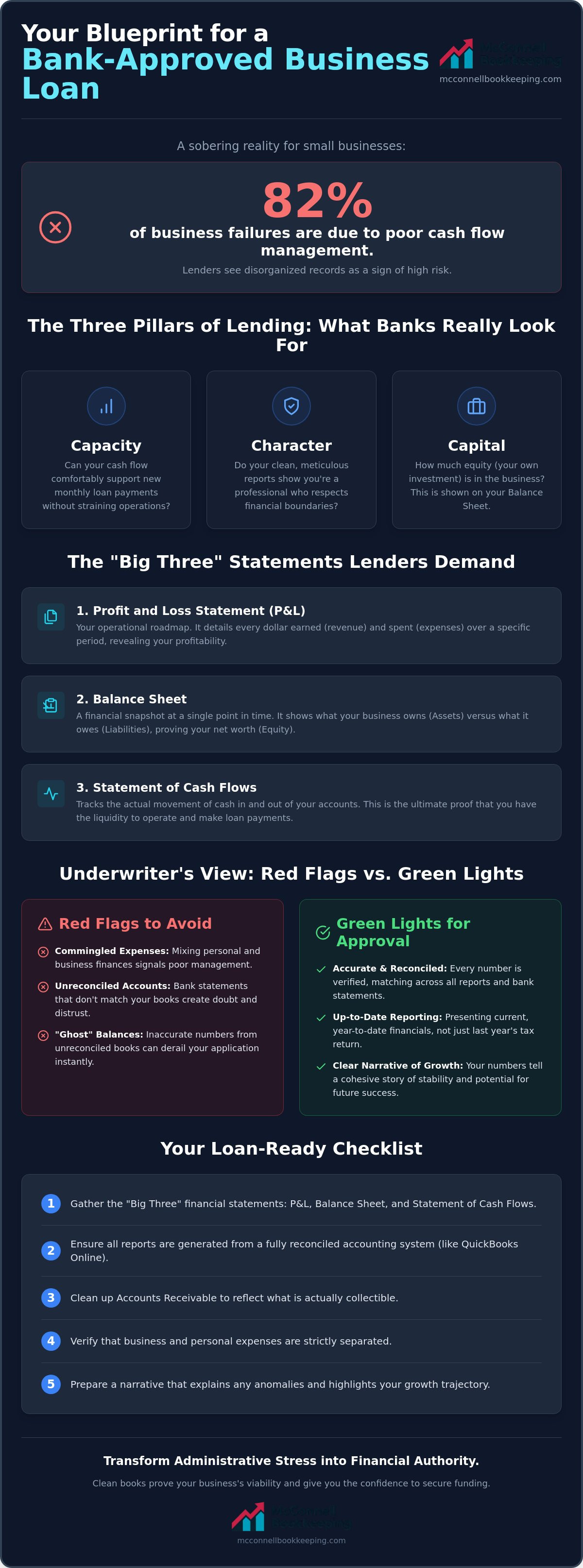
Lenders in the Phoenix and Scottsdale markets look for specific indicators within the 'Big Three' Financial Statements to assess your worthiness for capital. First, they evaluate "Capacity" by looking at your cash flow to ensure you can comfortably make monthly payments without straining operations. Second, "Character" is evidenced by the cleanliness of your reporting; meticulous books show that you are a professional manager who respects financial boundaries and pays attention to detail. Finally, "Capital" refers to the equity you have in the business, which is clearly visible on a well-maintained balance sheet. In 2026, transparent reporting is the standard that separates successful applicants from those left waiting.
The "Big Three" Financial Statements Every Small Business Needs
Securing capital requires more than just a high credit score; it requires a cohesive story told through your numbers. When you compile financial reporting to get a bank loan, you're translating your daily hard work into a language that underwriters understand and trust. Lenders demand a unified view of your business health, which is why they focus on three specific documents. These reports must be generated from a reconciled QuickBooks Online file to ensure the data is reliable. Unreconciled books lead to "ghost" balances that trigger immediate red flags for underwriters, making regular maintenance a non-negotiable step for approval.
The Profit and Loss Statement (P&L): This report acts as your operational roadmap, detailing every dollar earned and spent over a specific period.
The Balance Sheet: This document provides a frozen snapshot of your financial position, showing exactly what you own versus what you owe.
The Statement of Cash Flows: This tracks the actual movement of currency in and out of your accounts, proving you have the liquidity to stay afloat.
If you feel unsure about your current reports, engaging in professional financial statement preparation can bridge the gap between administrative confusion and informed confidence.
The Profit and Loss: Proving Your Ability to Repay
Underwriters look for consistent revenue trends and healthy margins to ensure your business is sustainable. Net Income is the most scrutinized line on this report because it proves you have the leftover funds to service new debt. Utilizing a monthly bank rec service ensures your P&L accuracy by catching missing expenses or duplicate income before a banker sees them. Clean records demonstrate that your profits are real, not just a result of sloppy data entry.
The Balance Sheet: Assessing Your Business’s Net Worth
Banks check for liquidity to confirm you can cover short-term bills while managing a loan. Accurate accounts receivable services are vital here, as they validate the assets you claim on paper and show how quickly you turn invoices into cash. Lenders also calculate debt-to-equity ratios to determine your risk level and interest rate. For many SBA loans, you'll also need to complete an SBA Personal Financial Statement to provide a full picture of the financial backing behind the business. Maintaining an organized balance sheet proves you are a meticulous steward of your company's resources.
Red Flags and Green Lights: What Underwriters Look for in Your Reports
Underwriters act as the ultimate gatekeepers for your business's future. When they review your financial reporting to get a bank loan, they search for patterns that indicate either disciplined management or hidden instability. A "green light" report shows consistent monthly closing of the books and detailed categorization that explains exactly where every dollar is deployed. This level of detail proves you understand your cost of goods sold versus your overhead. Conversely, a primary "red flag" is unreconciled bank accounts. These lead to "ghost" balances where your books show cash that doesn't exist in reality, or vice versa, which instantly destroys your credibility with a lender.
Commingling personal and business expenses is another significant deterrent, particularly in competitive markets like Phoenix. It suggests a lack of professional boundaries and makes it nearly impossible for an underwriter to determine the true profitability of the entity. Lenders want to see a clean separation of finances to ensure that the loan proceeds will be used solely for business growth. Strategic mentors emphasize that keeping these accounts strictly separate is the first step toward proving you are a reliable borrower who respects the integrity of the business entity.
Identifying Common Errors That Trigger Loan Rejections
Poor tracking often manifests as negative balances in asset accounts, such as cash or bank accounts. To a lender, a negative cash balance on a balance sheet is a glaring error that signals your records are not being maintained in real time. Similarly, large balances in "Uncategorized Expenses" act as a hiding place for potential liabilities or tax issues. If your records have fallen behind, seeking backlogged bookkeeping help can restore the financial clarity required to pass a bank's rigorous audit. Correcting these errors before submission prevents the "automatic decline" that often follows a sloppy application.
Financial Ratios That Make or Break Your Application
Bankers rely on specific formulas to quantify risk and determine your interest rate. The Debt Service Coverage Ratio (DSCR) is arguably the most critical metric; it measures your ability to use operating income to cover debt payments. Most lenders look for a ratio of 1.25 or higher to ensure a safety net exists. Another vital metric is the Current Ratio, which compares your current assets to current liabilities to prove you have the cash on hand to survive a slow month without defaulting. Professional financial reporting to get a bank loan ensures these ratios are calculated from accurate data, presenting your business as a secure investment for the bank.
Preparing Your Books for Success: A Step-by-Step Readiness Checklist
Securing capital begins with a clean slate. When you provide financial reporting to get a bank loan, you're presenting a formal testimony of your business's integrity. Lenders in 2026 have little patience for "approximate" numbers; they require precise data that matches your bank statements to the penny. Walking into a meeting with disorganized records often leads to immediate rejection, regardless of your revenue. Use this checklist to ensure your business presents as a low-risk, high-reward opportunity for the bank.
Step 1: Complete all bank and credit card reconciliations through the current month to ensure every transaction is accounted for.
Step 2: Review and clean up the Accounts Receivable aging report to prove your income is collectible and not tied up in bad debt.
Step 3: Verify that all payroll liabilities are accurately recorded and up to date, as lenders view tax compliance as a primary indicator of character.
Step 4: Generate and scrutinize the "Big Three" reports to catch obvious anomalies like negative cash balances or duplicate entries.
Step 5: Prepare a brief written narrative for any unusual fluctuations, such as a seasonal dip or a one-time capital expense, to preemptively answer the underwriter's questions.
The Cleanup Phase: Reconciling Accounts and Categorizing Expenses
Historical errors must be identified and corrected before an underwriter sees your files. Small mistakes from two years ago can snowball into significant balance sheet discrepancies today. Utilizing a QuickBooks diagnostic review allows you to uncover hidden issues that might trigger a loan rejection. This process ensures every transaction has a clear, business-related purpose, transforming your books from a source of stress into a strategic asset. Clean records don't just happen; they are the result of meticulous oversight and a commitment to transparency.
Organizing Accounts Payable for a Stronger Profile
Lenders want to see that you manage your obligations with the same discipline you apply to your sales. Professional accounts payable management proves that you pay your vendors on time and maintain healthy relationships. This demonstrates to the bank that your liabilities are controlled and not spiraling out of proportion to your income. Maintaining digital receipt trails creates an audit-ready environment that builds immense trust during the due diligence phase. When you show that you respect your creditors, the bank is far more likely to become one of them.
If you're ready to transform your records into a powerful tool for growth, contact McConnell Bookkeeping for comprehensive books cleanup and financial statement preparation today.
Partnering for Prosperity: How McConnell Bookkeeping Secures Your Financial Future
McConnell Bookkeeping acts as your strategic mentor, providing the meticulous oversight required to navigate the complex lending process. We deliver the clarity you need to walk into any Phoenix bank with absolute confidence. By focusing on monthly accuracy, we ensure your business remains "loan-ready" throughout the year, rather than just during tax season. Our Mesa-based team takes immense pride in supporting local growth through diligent financial guardianship. We don't file income tax returns, which allows us to focus 100% of our energy on management-ready financials that withstand the most rigorous bank scrutiny.
When you present financial reporting to get a bank loan, you're offering a window into your operational discipline. We provide monthly bank reconciliations so your records remain bulletproof and your cash balances are always verifiable. This proactive approach transforms your bookkeeping from a source of administrative stress into a powerful tool for liberation and growth. Our goal is to ensure you never fear a loan rejection due to disorganized records again. We manage the details so you can focus on the vision that made you start your business in the first place.
Specialized Reporting for Law and Dental Practices
Niche expertise is vital when a banker asks industry-specific questions about your revenue streams or liability management. For law firms, we prioritize IOLTA compliance to ensure your trust accounting is transparent and audit-ready for any lender. For medical professionals, we specialize in tracking dental practice financial metrics to prove clinic profitability and operational health. This specialized focus ensures that your reports speak the specific language of your industry, providing the depth that traditional, generic bookkeeping services often miss.
Moving from Cleanup to Strategic Growth
Reliable data is the foundation of every strategic decision you'll make as an owner. We offer QuickBooks training for business owners to help you maintain your records with professional precision. This empowerment leads to the long-term value of peace of mind bookkeeping services, where you know your business is in safe, capable hands. We look ahead to identify opportunities and risks before they impact your application, acting as a proactive partner in your success. It's time to move from financial uncertainty to a state of informed confidence.
Ready to secure the capital your business deserves? Schedule a consultation with McConnell Bookkeeping today and let us prepare your path to approval.
Secure Your Funding with Confidence
Transforming your books from a source of stress into a strategic asset is the final step toward your next phase of growth. We've explored how precise reconciliations and clear categorization act as the foundation for successful applications. Mastering your financial reporting to get a bank loan is the single most effective way to separate your business from the competition. When you present clean, reconciled data, you aren't just asking for capital; you're proving you have the discipline to manage it effectively.
Our team specializes in meticulous books cleanup and financial statement preparation for Mesa and Phoenix firms. As QuickBooks Online ProAdvisors with deep expertise in law and dental practice bookkeeping, we understand the specific nuances local lenders look for in your records. We'll act as your diligent guardian, ensuring every entry is accurate and every red flag is removed before you ever step into a bank. This proactive oversight provides the relief and clarity you need to focus on your vision.
You've worked hard to build a viable business. Let's work together to ensure your financial story is told with clarity and authority. Get Loan-Ready with McConnell Bookkeeping today and take the first step toward a prosperous 2026. Your future growth is within reach, and we're here to help you secure it.
Frequently Asked Questions
Do I need a CPA to prepare financial statements for a bank loan?
Most lenders do not require a CPA unless they specifically request audited or reviewed statements, which is rare for standard small business funding. Professional financial statement preparation from a diligent bookkeeper is typically sufficient for most term loans and lines of credit. This approach provides the accurate data banks need while allowing you to focus on your operations without the high cost of a formal audit.
How far back do banks look at financial statements for a business loan?
Lenders typically scrutinize the last two to three years of your annual financial history alongside your most recent year to date interim reports. They look for trends in revenue growth and expense management over time to predict your future stability. Providing a consistent multi year narrative through your financial reporting to get a bank loan proves that your business is a reliable long term investment.
Can I use my tax returns instead of financial statements for a loan?
Tax returns are a starting point, but they are never a substitute for current, management ready financial statements. Banks require an interim Profit and Loss statement and a Balance Sheet to see how your business is performing right now, rather than how it looked months ago. Since tax returns focus on minimizing liability, they often don't reflect the true cash flow capacity that lenders need to see.
What is the most important financial report for a bank loan approval?
The Balance Sheet is arguably the most critical document because it provides a snapshot of your business's net worth and liquidity. While the Profit and Loss shows your ability to generate income, the Balance Sheet proves you have the assets to back your obligations. Underwriters use this report to calculate your debt to equity ratio, which directly influences your interest rate and approval chances.
How often should I reconcile my books if I am planning to apply for a loan?
You should perform monthly bank reconciliations to ensure your data remains accurate and loan ready at all times. Waiting until you need a loan to clean up your books often leads to delays and missed opportunities. Monthly maintenance allows you to catch errors early, giving you a clear, real time view of your financial health that impresses loan officers.
What happens if my financial reports show a loss for the previous year?
A previous year's loss isn't an automatic disqualifier if you can provide a logical narrative for the deficit. Lenders look for "add backs" like one time capital investments or non cash expenses like depreciation that might hide your true repayment capacity. Clear financial reporting to get a bank loan allows you to highlight these nuances, proving that your business remains viable despite a temporary dip.
Is QuickBooks Online sufficient for bank-grade financial reporting?
QuickBooks Online is the industry standard and is perfectly sufficient for bank grade reporting when managed by a professional. The software provides the robust audit trails and detailed categorization that underwriters require during the due diligence phase. When your QuickBooks file is reconciled and maintained with precision, it serves as a definitive source of truth for your business's financial status.
What is a "reconciled" account and why does the bank care?
A reconciled account means your internal records perfectly match your actual bank or credit card statements. Banks care about this because it validates the integrity of your numbers, ensuring that your reported cash balances are real and not inflated by "ghost" entries. This process eliminates discrepancies, providing the transparency that builds trust between you and your lending institution.


Comments