Bookkeeping to Prepare for a Business Loan: The 2026 Guide to Getting Approved

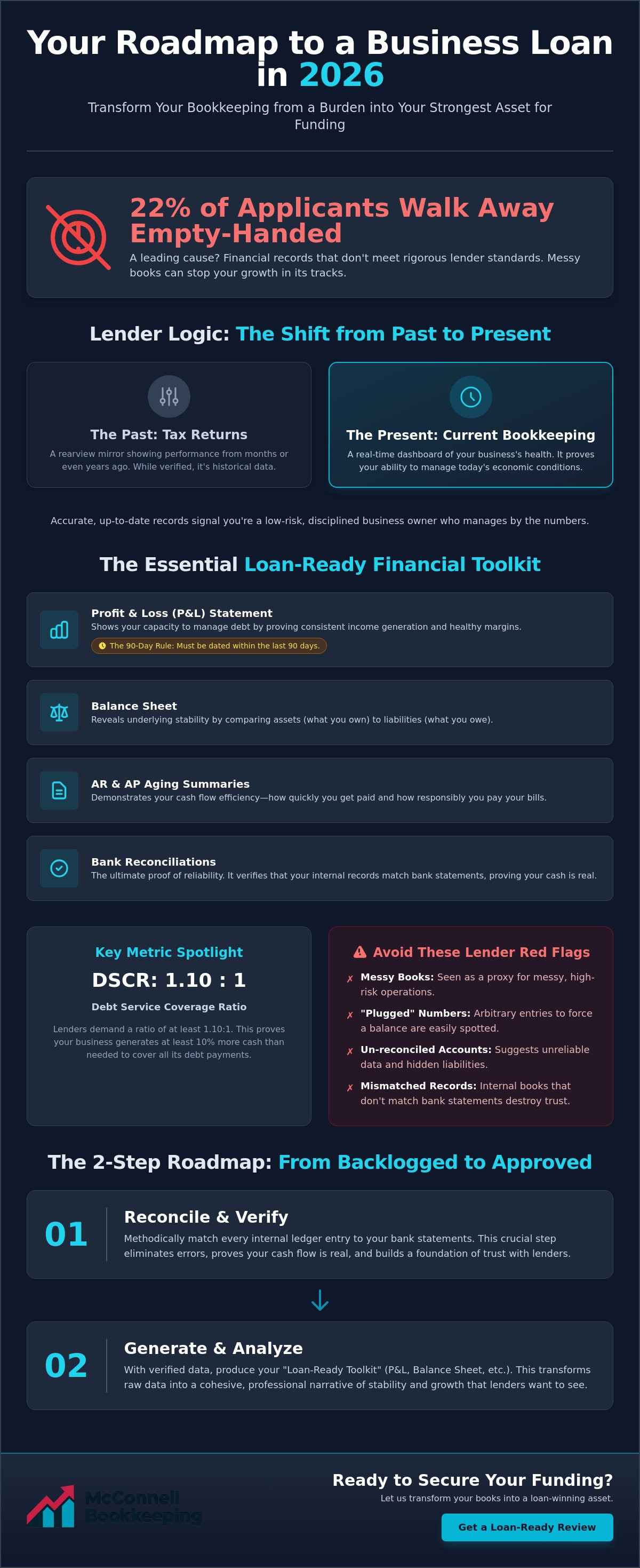
22% of small business loan applicants walked away with zero funding last year, often because their financial storytelling didn't meet the lender's rigorous standards. It's natural to feel a sense of anxiety when you're staring at backlogged entries or trying to decipher what an AR Aging report actually says about your company's health. You've worked too hard on your business to let messy records stand between you and your next phase of growth.
Our guide provides the definitive roadmap for bookkeeping to prepare for a business loan in 2026, ensuring your financial records reflect the true strength of your operations. We'll walk through a precise checklist of required documents, from the 1.10:1 debt service coverage ratio lenders now demand to the meticulous bank reconciliations that prove your reliability. This structured approach transforms your administrative burden into a strategic advantage, giving you a faster path to funding and the confidence that your numbers are ready for any underwriter's desk.
Table of Contents
Why Lenders Prioritize Your Bookkeeping Over Your Tax Returns
Lenders view your tax returns as a rearview mirror, but they need to see the road ahead to approve your capital request. While a tax return is a verified government document, it only reflects what happened months or even years ago. High-level financial statements generated from your current books provide a real-time pulse of your 2026 performance. When you focus on bookkeeping to prepare for a business loan, you're showing lenders that you respect the math of your own success. This distinction is the core of "Lender Logic": accurate, up-to-date records signal that you're a low-risk, disciplined business owner who manages by the numbers rather than by intuition. Banks want to see how you've handled the specific economic conditions of the current quarter before they commit their capital.
When you prioritize bookkeeping to prepare for a business loan, you're building a foundation of trust. Banks often spot "plugged numbers", which are arbitrary entries used to force a balance, during their due diligence process. If an underwriter finds that your internal records don't match your bank statements, it creates a red flag that no amount of revenue can overcome. They see messy books as a proxy for messy operations. Reliable lending decisions rely on the certainty that every dollar is accounted for through meticulous bank reconciliations that prove your cash is exactly where you say it is.
The 90-Day Rule: Why Timeliness Matters
Most lenders require Profit and Loss statements dated within the last 90 days to ensure they're seeing your current capacity to service debt. A business that was profitable in 2025 might be struggling in June 2026, and the bank needs to know the difference. If you wait until the end of the year to "catch up" on your entries, you'll be too late for a spring loan application. Utilizing a professional monthly bank rec service ensures your records are always "loan-ready" and compliant with this strict timeline. This proactive approach eliminates the stress of last-minute data entry and positions you as a sophisticated borrower who is ready for opportunity at a moment's notice.
Reconciliation as Verification
Bank reconciliation is the methodical process of matching your internal ledger entries to your actual bank statements to ensure zero errors. Un-reconciled accounts often hide "phantom" cash or unrecorded liabilities that can quickly scare away a cautious lender. These discrepancies suggest that your financial data is unreliable, making it impossible for a bank to calculate your true Debt Service Coverage Ratio. When a third-party expert oversees this process, it adds a layer of credibility that individual owners often can't provide alone. This verification step proves that your cash flow is real, your debts are documented, and your business is a safe bet for investment. It transforms your raw data into a professional narrative of stability.
The Essential 2026 "Loan-Ready" Financial Toolkit
Lenders don't just want a stack of papers; they want a cohesive narrative that proves your business is a safe harbor for their capital. When you engage in bookkeeping to prepare for a business loan, you are essentially building a toolkit that speaks the language of risk and reward. This toolkit centers on five core reports that provide a 360-degree view of your financial health. These documents serve as your primary evidence that the business is not only profitable but also professionally managed.
The Profit and Loss (P&L) Statement acts as your primary proof of income generation. Lenders analyze this to see if your margins are consistent enough to absorb new monthly interest payments. Meanwhile, the Balance Sheet reveals your underlying stability by comparing what you own against what you owe. A strong equity position on the Balance Sheet reassures an underwriter that the business has enough "skin in the game" to weather economic shifts. Beyond these high-level reports, lenders scrutinize your Accounts Receivable (AR) and Accounts Payable (AP) Aging summaries to understand your cash flow timing. Finally, a comprehensive Debt Schedule lists every current liability, from equipment leases to existing credit lines, ensuring total transparency during the underwriting process.
Optimizing Your Accounts Receivable for Lenders
Banks look at the "age" of your receivables to determine the actual quality of your cash flow. If your aging report shows a significant portion of invoices past the 60-day mark, lenders may discount that income entirely during their evaluation. They distinguish between "earned income" on paper and "collected cash" in the bank. Implementing strategic accounts receivable services allows you to clean up your aging report before a loan review. This proactive management ensures every dollar of revenue is treated as a tangible asset rather than a liability.
Managing Accounts Payable to Prove Liquidity
Your AP aging report serves as a testament to your character as a borrower. Consistently late payments to vendors signal poor liquidity or administrative disarray, which can derail a loan application even if your revenue is high. Utilizing accounts payable management helps you maintain a pristine payment history, proving you have the liquidity to manage new debt service. Hidden liabilities in messy books often lead to immediate rejection, so keeping this ledger clean is vital for success.
Organizing these records correctly is the most effective way to demonstrate that your business is prepared for expansion. If you find the technical requirements of these reports overwhelming, partnering with an expert for professional financial statement preparation can bridge the gap between messy books and a funded loan.
Industry-Specific Red Flags: Legal and Dental Practice Loans
Lenders specializing in professional services don't just look at the bottom line; they look for operational integrity. Generalist bookkeepers often overlook the technical accounting nuances that specialized bank underwriters prioritize during their review. When you utilize industry-specific bookkeeping to prepare for a business loan, you essentially perform a "pre-audit" of your own firm. This proactive step identifies discrepancies before they reach a lender's desk, transforming your financial records from a source of stress into a strategic asset. Specialized oversight ensures that your unique revenue streams are categorized correctly, which prevents the "high risk" labels that often lead to automatic rejection.
Common mistakes in QuickBooks Online, such as unapplied payments or incorrect payroll mapping, act as red flags for industry-specific lenders. These errors suggest a lack of administrative oversight that can jeopardize your funding timeline. By addressing these issues early, you demonstrate the meticulous nature of a disciplined business owner. Banks are far more likely to approve capital for a practice that shows a clear, error-free narrative of its financial history.
Legal Practices: The IOLTA Compliance Hurdle
A messy Interest on Lawyers' Trust Account (IOLTA) is a non-starter for lenders who value professional liability standards. Arizona law firms must demonstrate rigorous three-way reconciliation to prove that client funds are handled with absolute precision. This process involves matching the trust bank statement, the trust ledger, and the individual client ledgers to ensure they all align perfectly. Clean trust accounting does more than satisfy the Bar; it signals to a bank that your firm is ethically sound and financially stable. If your books show unallocated trust balances or commingled operational funds, lenders will categorize your practice as a liability rather than an opportunity.
Dental Practices: PPO Adjustments and Collections
Lenders evaluate dental practices based on the clarity of their revenue cycle, specifically the distinction between "Gross Production" and "Net Collections." Many practices struggle with "bloated" accounts receivable because they fail to post insurance adjustments correctly. Mastering dental practice financial metrics is essential for presenting an accurate picture of your profitability to a bank. When you record PPO adjustments in real-time, you provide the bank with a realistic valuation of your practice. This precision increases the likelihood of securing larger loans because the lender can trust your ability to forecast future cash flow accurately without the noise of uncollectible debt.
The Cleanup Roadmap: Moving from Backlogged to Approved
Transforming a neglected ledger into a loan-ready asset requires a methodical, step-by-step approach. When you begin the process of bookkeeping to prepare for a business loan, you must first engage in a Diagnostic Review. This detailed assessment identifies exactly where bank feed errors and missing entries live, ensuring that your application doesn't stall due to avoidable technical mistakes. Once the gaps are identified, we move into Transaction Catch-up. Reconciling every month of the current and prior fiscal year provides the continuity and depth of data that lenders demand in 2026.
Following the catch-up phase, an Equity and Liability Audit ensures all loans and owner draws are correctly categorized. This step is vital because misclassified draws can artificially lower your business's equity, making the company appear less stable to an underwriter. We then move to Financial Statement Finalization, where we generate the "Big Three" reports: the Profit and Loss statement, the Balance Sheet, and the Cash Flow statement. Finally, a ProAdvisor Review provides a layer of professional verification that gives you the confidence to submit your file for bank scrutiny. This structured sequence replaces administrative chaos with a clear, bankable narrative of success.
Resolving Backlogged Books in Scottsdale
Many businesses in Scottsdale discover they've ignored their financial records for 6 to 12 months, creating a significant barrier to funding opportunities. Seeking backlogged bookkeeping help restores financial clarity by reconstructing your missing history with meticulous precision. In the current lending environment, a professional cleanup usually takes between two to four weeks, depending on the volume of transactions. This timeline allows you to meet tight application deadlines while ensuring your records are beyond reproach. Restoring your books is the most effective way to demonstrate your commitment to professional management.
QuickBooks Tune-Ups for Tempe Businesses
A simple software "tune-up" often resolves the common bank feed errors that plague Tempe businesses before an application. Reviewing a QuickBooks tune-up service checklist helps you identify duplicate entries or broken connections that distort your true profit. It's important to understand the difference between fixing the software and fixing the accounting. While the software records the data, expert oversight ensures that data actually adheres to the rigorous standards of modern lenders. This distinction is often what separates an approval from a decline.
If your records are currently in disarray, don't let the backlog prevent you from securing the capital your business needs to grow. You can start your journey to approval today by scheduling a professional books cleanup to restore your financial integrity and peace of mind.
Partnering for Funding Success in the Phoenix East Valley
Securing a loan is a milestone, but managing that capital effectively is what defines your legacy. McConnell Bookkeeping serves as a strategic mentor, guiding you through the complexities of bookkeeping to prepare for a business loan while ensuring your foundation is unshakable. Our approach moves beyond simple record-keeping to provide the peace of mind bookkeeping services business owners rely on for total transparency. This clarity is especially vital when dealing with local institutions in Mesa, Gilbert, and Chandler. Local bankers appreciate working with businesses that have professional, neighborhood-based oversight; it suggests a higher level of accountability and community investment.
Maintaining clean books after the loan is funded is just as critical as the initial application. Once the capital hits your account, your bookkeeping to prepare for a business loan transitions into a system for debt management and growth tracking. Accurate records ensure you can meet your repayment obligations without straining your daily operations. It's about moving from a state of reactive stress to a state of proactive leadership. By keeping your ledgers pristine, you prove to your lender that their investment was well-placed, which often paves the way for future lines of credit as your enterprise expands.
QuickBooks Training for Long-Term Growth
Empowering yourself with the right tools is the fastest way to gain confidence before a bank interview. Through QuickBooks training for business owners, we help you master your own data so you can speak fluently to your lender. A banker's trust increases when you can explain the "why" behind your margins without hesitating. This transition from a DIY struggle to professional oversight transforms your financial software from a chore into a powerful decision-making engine. You'll no longer fear the technical questions because you'll have a deep, intuitive understanding of your own profitability.
Your Next Steps to Capital
Before you submit your final application, ensure your toolkit is complete and verified. Your final week checklist should include a Profit and Loss statement dated within the last 30 to 60 days, fully reconciled bank statements for the previous six months, and an updated Debt Schedule reflecting all current liabilities. We also recommend a final check for IOLTA or dental insurance adjustment compliance where applicable. The most reliable way to verify your readiness is through a professional diagnostic review. We'll identify any remaining discrepancies and provide the final validation your underwriter needs to see. Success isn't just about the money; it's about the clarity that allows you to use it wisely. Schedule a consultation to get your books loan-ready today.
Secure Your Business Future with Financial Clarity
Your path to capital depends on the narrative your numbers tell. By transitioning from historical tax data to real-time financial insights, you demonstrate the operational discipline that modern lenders demand. Meticulous bookkeeping to prepare for a business loan transforms your administrative burden into a powerful tool for growth; it ensures that your application stands out for its accuracy and integrity. Whether you're navigating the complexities of IOLTA compliance or managing dental practice collections, professional oversight provides the validation required to move from a state of uncertainty to a state of funded confidence.
McConnell Bookkeeping is your local, Mesa-based partner for this journey. As a QuickBooks Online Certified ProAdvisor with specialized expertise in legal and dental bookkeeping, we provide the meticulous detail and strategic mentorship your business deserves. We handle the technical cleanup so you can focus on leading your practice toward its next expansion. Don't let messy records delay your progress any longer. Take the first step toward a successful application today. Get Your Books Loan-Ready with McConnell Bookkeeping. Your vision for growth is within reach, and we're here to help you secure the capital to make it a reality.
Frequently Asked Questions
Do I really need a professional bookkeeper to get a business loan?
While you can technically apply with self-managed books, professional oversight significantly increases your approval odds. Lenders prioritize applications that feature third-party verification because it reduces the perceived risk of human error. Engaging an expert for bookkeeping to prepare for a business loan ensures your data adheres to industry standards, which gives the bank the confidence they need to fund your request.
What is the most common reason business loans are rejected due to bookkeeping?
Un-reconciled accounts and "plugged" numbers are the most frequent culprits for loan denial. When an underwriter's due diligence reveals that your internal ledger doesn't match your actual bank statements, they view the entire application as unreliable. This discrepancy suggests a lack of administrative control, leading lenders to categorize the business as high-risk regardless of its stated revenue or profit margins.
How far back should my bookkeeping be caught up before applying for a loan?
Lenders generally require the current year-to-date records and the previous two full fiscal years to be fully reconciled. This 24-month window allows the bank to perform a thorough year-over-year analysis of your growth and stability. Having your records caught up through the most recent month-end closing proves that you manage your business with the discipline required to handle new debt service.
Can I use my tax returns instead of a Profit and Loss statement?
No, lenders require both documents to get a complete picture of your financial health. Tax returns are historical and often reflect strategies to minimize liability, whereas a Profit and Loss statement provides a real-time view of your 2026 operating performance. Underwriters use the P&L to calculate your current debt service coverage ratio, which is the primary factor in determining your loan eligibility.
What is a "Debt Schedule" and why does the bank want one?
A Debt Schedule is a structured list of all current business liabilities, including original loan amounts, interest rates, and monthly payment terms. Banks require this document to evaluate your total monthly debt obligations against your available cash flow. It helps them determine if your business has the liquidity to support additional payments without compromising your daily operations or payroll requirements.
How long does a professional books cleanup take for a loan application?
A standard cleanup typically takes between two to four weeks depending on the volume of transactions and the complexity of your accounts. Starting your bookkeeping to prepare for a business loan early ensures you don't miss narrow funding windows or quarterly application deadlines. This timeline allows for a meticulous diagnostic review and the resolution of any bank feed errors before the underwriter sees the file.
Does QuickBooks Online automatically make my books "loan-ready"?
No, QuickBooks is a tool that is only as accurate as the data provided to it. While the software records transactions, it doesn't automatically categorize them according to lender preferences or perform the essential month-end reconciliations. Professional oversight is necessary to ensure the software's outputs are accurate, verified, and ready for the rigorous scrutiny of a bank's credit department.
What specific reports do Mesa and Phoenix banks usually ask for?
Banks in the Phoenix East Valley typically request a Balance Sheet, a Profit and Loss statement, and an Accounts Receivable Aging report. They also frequently ask for a Debt Schedule and three to six months of business bank statements to verify the integrity of your internal ledger. Providing these reports in a professional, organized format signals that you are a sophisticated and prepared borrower.


Comments