Bookkeeping for Phoenix Real Estate Agents: 2026 Guide

The best bookkeeping fit for a Phoenix real estate agent may not be the provider with the boldest claim of industry specialization. When comparing bookkeeping for real estate agents Phoenix providers, look for a consistent process that keeps income, expenses, and records organized. Ask how the provider would handle your commission workflow before you engage them.
Commission deposits, brokerage splits, transaction costs, and everyday business expenses can be difficult to track consistently. When records fall behind or don’t reconcile, it’s harder to understand cash flow and assess how your business is performing. A dependable bookkeeping routine helps bring those details into focus.
This 2026 guide explains how to compare bookkeeping options, identify the records and financial reports your business may need, and assess a Phoenix-area bookkeeper’s fit. It also covers what to ask about reconciliations, financial statement preparation, books cleanup, and QuickBooks Online support, so you can choose a process that suits your needs without relying on unsupported promises of real estate expertise.
Table of Contents
Why Phoenix Real Estate Agents Need Bookkeeping Beyond a Bank Balance
Bookkeeping Features Phoenix Real Estate Agents Should Evaluate
Compare DIY Bookkeeping, a General Bookkeeper, and a CPA Firm
How to Choose a Phoenix Bookkeeper: A Practical Evaluation Checklist
How McConnell Bookkeeping Can Support Real Estate Agents in Phoenix
Why Phoenix Real Estate Agents Need Bookkeeping Beyond a Bank Balance
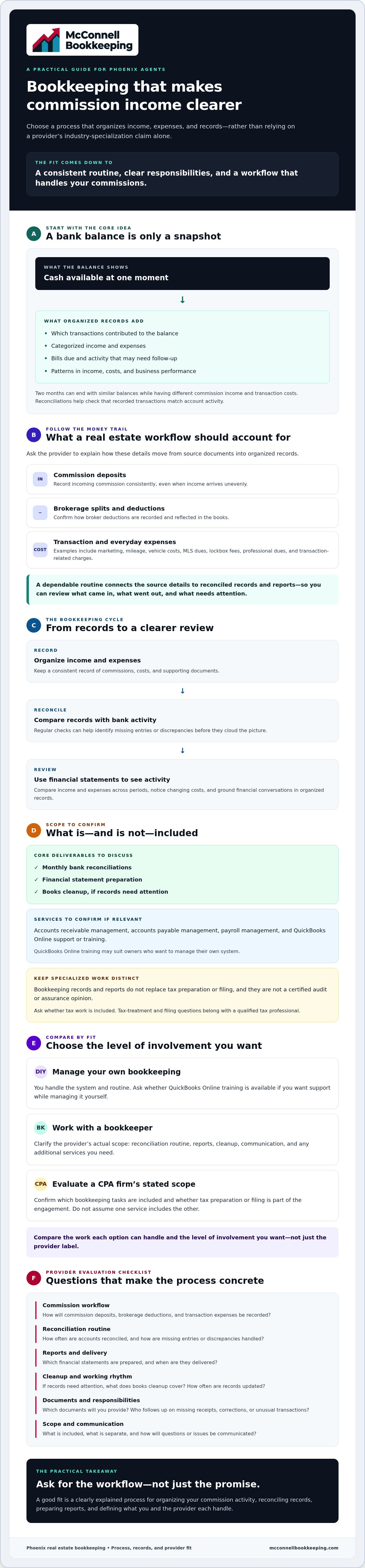
Commission income can arrive unevenly, while marketing, mileage, MLS dues, lockbox fees, and other business costs continue between closings. A bank balance shows the cash available at one moment, but not which transactions contributed to it or which payments still need attention. Consistent records help Phoenix agents see the activity behind the balance.
Bookkeeping is the process of recording and organizing financial transactions, reconciling account records with bank activity, and preparing reports that summarize business finances. In practice, bookkeeping for real estate agents Phoenix means keeping an organized record of income and expenses so agents can review business activity more clearly. Bookkeeping records can support financial decisions, but they aren’t a substitute for tax preparation or a certified audit.
A bank balance alone won’t show categorized income, bills due, or patterns in business performance. For example, two months might end with similar balances even though one had stronger commission income and higher transaction costs. Regular reconciliation checks whether recorded transactions match account activity, helping identify missing entries or discrepancies before they cloud the picture.
What bookkeeping can clarify for a commission-based business
Recording each commission deposit consistently gives an agent a clearer view of incoming cash over time. Expense categories can show where business funds are going, from advertising and vehicle costs to professional dues and transaction-related charges. These are examples of ways to organize records, not advice about tax deductibility. Monthly financial statements can help compare income and expenses across periods, spot changing costs, and support a more informed review of business activity.
This routine is especially useful when income varies. Rather than relying on memory or a busy-season bank balance, an agent can review organized records and statements to understand what came in, what went out, and what may need follow-up. Accurate records also make financial conversations more grounded.
Where bookkeeping ends and tax or audit services begin
Bookkeeping records and reports organize financial activity. Income tax preparation and filing involve applying tax rules to prepare returns. Questions about tax treatment or filing belong with a qualified tax professional. Likewise, bookkeeping reports are not a certified audit or assurance opinion. They summarize the records maintained but do not independently verify the financial statements.
Keeping these roles clear helps agents choose the right support for each need. A bookkeeper can help maintain reconciled records and prepare financial statements, while tax and audit questions should go to appropriately qualified professionals. This provides a clearer foundation for reviewing business finances without confusing routine recordkeeping with specialized tax or assurance work.
Bookkeeping Features Phoenix Real Estate Agents Should Evaluate
A useful bookkeeping arrangement is defined by its routine, responsibilities, and reporting, not just a list of services. For bookkeeping for real estate agents Phoenix, ask the provider to explain how commission records, broker deductions, and transaction expenses would move from source documents into organized accounts. Confirm that workflow directly rather than assuming a provider’s title signals real estate experience.
Use this checklist to clarify the scope you’re discussing:
Core bookkeeping deliverables to confirm: monthly bank reconciliations, financial statement preparation, and books cleanup if records need attention.
Services to confirm if relevant: accounts receivable management, accounts payable management, and payroll management.
Separate or optional needs: QuickBooks Online training may suit owners who want to manage their own system. Ask whether income tax preparation or filing is included. Don’t assume bookkeeping covers it.
Establish the working rhythm, too. Ask which documents you’ll provide, how often records are updated, when statements are delivered, and how the provider flags missing receipts, corrections, or unusual transactions. The IRS recordkeeping guidelines offer a useful reference for understanding why supporting records matter. Clear responsibilities help keep the process on track.
Questions to ask about commissions, expenses, and reporting
Bring a sample commission statement and ask how the provider would record its details and match the deposit to bank activity. Find out whether broker deductions and transaction costs can be recorded in categories that make sense for your business, and which reports those records support. Ask who follows up when documents are missing, how corrections are approved, and how unusual transactions are handled before they appear in reports.
QuickBooks Online, cleanup, and ongoing support
If you already use QuickBooks Online, confirm whether the provider can work in your existing file and what setup or access is needed. Before routine monthly work begins, ask how older errors or unreconciled periods will be assessed, and whether cleanup may be needed first. If you’d rather keep day-to-day control, QuickBooks Online training may help you use the system with more confidence. Confirm the training scope and workflow that fit your needs.
McConnell Bookkeeping’s confirmed services include monthly bank reconciliations, financial statement preparation, books cleanup, receivables, payables, payroll management, and QuickBooks Online training. Ask whether its bookkeeping scope fits your commission and expense workflow. Its bookkeeping services and support page is a starting point for that conversation.
Compare DIY Bookkeeping, a General Bookkeeper, and a CPA Firm
The right option depends on the work you need handled and the support you want, not the provider’s title alone. A bookkeeper or CPA may or may not be familiar with how your commission statements, broker deductions, and deposits should be recorded. Ask each provider to explain how they would handle your actual workflow before deciding.
The IRS guidelines for real estate agents provide tax information relevant to licensed agents. Keep routine transaction recording distinct from tax planning, tax return preparation or filing, and audit engagements. A CPA firm may offer some of these services, depending on the firm and your engagement. Confirm what’s included rather than inferring it from the title.
When DIY bookkeeping may remain workable
DIY can be practical if your transaction volume is manageable, you keep source documents organized, and you can maintain a regular recording routine. You’ll still need to review reconciliations and understand what your reports show. If you use QuickBooks Online but feel unsure about its setup or reports, training may help strengthen your process while you retain day-to-day control.
When outsourced bookkeeping may be a better fit
A growing backlog, accounts that repeatedly remain unreconciled, or too little time to maintain records can signal that outside bookkeeping support is worth evaluating. A bookkeeper can take on agreed routine recordkeeping and reporting, while you remain responsible for business decisions. For bookkeeping for real estate agents Phoenix, ask specifically how the provider would organize commission statements, broker deductions, and transaction records. Direct tax, legal, and audit questions to appropriately qualified professionals, and confirm those services are separate from bookkeeping.
How to Choose a Phoenix Bookkeeper: A Practical Evaluation Checklist
A clear evaluation process helps you compare the work, communication, and fit behind each bookkeeping option. Use these steps to define the scope, and confirm directly whether the provider serves your location and can accommodate your bookkeeping needs.
What to prepare before speaking with a bookkeeper
Before reaching out, make a brief inventory of your accounts, current bookkeeping software, typical transaction activity, and any concerns, such as missing records or unreconciled months. Note whether your books are current or may need cleanup. You can discuss your workflow and desired reports without sharing account passwords or sensitive credentials during an initial conversation.
A practical evaluation sequence
Define your needs. List the tasks you want handled, such as monthly bank reconciliations, financial statement preparation, or books cleanup. Identify the reports that would help you review business activity.
Review the workflow. Ask how commission statements, broker deductions, deposits, and transaction expenses would be documented and recorded. Request a clear explanation of what information you’ll need to provide.
Confirm the scope. Establish which services are included, how often bookkeeping work is completed, when statements are delivered, and whether cleanup is needed before ongoing work begins. Clarify which responsibilities remain yours.
Discuss communication. Find out how the provider handles missing documents, questions, unusual transactions, and corrections. Agree on how you’ll share records and receive updates.
Compare fit. Consider whether the proposed process, reporting, communication, and service availability match your needs. Don’t assume that a Phoenix-area provider has capacity or a workflow suited to your business. Ask directly.
How to assess scope and service fit
Ask for specifics, not broad assurances. For example: “Are bank accounts reconciled monthly?” “Which financial statements will I receive, and when?” “How do you assess older errors or unreconciled periods?” “What documents must I provide, and how should I submit them?” Clear answers make it easier to compare providers and understand what you’re agreeing to.
Confirm service boundaries as well. Bookkeeping support is distinct from income tax return filing and certified audits. If you need tax filing or audit services, ask an appropriately qualified professional about those needs. For bookkeeping for real estate agents Phoenix, confirm that the provider can accommodate your commission and expense workflow instead of relying on a general claim of specialization.
Once you’ve outlined your accounts, workflow, and reporting needs, you can Discuss your bookkeeping needs with McConnell Bookkeeping and ask whether its confirmed services and availability fit your situation.
How McConnell Bookkeeping Can Support Real Estate Agents in Phoenix
Choosing bookkeeping support starts with a practical question: does the provider’s confirmed scope match the records and routine your business needs? McConnell Bookkeeping serves Phoenix and nearby communities. Its confirmed services include monthly bank reconciliations, financial statement preparation, books cleanup, accounts receivable management, accounts payable management, and payroll management. The firm also offers QuickBooks Online training for owners who want more confidence using their bookkeeping system.
Match confirmed services to your bookkeeping needs
Monthly bank reconciliations compare recorded transactions with bank activity, helping you check whether your books reflect what happened in your accounts. Financial statement preparation organizes business activity into reports you can use to review income and expenses. If records are behind or contain historical errors, books cleanup may be a starting point, subject to an assessment of the records and work involved.
Receivables, payables, and payroll management may also be relevant depending on how your real estate business operates. These are confirmed service categories, but don’t assume they automatically cover agent-specific workflows. Before engaging a provider for bookkeeping for real estate agents Phoenix, ask whether its process can accommodate your commission statements, broker deductions, and transaction-related expenses. Confirm exactly what will be recorded, how it will be categorized, and which reports are included.
Set clear expectations before getting started
Discuss your process before sharing access or beginning ongoing work. Ask whether the firm has experience with the specific records you use and whether its bookkeeping scope fits your workflow. Establish practical details, including:
Which software and file access the work requires, and how documents will be handed over.
How often reconciliations and other agreed bookkeeping tasks are completed.
Which financial statements or other reports will be prepared, and when you can expect them.
What records you’ll provide, who follows up on missing information, and how questions or corrections are handled.
Clear boundaries matter, too. McConnell Bookkeeping does not provide income tax return filing or certified audits. For income tax preparation or filing questions, work with a qualified tax professional. Bookkeeping reports are not an audit or assurance opinion.
A direct conversation can help you determine whether the firm’s services and working arrangements fit your needs. Contact McConnell Bookkeeping to discuss your bookkeeping requirements and ask about the scope that may apply to your records.
Build a Clearer Financial Routine for Your Real Estate Business
Choose bookkeeping support based on the consistency of its process and how clearly it defines responsibilities, reporting, and service scope. For bookkeeping for real estate agents Phoenix, confirm directly whether a provider can accommodate your commission and expense workflow rather than relying on a general claim of industry expertise.
McConnell Bookkeeping’s primary service is monthly bank reconciliations, with confirmed support for financial statement preparation, books cleanup, and QuickBooks Online training. Reconciliations help check recorded transactions against bank activity, while statements organize business finances for review. If your records need attention, cleanup may be a starting point, subject to assessment. McConnell Bookkeeping serves Phoenix and nearby communities, including Mesa, Gilbert, Tempe, Chandler, and Scottsdale.
To discuss whether the firm’s services fit your records and bookkeeping needs, Discuss your bookkeeping needs with McConnell Bookkeeping.
Frequently Asked Questions
What bookkeeping services does a real estate agent need?
A real estate agent generally needs organized income and expense records, reconciled business accounts, and useful financial statements. For bookkeeping for real estate agents Phoenix, consider whether support should also include books cleanup, accounts receivable or payable management, or payroll management. The right scope depends on your business activity and recordkeeping routine. McConnell Bookkeeping offers these confirmed bookkeeping services, but ask whether its workflow fits your commission and expense records.
Can a bookkeeper track real estate commissions and broker deductions?
A bookkeeper may be able to record commissions and broker deductions, but confirm the provider’s process and capability before engaging them. Ask how commission statements will be matched to bank deposits and whether brokerage splits, referral fees, and transaction costs can be recorded separately in categories that suit your reports. Share a sample statement with sensitive details removed to discuss the workflow. Don’t assume general bookkeeping experience includes familiarity with agent-specific records.
How often should a Phoenix real estate agent reconcile business accounts?
Monthly reconciliation is a practical routine for keeping recorded transactions aligned with bank activity and reviewing finances regularly. It can help identify missing entries or discrepancies before they remain unresolved across multiple reporting periods. Reconcile each business account, including any business credit card accounts, and keep supporting records organized. McConnell Bookkeeping’s primary service is monthly bank reconciliations. Confirm which accounts and records would be covered under an engagement.
Should real estate agents use QuickBooks Online for bookkeeping?
QuickBooks Online may suit agents who want a digital system for organizing transactions and reviewing financial activity, but the software alone doesn’t ensure accurate records. Set up categories that reflect your business and establish a consistent routine for recording activity and checking reports. If you already use the platform, ask a bookkeeper whether they can work in your existing file. McConnell Bookkeeping offers QuickBooks Online training for owners who want to manage their system themselves.
Can a bookkeeper help clean up a real estate agent’s overdue books?
Yes, books cleanup may help address disorganized records, historical errors, or unreconciled periods before regular bookkeeping resumes. First, ask the provider to assess how far behind the records are, what documents are available, and what work may be needed. Don’t assume cleanup is automatically part of monthly service. McConnell Bookkeeping offers books cleanup, but the appropriate starting point depends on the condition and scope of the records.
Does bookkeeping for real estate agents include tax preparation?
No, bookkeeping and income tax preparation are separate services. Bookkeeping organizes transactions, reconciles accounts, and prepares financial reports. It doesn’t automatically include preparing or filing income tax returns. A bookkeeper’s records may inform discussions with a tax professional, but questions about tax treatment, planning, or filing should go to a qualified tax professional. McConnell Bookkeeping does not provide income tax return filing, so confirm service boundaries before engaging any provider.
How do I choose a bookkeeper for my real estate business in Phoenix?
Compare providers by their process, deliverables, communication, and fit with your workflow, not by title alone. Ask how they handle commission statements, broker deductions, monthly reconciliations, financial statements, cleanup, and missing documents. Confirm who supplies records, when reports arrive, and what remains your responsibility. Phoenix-area prospects, including agents in Mesa, Gilbert, Tempe, Chandler, and Scottsdale, should verify service availability and working arrangements directly before deciding.


Comments