Bookkeeping for Law Firms in Mesa: Build Clearer Financial Records

A firm can bring in steady work and still struggle to see where its money is going. When transactions are scattered and financial reviews happen only when time allows, it’s hard to understand operating income and expenses, especially when client-fund records also need distinct attention. If you’re searching for bookkeeping for law firms Mesa, look for a dependable monthly routine that makes the firm’s business finances easier to review.
Law firms share many bookkeeping needs with other small businesses, but client funds involve separate recordkeeping considerations. Regular transaction recording and bank reconciliations help clarify the firm’s operating activity, while organized reports give owners a more useful basis for routine decisions.
This article explains which records and reports can help you understand your firm’s operating finances, why client-fund records require separate attention, and how bookkeeping can fit into your monthly routine. You’ll also learn how Book Clean-up can organize historical transactions and how Financial Analysis can provide strategic insight from clearer records. With a consistent process, your numbers can become more than paperwork: they can help you make informed decisions with greater confidence.
Table of Contents
Bookkeeping for Law Firms in Mesa: What Clear Records Make Possible
A firm’s financial records should do more than store a trail of transactions. Law-firm bookkeeping organizes, records, and reviews a practice’s operating activity so its owners can understand how income and expenses shape business performance, not just see that entries were made. Transaction entry captures individual events; bookkeeping brings them together in a consistent picture the firm can review.
For a small practice, scattered records can make it difficult to tell whether revenue has been recorded accurately, which expenses have been paid, or how current activity compares with an earlier period. A dependable process creates structured records and supports financial statements that are more useful for routine review. It also keeps the firm’s operating picture distinct from client-fund recordkeeping, which has its own considerations and should be handled according to applicable guidance.
Which financial activity belongs in a law firm’s operating books?
The operating books should capture the firm’s business income and ordinary expenses accurately, with each transaction recorded consistently. For example, a payment received for the firm’s work and a recurring software or office expense both need a clear place in the records. The goal is not simply to enter amounts, but to preserve enough detail to understand what each transaction represents.
Complete records make financial statements more useful because those statements rely on the activity entered in the books. Missing or duplicated transactions, or entries that are difficult to interpret, can leave an owner with an incomplete view. Organized entries connect day-to-day activity with the broader picture of income, expenses, and operating performance.
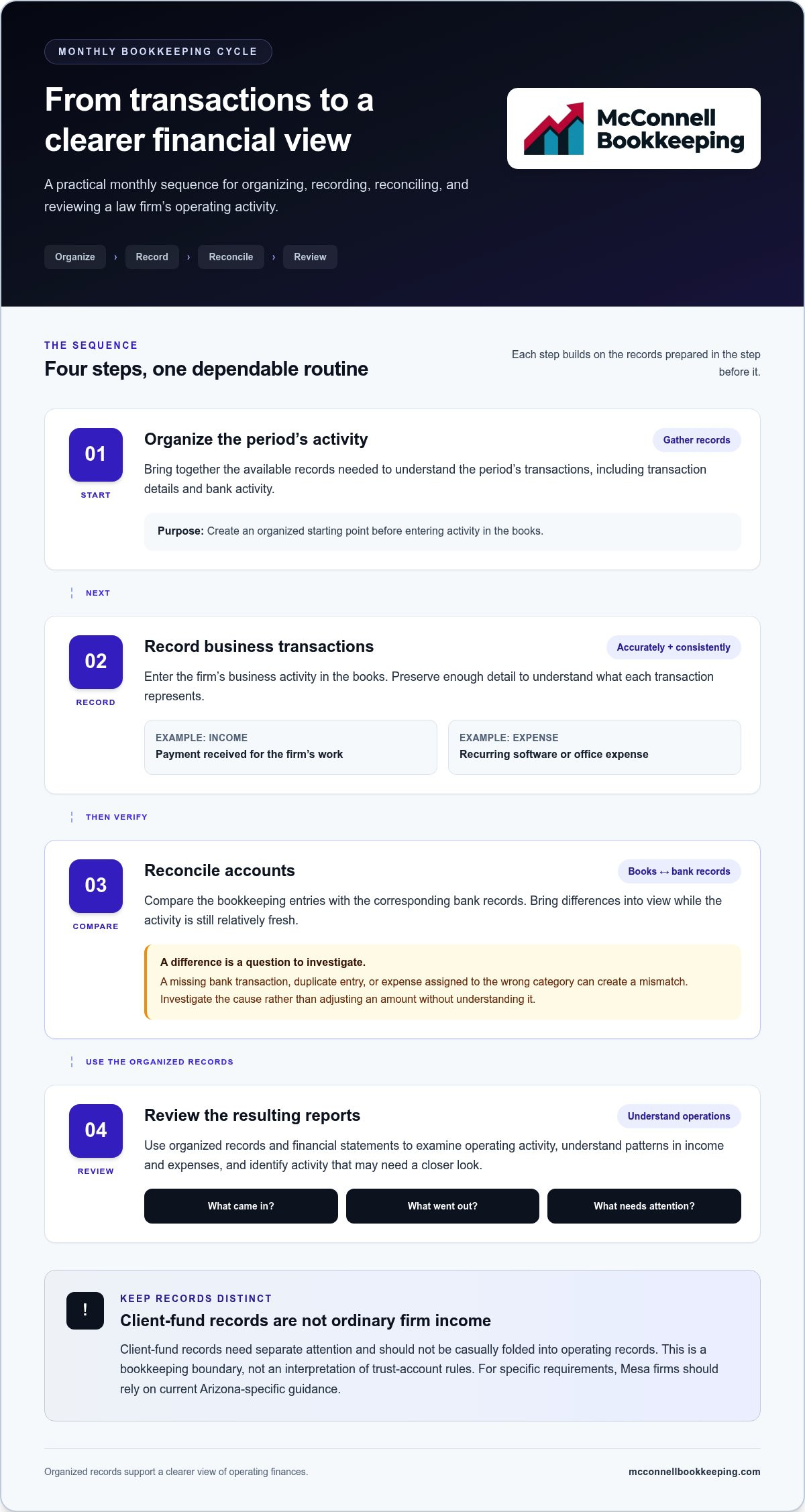
Client-fund records are a separate consideration. They shouldn’t be treated as ordinary firm income or casually folded into operating records. This distinction is a bookkeeping boundary, not an interpretation of trust-account rules. For questions about specific requirements, Mesa firms should rely on current Arizona-specific guidance.
Why Mesa law firms benefit from a consistent financial picture
A regular view of the books helps owners and office managers make practical decisions using current information. They can review what came in, what went out, and whether recorded activity reflects the firm’s operating picture before planning upcoming expenses or assessing business activity. Clear records also make it easier to spot entries that need attention before questions accumulate.
For small firms and practices in Mesa, AZ, a consistent process can replace occasional catch-up with a more dependable financial routine. Each review builds on organized records, helping the next report tell a clearer story. The benefit is a stronger basis for understanding the firm and deciding what deserves attention next, not a guaranteed business outcome.
How Monthly Bookkeeping Gives Mesa Law Firms a More Reliable Financial View
A dependable monthly process turns day-to-day activity into records a firm can review and use. For bookkeeping for law firms Mesa, the work follows a practical sequence: organize the activity, record transactions, reconcile accounts, and review the resulting reports. Each step supports the next. If records are incomplete or entries are unclear, the final reports may not provide a reliable view of the firm’s operating finances.
What happens during a monthly bookkeeping cycle?
The cycle begins by gathering the available records for the period, such as transaction details and bank activity. Once the information is organized, transactions are recorded accurately in the books. The account is then reconciled by comparing the bookkeeping entries with the corresponding bank records. Any difference becomes a question to investigate, not an amount to adjust without understanding its cause.
Organize activity: Bring together the records needed to understand the period’s transactions.
Record transactions: Enter business activity accurately and consistently.
Reconcile accounts: Compare what the books show with the bank’s records and identify differences.
Review reports: Use the organized records to examine the firm’s operating activity.
A missing bank transaction, a duplicate entry, or an expense assigned to the wrong category can create a mismatch or distort reports. Regular reconciliation helps surface those issues for follow-up while the activity is still relatively fresh. Differences can have different causes, so investigate them rather than assuming each one is an error.
Monthly reconciliations improve confidence in recorded balances by checking the bookkeeping records against the bank’s activity and bringing unexplained differences into view. This is a useful foundation for understanding operating finances. It remains distinct from client-fund recordkeeping, which requires its own attention and applicable guidance.
How financial statements support law-firm decisions
Accurately recorded and reconciled transactions give financial statements a stronger foundation. These reports can help owners review the firm’s financial position, understand patterns in income and expenses, and identify activity that may need a closer look. They describe recorded performance; they don’t predict what the firm will earn or guarantee a particular result.
For example, a firm reviewing its reports may notice that an expense category has changed from the previous period or that recorded income doesn’t match expectations. That observation gives the team a specific point to investigate and makes routine planning more informed. A steady review also reduces reliance on memory or a last-minute scan of transactions.
Monthly bank reconciliations provide a practical foundation for this reporting routine, including for law practices in Phoenix. McConnell Bookkeeping’s Monthly Bookkeeping includes precise transaction recording and monthly bank reconciliations to help keep operating records organized and ready for review.
General Bookkeeping and Law-Firm Client-Fund Records Are Not the Same
Law-firm finances involve two different recordkeeping pictures: the firm’s own business activity and funds held for clients. Ordinary bookkeeping helps owners understand the operating side, but it doesn’t explain every responsibility connected with client funds. Keeping those areas conceptually separate helps prevent an operating report from being mistaken for a complete view of all financial records a practice may need.
What belongs in operating bookkeeping versus specialized trust records?
Operating bookkeeping records the firm’s own business activity, such as income received by the practice and its ordinary expenses. Those entries help describe how the business is functioning. Client-fund records serve a different purpose: they concern money held for clients and require a separate recordkeeping approach. The distinction is about the type of funds and records involved, not a substitute for interpreting specific requirements.
A common misconception is that recording every transaction in general bookkeeping software explains every financial obligation a law firm has. It doesn’t. A clear operating ledger can support useful reports, while client-fund records remain a distinct area that needs careful handling. Treating the two as interchangeable can obscure what the operating reports actually represent.
How to approach trust-account questions responsibly in Arizona
Trust-account questions can depend on professional requirements that are separate from routine operating bookkeeping. Rather than relying on a general bookkeeping explanation to settle a specific issue, Mesa firms should consult current guidance from the Arizona State Bar. This article draws a practical boundary between recordkeeping areas; it doesn’t interpret rules or determine what a particular practice must do.
For owners exploring bookkeeping for law firms Mesa, this distinction helps define the scope of a useful financial review. Operating books can show the firm’s own business activity, while client-fund records need to be considered separately under applicable guidance. Keeping those purposes clear supports better questions, more understandable reports, and a more disciplined financial routine.
A practical way to maintain that boundary is to label records by purpose and review operating reports as a picture of the firm’s business activity, not as a complete account of client-fund responsibilities. If an entry’s nature is unclear, flag it for appropriate follow-up instead of assuming its treatment based only on where it appears in the books. Clear boundaries make bookkeeping more useful without blurring distinct responsibilities.
A Practical Bookkeeping Checklist for Mesa Law-Firm Owners
A repeatable checklist keeps routine bookkeeping from becoming a last-minute scramble. For Mesa law-firm owners, the goal is to review operating records consistently, note missing information, and keep questions about client-fund records separate for appropriate Arizona-specific guidance. This structure helps owners and office managers know what’s been reviewed and what still needs attention.
Records to keep organized for routine bookkeeping
Keep bank activity, transaction details, and supporting business records together in a consistent system. Clear descriptions and organized documentation make it easier to connect an entry to the activity it represents. They also help identify gaps, such as a bank transaction without a matching bookkeeping entry or an entry that needs clarification. This is a practical organization habit, not a statement about legally required retention periods.
Use this monthly operating-book checklist:
Gather records: Collect bank activity, transaction information, and available supporting business records for the period.
Check completeness: Look for transactions that may be missing, duplicated, or difficult to identify, and flag them for follow-up.
Review categorization: Confirm that recorded business activity is organized consistently so reports are easier to interpret.
Review reconciled balances: Compare bookkeeping records with the corresponding bank activity and note any unresolved differences.
Look at available statements: Review the financial statements for a clear view of recorded income, expenses, and operating activity.
Separate trust-account questions: Keep client-fund recordkeeping distinct from the routine operating review, and consult current Arizona-specific professional guidance for questions about trust-account responsibilities.
A short, regular review can make follow-up more manageable. If a transaction is unclear, record the question and the information needed to resolve it rather than relying on memory later. Consistent organization also makes patterns and unusual entries easier to spot without treating every difference as an error.
How QuickBooks Online can support an organized process
McConnell Bookkeeping uses QuickBooks Online. A well-organized transaction record in the platform can support a clearer review by keeping business activity in a structured bookkeeping system. The software is a tool, not a substitute for reviewing entries, reconciling accounts, or keeping operating records separate from client-fund responsibilities.
For firms in Chandler and nearby communities, the practical reminder is simple: gather the records, check completeness, review reconciled balances and statements, then set aside trust-account questions for applicable guidance.
If you’d like support keeping operating records organized and reviewed each month, explore Monthly Bookkeeping from McConnell Bookkeeping.
How McConnell Bookkeeping Supports Law Firms in Mesa and Phoenix
Clear operating records give a law firm a steadier basis for reviewing its finances. McConnell Bookkeeping serves small businesses in Mesa, AZ and the Phoenix business community, including nearby Gilbert, Tempe, Chandler, and Scottsdale. Its services include Monthly Bookkeeping, Book Clean-up, Payroll Services, and Financial Analysis. For firms considering bookkeeping for law firms Mesa, start with the task causing the most friction: keeping current transactions organized, sorting out older records, managing payroll, or gaining more insight from financial information.
Which McConnell Bookkeeping services fit a law firm’s needs?
Monthly Bookkeeping includes precise transaction recording and monthly bank reconciliations. Those recurring tasks help keep operating records organized and make recorded balances easier to review. Book Clean-up reviews and organizes past transactions to resolve discrepancies, helping bring historical records into a clearer state. These services support the firm’s operating picture, distinct from client-fund recordkeeping.
For a practice with payroll activity to manage, Payroll Services provide accurate, on-time payroll processing while staying compliant with local tax regulations. Financial Analysis provides strategic data and insights that can inform long-term profitability decisions. Each service addresses a different need: orderly current records, attention to past transactions, payroll support, or a more considered view of financial information. The focus is useful information for decision-making, not a promised financial result.
These services can address different priorities rather than following a one-size-fits-all approach. A firm whose books need a fresh start may prioritize organizing historical transactions; a firm with current records may focus on recurring recording and reconciliations. Financial Analysis can help owners use the resulting information to consider longer-term business decisions. The first step is identifying which part of the process needs attention.
What a clear next step can look like
Before taking action, make a short list of bookkeeping questions that come up repeatedly. Note whether you need more consistent transaction records, help reviewing past activity, payroll support, or clearer financial insight. This gives the conversation a concrete focus and helps connect the firm’s current needs with an appropriate bookkeeping priority.
For Mesa and Phoenix-area practices, a dependable process can make routine financial review more manageable by keeping attention on the firm’s operating records and reporting needs. If you’re ready to discuss support for those records, explore bookkeeping support for your firm.
Make Your Next Financial Review More Intentional
A clearer financial routine starts with one practical choice: decide what you want your books to help you understand. You might want to see whether current records are complete, get a more useful view of operating activity, or create a regular moment to review the numbers. Naming that priority turns bookkeeping for law firms Mesa from a broad concern into a focused next step.
You don’t need to solve every bookkeeping challenge at once. Start with the question that most often interrupts your attention, then build a process that keeps it visible and manageable. As your records become easier to review, you can approach financial decisions with greater context and less uncertainty. That steady progress can make bookkeeping a practical part of running your firm, rather than a task that only surfaces when something feels unclear.
Ready to take the next step? Explore bookkeeping support from McConnell Bookkeeping and begin building a financial routine that fits your firm’s needs.
Frequently Asked Questions
Is bookkeeping different for a law firm than for another small business?
Yes. Law firms and other small businesses both need core bookkeeping tasks, including recording transactions and reconciling accounts. A law firm may also have separate responsibilities for recording client funds, which aren’t explained by ordinary operating books alone. For bookkeeping for law firms Mesa, keep those recordkeeping areas distinct, and consult current Arizona State Bar guidance for applicable professional requirements rather than relying on a general bookkeeping explanation.
Can a Mesa law firm use QuickBooks Online for its bookkeeping?
Yes. QuickBooks Online is the platform McConnell Bookkeeping uses, and it can support organized transaction records and financial reporting. Consistently recording business income and expenses, for example, can make operating activity easier to review. The software doesn’t make entries accurate on its own, and using it doesn’t resolve specialized trust-account responsibilities. Firms still need careful records and appropriate guidance for client-fund questions.
What should a law firm do when its older bookkeeping records contain discrepancies?
Start with a structured review of past transactions so unclear entries and differences can be identified and organized for follow-up. McConnell Bookkeeping’s Book Clean-up reviews and organizes past transactions to resolve discrepancies. A practical first step is to gather the existing records and note where amounts or descriptions seem inconsistent. That creates a clearer starting point without assuming every difference has the same cause or can be resolved in the same way.
Does monthly bookkeeping help a law firm understand its financial position?
It can support a clearer understanding by keeping operating records current and easier to review. Accurate transaction recording and monthly bank reconciliations provide a more dependable basis for financial statements, which owners can use to assess recorded income, expenses, and balances. Those reports help frame decisions, but bookkeeping alone doesn’t guarantee profitability or predict what the firm will earn. The value is a more informed view of the activity already recorded.
Can bookkeeping help a law firm keep payroll records organized?
Yes. McConnell Bookkeeping provides Payroll Services for accurate, on-time processing while staying compliant with local tax regulations. Keeping payroll activity organized alongside the firm’s other business records can make routine financial reviews easier and help owners see payroll activity in the operating picture. Payroll support is one part of a broader bookkeeping routine; it doesn’t replace the need to maintain clear records for the firm’s other transactions.
What is the difference between a law firm’s bank balance and its bookkeeping records?
A bank balance reflects activity the financial institution has processed, while bookkeeping records show transactions entered for the firm’s business. The figures may differ if activity hasn’t cleared, an entry is missing, or a transaction was recorded incorrectly. Reconciliation compares the two sources and helps bring discrepancies to light for follow-up. Neither the bank balance nor the bookkeeping records alone explain the firm’s complete financial position.
How can a law-firm owner prepare for an initial bookkeeping review?
Make recent bank activity, transaction details, and existing bookkeeping records easy to access and review. You can also jot down specific questions, such as an unexplained entry or a balance that doesn’t match your expectations. This helps focus the review on concrete issues instead of searching through scattered information. Keep client-fund questions separate from routine operating-book questions, and use current Arizona-specific guidance when trust-account requirements are involved.



Comments