Bookkeeper Red Flags: 9 Warning Signs Small Businesses Shouldn’t Ignore in 2026

What if a bookkeeping problem isn’t a single missed transaction, but a pattern you’ve been taught to overlook? Bookkeeper red flags can show up as late reports, confusing explanations, or bank balances that don’t match your records. These concerns deserve a clear answer, not guesswork.
You’re right to expect timely, understandable financial information and a straightforward explanation of how the numbers were recorded. When the records don’t add up, it doesn’t always mean the situation can’t be corrected. It does mean you need to understand what’s missing, how the issue will be reviewed, and what happens next.
In this guide, you’ll learn nine warning signs to watch for, which records and explanations to request, and how to assess whether the books need a closer review. You’ll also see how regular bank reconciliations and accurate monthly bookkeeping can make your financial information more useful for day-to-day decisions. With a clearer picture of your records, you can move forward with greater confidence.
Table of Contents
Bookkeeper red flags: what they can reveal about your business records
Accuracy and timing red flags: late books, unreconciled accounts, and unclear reports
Communication and transparency red flags: when bookkeeping questions go unanswered
How McConnell Bookkeeping supports clearer records in Mesa and Phoenix
Bookkeeper red flags: what they can reveal about your business records
A bookkeeping concern deserves attention when it keeps happening, remains unresolved, or comes without a clear explanation. One incorrect entry can be an ordinary mistake; repeated discrepancies or missing records may point to a process that needs closer review. Focus on what the records show rather than assuming why an issue occurred.
A bookkeeper red flag is a recurring, observable problem in financial records or communication, not a single error that’s promptly explained and corrected. Keep the focus on what you can verify: which account or report is affected, when the issue appeared, and what explanation or correction followed.
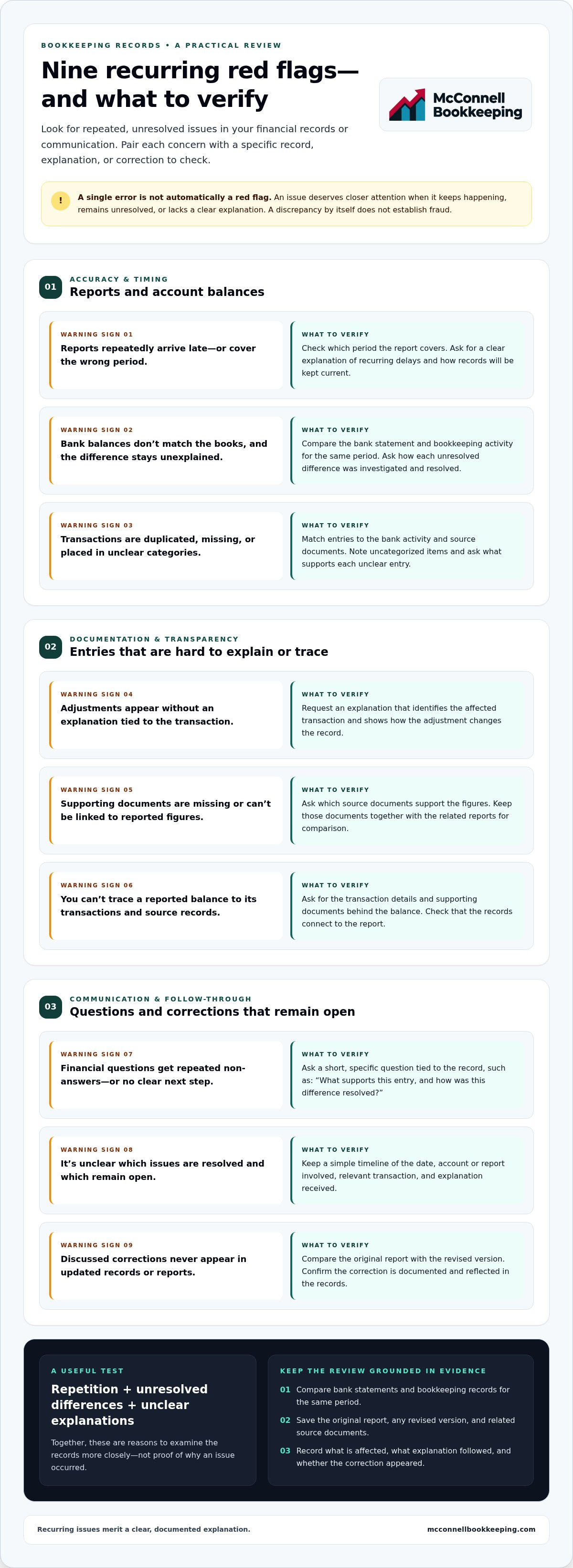
Nine warning signs to look for are:
Reports repeatedly arrive late or cover a period different from the one you requested.
Bank balances don’t match the bookkeeping records, and the differences remain unexplained.
Transactions appear twice, are missing, or are recorded in an unclear category.
Adjustments are made without an explanation tied to the affected transaction.
Supporting documents are missing or can’t be connected to reported figures.
Financial questions receive repeated non-answers or no clear next step.
You can’t tell which issues are resolved and which remain open.
Corrections are discussed but don’t appear in the updated records or reports.
You can’t trace a reported balance back to its transaction details and source documents.
For a broader overview of deliberate financial misrepresentation, see this explanation of accounting fraud. A bookkeeping discrepancy alone doesn’t establish fraud. It’s a reason to seek documentation and a clear account of what happened.
For a quick overview of common warning signs, watch this video:
When does a bookkeeping issue become a warning sign?
Look for repetition, unresolved differences, and answers that don’t explain the records. A transaction may be entered in the wrong category, for example. If the error is acknowledged, corrected, and reflected in the updated report, you have a concrete way to track its resolution. If similar entries keep appearing or the correction is never documented, follow up with the specific transaction details.
Keep a simple timeline so you can discuss facts rather than rely on memory. Note the date, account or report involved, amount or transaction if relevant, and any explanation you received. Save the original report and any revised version. This makes it easier to see whether the issue is isolated or part of a pattern.
Why small businesses need dependable financial records
Current, organized records help you understand income and expenses alongside the cash available to run the business. A bank balance alone doesn’t tell the full story: payments may still be outstanding, transactions may not yet be recorded, or expenses may be assigned incorrectly. Reviewing complete records gives you a more useful view of your cash position.
Financial information helps owners review business performance over time, spot changes in revenue or spending, and make decisions with more context. For a small business in Mesa or elsewhere in the Phoenix business community, that could mean examining whether a slower period reflects lower sales, higher costs, or transactions that still need to be recorded. The numbers are most useful when they’re timely and understandable.
Record the date and details of recurring issues.
Keep reports and supporting documents together for comparison.
Ask for an explanation tied to the specific transaction or balance.
Approaching concerns this way keeps the conversation grounded in evidence. It also helps clarify what needs correction and what additional records would make your business finances easier to understand.
Accuracy and timing red flags: late books, unreconciled accounts, and unclear reports
Reliable books should give you a usable picture of a specific period, not a set of figures you can’t verify or interpret. Repeated delays become a concern when you’re reviewing last month’s finances only after decisions about spending, staffing, or cash have already been made. A late report may have an understandable cause, but recurring delays deserve a clear explanation and a plan for keeping records current.
A bank reconciliation compares recorded account activity with the transactions shown on the bank statement for the same period. This comparison helps identify differences that need investigation, such as a transaction missing from the books or an entry recorded twice. A difference doesn’t automatically mean someone made a serious error. Timing, incomplete information, or a recording mistake may explain it. What matters is whether it’s reviewed and resolved.
How to spot reconciliation and transaction-recording problems
Choose a completed month and compare the bank statement with the bookkeeping activity for that exact period. Check that the opening and closing balances are understandable, then look for transactions that appear on one record but not the other. Compare matching date ranges; using different periods can create apparent mismatches that don’t reflect a bookkeeping error.
Ask for clarification when you find an unresolved difference, a duplicate entry, or a transaction without documentation that explains its business purpose. Also note uncategorized items and balances that don’t have an evident connection to supporting records. A short, specific question is useful: “What supports this entry, and how was this difference resolved?” Regions Bank’s guide to bookkeeper fraud red flags offers additional context, but a discrepancy by itself doesn’t establish misconduct.
What late or unclear financial reports can signal
When reports repeatedly arrive too late for review, you may be relying on outdated information to judge income, expenses, and cash available. That can make it harder to distinguish a real change in business performance from transactions that haven’t been entered or reviewed yet. Routine decisions are more grounded when they’re based on current records.
Start by checking the report’s date range. Then ask what a balance represents, whether transactions are still awaiting categorization, and whether any figures rely on estimates or adjustments. If a report shows a surprising expense balance, request the transaction detail and supporting documentation so you can understand what’s included. A clear answer should connect the summary figure to the underlying records.
Monthly reconciliations provide a regular opportunity to review differences and improve confidence in account balances. McConnell Bookkeeping supports businesses in Mesa and the Phoenix area with monthly bank reconciliation services for Mesa and Phoenix businesses. If recurring mismatches or delays are making your reports harder to use, monthly bank reconciliations can add structure to your review process.
Communication and transparency red flags: when bookkeeping questions go unanswered
Bookkeeping is a shared process: your bookkeeper records and organizes financial activity, while you need enough context to understand what the records show. A temporary delay or one unclear explanation can happen. The concern grows when questions repeatedly go unanswered, adjustments appear without an explanation, or you can’t tell who is responsible for resolving an issue. These patterns make it difficult to review your finances with confidence.
Not every mistake or communication gap means you should replace your bookkeeper. First consider whether the issue was acknowledged, whether the response addressed your question, and whether the records were corrected or clarified. A professional relationship should support reasonable questions and clear ownership of follow-up, even if a response isn’t immediate.
What clear bookkeeping communication should help you understand
A useful explanation connects the report to the underlying records. It should identify the period covered, clarify what a balance or adjustment represents, and explain whether any documentation is still needed. For example, if an expense has been moved to a different category, you should be able to understand what changed and why. Clear communication helps you review the books without guessing at the meaning of an entry.
Make requests specific and keep the responses with the related reports or records. You might ask:
Which transactions make up this balance?
What documentation supports this adjustment?
Is anything still needed to complete the records for this period?
Who is responsible for following up, and what is the next step?
Written questions and answers create a useful reference if the same issue comes up again. They also make it easier to distinguish a resolved concern from one that is still open.
How to assess explanations and record access
Review the response against the question you asked. Does it explain the specific transaction, adjustment, or report figure? Does it point to relevant supporting documentation or identify what remains unresolved? If not, restate the question with the account, reporting period, or transaction details so the discussion stays focused. An unclear answer alone doesn’t prove unethical conduct, but repeated non-answers can prevent informed review.
Check, too, whether you can access the business records needed to understand the bookkeeping. Depending on the issue, that may include transaction details, receipts, invoices, bank statements, or updated reports. Records should be organized enough for you to connect a reported figure with its supporting information. If access or responsibility is unclear, ask how the records are maintained and who handles each follow-up task.
Look for a pattern over time: questions answered with relevant details, corrections reflected in the records, and clear next steps indicate a workable process. Repeated unanswered requests, unexplained adjustments, or uncertainty about who owns the follow-up deserve a direct conversation about expectations and how open issues will be resolved.
How to handle bookkeeper red flags without disruption
Finding a bookkeeping problem doesn’t mean you need to make a rushed change. A steady review can clarify whether the issue is a correctable mistake, a process gap, or a pattern that remains unresolved. Start with the records for the periods involved, and tie each concern to a specific example so the discussion stays practical and focused.
A practical review process for business owners
Gather bank statements, bookkeeping reports, and supporting documents such as receipts or invoices for the same periods. Keep the files together, and make a short list of the issues you want to understand. Include dates, accounts, transactions, and any earlier explanation or correction. This gives everyone a shared reference and reduces the chance of discussing different versions of the records.
Collect the records. Assemble statements, reports, and relevant supporting documents for each period in question.
Describe each concern. Note the specific transaction, unexplained balance, late report, or missing document instead of making a broad accusation.
Request an explanation. Ask what the record represents, what information supports it, and whether a correction is needed.
Review the response. Compare any proposed correction with the source documents and updated report.
Track what remains open. Record agreed actions and follow-up dates, then check whether the records reflect the resolution.
Before a review meeting, use this checklist: bring the records, identify the period, describe the concern, request supporting details, and document the next step. This sequence helps you stay organized and assess progress without disrupting routine business operations.
When past records need a closer review
If differences span multiple periods or transactions are difficult to trace, a structured review of past records may be appropriate. Book Clean-up involves reviewing and organizing past transactions to help resolve discrepancies and make the records easier to follow. The aim is to improve the organization and accuracy of the books, not promise a particular financial result.
McConnell Bookkeeping provides Book Clean-up for businesses in the Phoenix area, including support for bringing past transactions into clearer order. If explanations and agreed corrections still don’t resolve recurring issues, consider whether a structured clean-up or a change in bookkeeping arrangements is the sensible next step. Base that decision on the records, follow-through, and whether you can get the information needed to review your finances.
For help organizing past transactions and addressing discrepancies, explore Book Clean-up support from McConnell Bookkeeping.
How McConnell Bookkeeping supports clearer records in Mesa and Phoenix
Recognizing bookkeeper red flags gives you a starting point: the next step is building records you can review and use. McConnell Bookkeeping supports small businesses in Mesa, AZ, and the Phoenix business community with Monthly Bookkeeping, monthly bank reconciliations, Book Clean-up, and Financial Analysis. These services address different needs, from keeping current transactions organized to making sense of past activity.
Monthly bookkeeping that makes the numbers easier to review
Monthly Bookkeeping includes precise transaction recording and monthly bank reconciliations using QuickBooks Online. Recording transactions and comparing account activity with bank statements helps identify discrepancies that need attention. Organized monthly records also give you a clearer foundation for reviewing income, expenses, and account balances with more context.
Consistent records can help you distinguish an actual shift in business performance from activity that hasn’t been recorded or clarified. If a statement shows an expense change, for instance, transaction details can help you understand what contributed to it. Reliable information supports more informed decisions, while regular reconciliation gives you a recurring opportunity to examine whether recorded balances align with the bank’s records.
Financial information is more useful when the underlying activity is organized and understandable. Monthly Bookkeeping supports that foundation by keeping transaction recording and reconciliation part of an ongoing process, rather than leaving a long backlog to untangle later. It also gives business owners a consistent basis for reviewing results from one period to the next.
A clear next step for small businesses in the Phoenix area
If concerns involve earlier periods, Book Clean-up reviews and organizes past transactions to help resolve discrepancies. It can be a practical next step when older entries are difficult to trace, records need organizing, or you want to understand what remains unresolved. The goal is clearer, better-organized books, not a guaranteed financial outcome.
Financial Analysis can build on organized records by providing strategic data and insights for business decisions, including consideration of longer-term profitability. Clearer information can help you examine performance and weigh choices with a better understanding of the numbers behind them. It doesn’t replace your judgment as the owner; it gives you more useful financial context for applying it.
A practical starting point is to gather the periods and accounts that concern you, note which discrepancies remain open, and identify what you need to understand from the records. That preparation helps make a bookkeeping review focused and productive. McConnell Bookkeeping’s monthly reconciliations and Book Clean-up support clearer records for businesses in Mesa, Phoenix, Gilbert, Tempe, Chandler, and Scottsdale, whether the priority is strengthening current bookkeeping or organizing past transactions.
To see how this support can fit your business needs, learn about McConnell Bookkeeping’s services.
Build a clearer path forward for your business
Not every bookkeeping concern calls for an immediate change. What matters now is whether you can get clear answers, understand what remains unresolved, and see a practical way to move forward. Use the records you’ve gathered to decide what needs attention first, then set a clear expectation for how open questions will be addressed.
Recognizing bookkeeper red flags is a way to protect your ability to make informed choices, not a reason to assume the worst. A thoughtful review can help you distinguish a fixable process problem from a recurring issue that needs a different approach. You deserve financial information you can understand and use as your business grows.
For small businesses in Mesa and the Phoenix community, McConnell Bookkeeping provides support designed to bring structure and insight to business finances. Take the next step toward records that better support your decisions: explore monthly bookkeeping and financial analysis for your business.
With the right information and a clear plan, you can move ahead with greater confidence.
Frequently Asked Questions
What are the most common bookkeeper red flags?
Common bookkeeper red flags include repeated late records, balances that don’t tie to supporting documents, transactions with no clear explanation, and financial questions that remain unanswered. Look at how issues are handled, too. A one-time mistake with a clear correction is different from a concern that reappears without explanation. Keep a dated note of what you noticed so you can discuss specific facts rather than rely on memory.
How can I tell if my bookkeeping is accurate?
Check whether key figures can be traced from a financial report to transaction details and supporting documents. For example, select a recorded expense and see whether its date, amount, and business purpose match the invoice or receipt. Confirm that you’re reviewing the same reporting period across records. If a figure can’t be traced, ask what information supports it before relying on that number for a business decision.
Can a bookkeeper make mistakes?
Yes. Bookkeepers can make data-entry or categorization mistakes, just as errors can arise from incomplete or unclear source information. One mistake doesn’t establish a broader problem. Focus on whether the entry can be explained, corrected in the records, and reflected in any affected reports. If you find an error, share the supporting document and ask what changed so you can understand the updated entry.
What should I do if my bookkeeper is not reconciling accounts?
Ask which accounts and reporting periods haven’t been reconciled, then compare the related statements and bookkeeping records. Avoid making a manual adjustment just to force two balances to match, since that can obscure the original difference. Keep the records together and identify what information is needed to complete the review. McConnell Bookkeeping provides monthly bank reconciliations for businesses in Mesa, Phoenix, Gilbert, Tempe, Chandler, and Scottsdale.
When should I consider a bookkeeping clean-up?
Consider a clean-up when older transactions are difficult to trace, records cover several periods with unresolved differences, or you can’t confidently use the reports to understand your business activity. Before starting, gather the statements, reports, and supporting documents you have, and note which periods or accounts concern you. McConnell Bookkeeping’s Book Clean-up reviews and organizes past transactions to help resolve discrepancies and make records easier to follow.
Should I change bookkeepers after finding a bookkeeping error?
Not necessarily. First determine whether the error was corrected and whether you can understand how it affected the records or reports. Consider a change if concerns keep recurring, explanations don’t address the issue, or agreed follow-up repeatedly goes unfinished. Your decision should reflect the overall pattern and your ability to review the books, not just the fact that one entry was wrong.
Can monthly bank reconciliations help identify bookkeeping problems?
Yes. Comparing recorded account activity with the bank statement each month can help surface missing, duplicate, or incorrectly recorded transactions while the relevant period is easier to review. A reconciliation can point to a difference that needs attention, but it doesn’t explain its cause on its own. Review the transaction details and supporting documents before deciding whether a correction is needed.



Comments