2026 Profitability Guide for Arizona Small Businesses

What if a healthy bank balance is hiding an unprofitable business? Cash on hand can feel reassuring, but it doesn’t show whether your revenue covers expenses, whether bills are still outstanding, or what you can truly take home. Measuring business profitability starts with accurate, reconciled records, not a glance at your account balance.
If you’ve struggled to tell cash flow from profit, or worry that messy books could complicate tax season or a loan application, you’re not alone. Reliable numbers bring those questions into focus and give you a steadier foundation for decisions.
This guide explains the key profitability metrics to track, how to read them alongside cash flow, and why regular bank reconciliations matter. You’ll also learn how clear financial statements can reveal your real take-home pay and help you plan with confidence. Whether you run a law firm, dental practice, or another small business in Mesa, Phoenix, Gilbert, Tempe, Chandler, or Scottsdale, a consistent bookkeeping process can turn confusing figures into useful insight.
Table of Contents
Beyond the Bank Balance: What Measuring Profitability Really Means
The 3 Essential Profitability Ratios Every Arizona Business Owner Should Know
Industry-Specific Metrics: Profitability for Law Firms and Dental Practices
The 'Clean Books' Prerequisite: Why Your Metrics Might Be Lying to You
Strategic Financial Oversight: Transforming Data into Growth with McConnell Bookkeeping
Beyond the Bank Balance: What Measuring Profitability Really Means
Your bank balance tells you how much cash is available at a moment in time. It doesn’t tell you whether the business earned a profit, whether outstanding bills will absorb that cash, or whether operations are generating returns efficiently. For Arizona owners making decisions about staffing, expansion, or their own pay, measuring business profitability means looking beyond the account balance to accurate financial records.
Profit is the dollar amount left after expenses are deducted from revenue over a defined period. Profitability measures how effectively the business turns revenue into profit, often expressed as a margin. As a reference point, profit margin is a financial ratio that measures the percentage of profit earned by a company in relation to its revenue. A business may report a larger profit simply because it has more revenue, while a margin helps show how efficiently it earns that profit.
Cash Flow vs. Profit: The Great Confusion
Cash flow is the timing of money entering and leaving your business. Those movements don’t always match when revenue is earned or expenses are recorded. For example, a customer may pay an invoice this month for work completed earlier, while rent, payroll, and supplier bills are due now. The deposit can lift your bank balance without proving that this month’s work was profitable.
The reverse can happen, too: a business can show a profit on its financial statements but run short of cash because customers pay late, bills come due, or funds are tied up in unpaid invoices. If it can’t meet obligations as they arise, even a profitable business can face serious financial strain. For a new Mesa startup, burn rate is the pace at which it spends cash reserves, a useful measure of how quickly available funds may run down before revenue covers expenses.
A profit and loss statement shows revenue and expenses over a period; a balance sheet summarizes assets, liabilities, and equity at a point in time; and a cash flow statement tracks cash movement. Together, they offer a fuller view of performance, obligations, and liquidity. Regular reconciliations connect recorded transactions to bank and credit card activity, helping uncover missing expenses, duplicate entries, or other errors that can create phantom profits. McConnell Bookkeeping’s monthly bank reconciliation service supports accurate records so owners can base decisions on figures they can trust.
The Strategic Importance of Accurate Measurement
Reliable profitability data turns major choices into informed decisions. Before hiring an associate or technician, compare the added payroll and related expenses with the revenue that role can reasonably support. For a Phoenix business considering expansion financing, organized financial statements can help show lenders its earnings, obligations, and ability to manage payments. They don’t guarantee approval, but clear, consistent records make the business’s financial position easier to assess.
With current, reconciled figures, you can spot pressure earlier, plan for upcoming costs, and decide when growth is financially sustainable. That’s the shift from reacting to a low balance or surprise bill to proactively guiding the business with evidence.
The 3 Essential Profitability Ratios Every Arizona Business Owner Should Know
Once your financial records are organized, a few carefully chosen ratios can show where revenue is going and what your business keeps. Measuring business profitability doesn’t require tracking every figure equally. Start with gross, operating, and net profit margins, then review them consistently to see whether changes in sales, costs, or staffing are affecting performance.
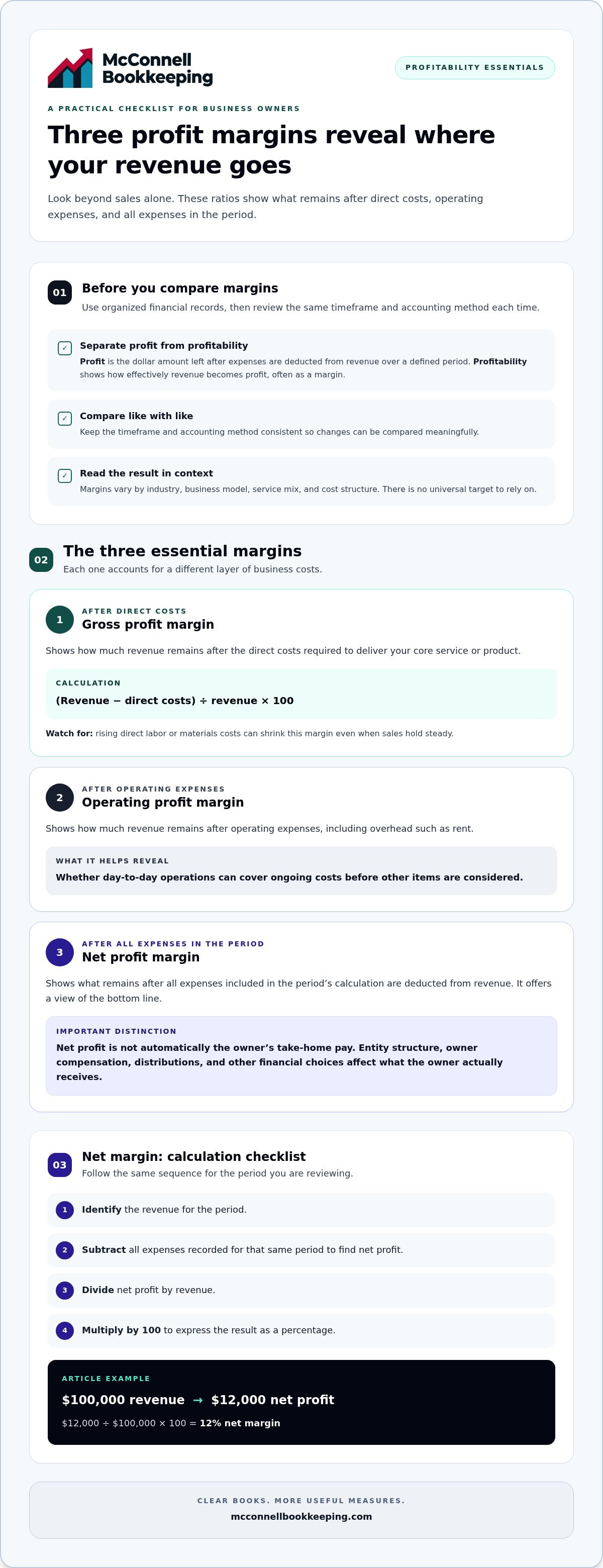
Gross profit margin shows how much revenue remains after direct costs required to deliver your core service or product. Calculate it as (revenue minus direct costs) divided by revenue, then multiply by 100. For a service business, consistently rising direct labor or materials costs can shrink this margin even if sales hold steady.
Operating profit margin shows how much revenue remains after operating expenses, including overhead such as rent in Scottsdale or Chandler. It helps reveal whether the day-to-day business can cover its ongoing costs before other items are considered.
Net profit margin shows what remains after all expenses included in the period’s calculation are deducted from revenue. It offers a view of the bottom line, but it isn’t automatically the owner’s take-home pay. Entity structure, owner compensation, distributions, and other financial choices affect what an owner actually receives.
A healthy margin varies widely by industry, business model, service mix, and cost structure, so compare your results with context rather than relying on a universal target.
Calculating Your Margins: A Simple Framework
For net profit margin, use this straightforward sequence: identify revenue for the period, subtract all expenses recorded for that same period to find net profit, divide net profit by revenue, then multiply by 100. For example, if a business records $100,000 in revenue and $12,000 in net profit, its net margin is 12%. Keep the timeframe and accounting method consistent so the comparison is meaningful.
Phoenix owners should pay attention to how they categorize owner-related expenses, subcontractor payments, software subscriptions, insurance, vehicle costs, and one-time purchases. Misclassification can shift costs between categories and make one margin look stronger or weaker than it is. Payroll deserves particular attention: wages and related employer costs can materially affect operating margin, especially when hiring increases faster than revenue or productive capacity. For dependable comparisons, clean books are current, accurate, and well-supported records that provide a reliable picture of financial health.
Benchmarking Your Success
Compare each month in 2026 with the same month in 2025, then review the full-year trend. Matching periods can help account for seasonal shifts that a simple month-to-month comparison may miss. Use consistent categories and investigate changes in revenue, direct costs, overhead, and payroll before deciding what a movement in margin means.
Industry averages can offer a starting reference, but your own history and goals provide more useful context. Watch for repeated declines in gross margin, overhead growing faster than revenue, or net margin narrowing despite steady sales. A single unusual month may have a clear explanation; a pattern deserves attention. Reviewing clear financial statements helps turn those signals into practical next steps, and financial statement preparation support can help keep the figures organized for that review.
Industry-Specific Metrics: Profitability for Law Firms and Dental Practices
A law firm and a dental practice can have very different cost structures, revenue cycles, and definitions of productive work. That’s why measuring business profitability calls for metrics that reflect how each practice earns and collects revenue, not just general small-business ratios. A useful approach connects service activity to collected income and the costs required to deliver it.
Key Performance Indicators (KPIs) for Legal Practices
For a law firm, hours worked are only part of the profitability picture. Track time recorded, fees billed, and fees collected to see where value is lost between work performed and cash received. The realization rate helps describe how much of the recorded or billed value ultimately becomes collected fees. A gap may prompt a closer look at write-downs, billing delays, unbilled work, or overdue accounts, rather than an assumption that the firm simply needs more billable hours.
Review results by partner and practice area, such as family law and estate planning, if the bookkeeping records support those categories. Compare collected revenue with direct costs and a reasonable allocation of shared overhead. This can reveal whether one area’s apparent strength depends on costs being assigned elsewhere. Profit per partner can also be informative, but define whether partner compensation is treated as an expense before comparing periods; otherwise, the figure may tell a misleading story.
Trust-related funds require clear separation and careful records. Meticulous IOLTA management helps the firm maintain financial clarity by keeping client trust activity distinct from the firm’s operating performance. Reviewing these records alongside operating accounts helps owners understand which funds represent business revenue and which do not.
Profitability Drivers for Dental Clinics
Dental practices need to connect clinical activity with collections and operating costs. Production records show the value of services provided, while collections show the revenue actually received. Differences can point to delayed claims, unpaid patient balances, adjustments, or follow-up gaps in accounts receivable. Reviewing aging balances and collection patterns helps owners identify where expected revenue is getting stuck.
Look at hygiene separately from other services. Compare hygiene collections with the related labor, supplies, and allocated overhead to see whether the department contributes to overall practice results or serves a broader patient-retention role. Either outcome can be intentional, but the numbers should make the trade-off visible.
Equipment costs, dental supplies, and laboratory fees can all affect margins. Track these expenses consistently and compare them with the services they support. If lab fees rise while collections for related procedures stay flat, the practice has a specific trend to investigate. Patient acquisition costs also matter: consider the expense of attracting new patients alongside the revenue collected from their care, without assuming every new patient produces the same return.
Consistent categories make these comparisons more useful over time. For additional practice-focused measures and ways to interpret them, explore this guide to dental practice financial metrics.
The 'Clean Books' Prerequisite: Why Your Metrics Might Be Lying to You
A profitability ratio can be calculated correctly and still tell the wrong story if the records behind it are incomplete. In QuickBooks Online, reports reflect the transactions entered and the categories assigned to them. That’s the “Garbage In, Garbage Out” problem: an omitted bill can make expenses look lower, while duplicate income can make revenue and profit appear higher than they are. Accurate data is the starting point for measuring business profitability with confidence.
Common errors include recording a customer payment as new income when it actually pays an existing invoice, entering the same expense twice, leaving bank fees unrecorded, or posting a business purchase to the wrong account. These mistakes can distort margins, obscure unpaid bills, and make one month look unusually strong or weak. If bookkeeping has fallen behind, a books cleanup can bring records current and make financial reports useful again for businesses in Scottsdale and across the East Valley.
The Power of Monthly Bank Reconciliations
A bank reconciliation matches transactions in your accounting software with the activity on a bank statement for the same period. The goal is to explain differences, such as outstanding checks or deposits in transit, and confirm that the reconciled balances agree. Monthly reconciliation helps surface missing receipts, bank fees, duplicate entries, and unfamiliar transactions that may need investigation.
This regular check matters because an unreconciled account can leave errors sitting unnoticed in the books. Those errors may flow into the balance sheet and affect the Profit and Loss report, making its results less dependable. Reconciliation doesn’t verify every account or prove that every expense is categorized correctly, but it’s a core accuracy step. Without it, owners lack a dependable foundation for a true profit number.
Cleaning Up Historical Errors
Look for warning signs such as negative balances in accounts that shouldn’t normally be negative, old uncleared transactions, large uncategorized expenses, or assets recorded without clear support. These entries don’t always mean the business is in trouble, but they do call for review. A books cleanup can trace discrepancies, correct classifications, and clarify which balances need follow-up before you rely on the reports.
Correcting historical errors can make financial statements easier to understand and support more informed decisions. Before a loan application or a practice sale, organized records help present a clearer picture of revenue, expenses, assets, and liabilities. They don’t guarantee financing or a sale outcome, but unresolved inconsistencies can invite questions and slow a review. A careful examination of past transactions may also reveal recurring costs, collection gaps, or expense patterns that have been quietly squeezing margins.
Bring your records up to date with professional books cleanup and monthly reconciliation support, then use the corrected reports to make decisions from a steadier financial footing.
Strategic Financial Oversight: Transforming Data into Growth with McConnell Bookkeeping
Accurate bookkeeping does more than organize transactions. It gives you dependable information to guide decisions, understand financial pressure, and plan your next move. With consistent records and clear reports, measuring business profitability becomes an ongoing management practice rather than a last-minute scramble for numbers.
McConnell Bookkeeping supports small businesses in Mesa, Phoenix, Gilbert, Tempe, Chandler, and Scottsdale with monthly reconciliations, financial statement preparation, and bookkeeping tailored to law and dental practices. Payroll, accounts payable, and accounts receivable management can also help owners keep essential financial processes organized, leaving clearer information to review instead of a pile of unexplained entries.
Your Monthly Financial Roadmap
A practical reporting routine gives you several connected views of the business. A Profit and Loss statement summarizes revenue and expenses for a period. A Balance Sheet shows assets, liabilities, and equity at a point in time. Accounts receivable and payable details help you see what customers owe and which bills are upcoming. Together, these reports can help explain why a profitable period may still feel tight on cash, or why revenue growth hasn’t translated into stronger margins.
Use each reporting cycle to ask focused questions: Which expenses changed? Are customer balances aging? What obligations are coming due? Is a shift in revenue reflected in the bottom line? These questions can help you decide whether to adjust spending, follow up on receivables, or revisit a hiring or expansion plan. Reports provide useful evidence, but business owners make the strategic choices.
QuickBooks Online training can help you understand how transactions flow into reports and build confidence reading your own figures. McConnell Bookkeeping offers QuickBooks Online training to help business owners use the software and interpret their financial data.
Taking the Next Step Toward Clarity
Moving from DIY bookkeeping to professional oversight doesn’t mean giving up visibility. It means having support to organize records, maintain consistent processes, and prepare financial statements you can use. If payroll, bill management, or customer collections are taking time away from running the business, structured support in those areas can make your financial picture easier to maintain.
Industry knowledge matters, too. Law practices have distinct bookkeeping needs, including IOLTA management, while dental practices benefit from records that help owners follow collections and practice expenses. Specialized law and dental bookkeeping can bring greater consistency to the categories and reports relevant to each type of business.
McConnell Bookkeeping provides bookkeeping support to help businesses organize their records and understand what the numbers show. Explore bookkeeping support for your business.
Make Your Next Financial Decision with Confidence
Your next step isn’t to chase every number. It’s to build a steady habit of using reliable financial information to guide one meaningful decision at a time. With clear records, measuring business profitability can help you approach growth, staffing, and spending with greater confidence rather than guesswork.
McConnell Bookkeeping provides bookkeeping support for law and dental practices, along with QuickBooks Online training to help owners better understand their financial picture. The firm serves businesses in Mesa, Phoenix, Gilbert, Tempe, Chandler, and Scottsdale.
Ready to move forward with greater clarity? Contact McConnell Bookkeeping to organize your records and get clearer financial reporting. A stronger understanding of your numbers can help you make your next decision with confidence.
Frequently Asked Questions
What is the most important metric for measuring business profitability?
Net profit margin is a useful starting point because it shows how much revenue remains after expenses for the period are accounted for. But no single metric answers every business question. A service business with strong net margins may still face late customer payments, while a declining gross margin can flag rising delivery costs before the bottom line shifts. Pair the margin with the decision you’re evaluating, such as pricing, hiring, or managing overhead.
How often should I review my business profitability ratios?
Review ratios monthly once transactions for the period are recorded, then compare trends quarterly to make broader plans. A monthly review can catch a change soon after it appears, while a quarterly view helps distinguish a persistent shift from a one-off event, such as a large equipment purchase. Set a recurring calendar reminder and use the same accounting categories each time, so the comparisons stay meaningful.
Can a business be profitable but have no cash in the bank?
Yes. A business may record revenue before customers pay, while rent, payroll, or supplier bills require cash now. For example, a Phoenix consultant could complete a large project and record the earned revenue, but have little available cash if the client’s invoice remains unpaid and several expenses fall due. Review receivables and upcoming obligations alongside profit to understand whether the business can meet near-term commitments.
Why do my QuickBooks reports look different from my bank statement?
They may cover different types of information or timing. A bank statement shows posted account activity, while QuickBooks reports may include unpaid invoices, bills, transfers, or transactions recorded on different dates. Check the report’s date range and accounting method, then review pending deposits, outstanding checks, and uncategorized entries. If the difference remains unexplained after those checks, a reconciliation can help identify the specific transactions creating the gap.
What is a 'good' net profit margin for a small service business in Arizona?
There isn’t one net margin that qualifies as good for every Arizona service business. Results depend on the type of work, pricing, labor mix, owner compensation, and overhead. A Phoenix consulting firm and a dental practice, for instance, have different operating costs and revenue patterns. Compare your margin with your own prior periods and business goals, and interpret changes alongside cash needs rather than treating a single benchmark as a pass-or-fail test.
How does professional bookkeeping help with business loan applications?
Professional bookkeeping helps organize consistent records that make it easier to explain revenue, expenses, outstanding customer balances, and liabilities. Before applying, review that your reporting period is clear, major accounts are supported, and unusual transactions have explanations. A lender may request specific documents, so well-maintained financial statements can help you respond with less scrambling. Accurate bookkeeping can strengthen clarity, but it can’t guarantee a loan decision.
What is the difference between an internal bookkeeper and an outsourced service?
An internal bookkeeper is part of the business’s staff and works within its own management structure. An outsourced bookkeeping service is provided by an external business that handles agreed bookkeeping tasks, such as reconciliations or financial statement preparation. The right fit depends on the work volume, the records you need maintained, and how you want to manage oversight. Small businesses in Mesa, Gilbert, Tempe, Chandler, Scottsdale, and Phoenix can consider which approach best fits their operations.
How long does it take to clean up messy books for a profitability analysis?
There’s no reliable fixed timeline without understanding the records. The amount of history to review, number of accounts, volume of transactions, and extent of unresolved errors all affect the work. A business with one account and a short backlog differs from one with multiple accounts and uncategorized activity across several periods. A books cleanup can organize the records first, so profitability analysis uses a dependable period and clearly supported balances.



Comments