15 Essential Questions to Ask a Potential Bookkeeper in 2026

What if the biggest threat to your business growth isn't a competitor, but a quiet error buried deep within your reconciled accounts? Many small business owners feel a constant weight of anxiety over messy QuickBooks files, fearing that one wrong click could lead to a financial disaster. You've likely spent too many late nights trying to make sense of your cash flow when you should be focusing on your clients. It's common to feel that you need help, yet the process of finding the right person feels overwhelming. Identifying the right questions to ask a potential bookkeeper is the first step toward reclaiming your time and ensuring your financial records are more than just a list of transactions.
You deserve a partner who acts as a diligent guardian of your prosperity, not just a remote data entry clerk. By asking the right vetting questions, you can distinguish between someone who merely records history and a strategic mentor who understands the unique needs of your industry. In this guide, we'll explore fifteen critical questions that cover everything from AI-powered bank matching to the new 2026 reporting requirements for overtime and 1099-NEC thresholds. You'll gain the clarity needed to hire a professional who provides peace of mind and prepares your business for long-term success.
Table of Contents
Beyond Data Entry: Why Your Choice of Bookkeeper Defines Your Business Growth
Core Competencies: Probing Technical Expertise and QuickBooks Mastery
Industry Specialization: Vetting for Law and Dental Practice Expertise
Operational Alignment: Communication, Security, and Scalability
Making the Decision: Transitioning to Professional Oversight
Beyond Data Entry: Why Your Choice of Bookkeeper Defines Your Business Growth
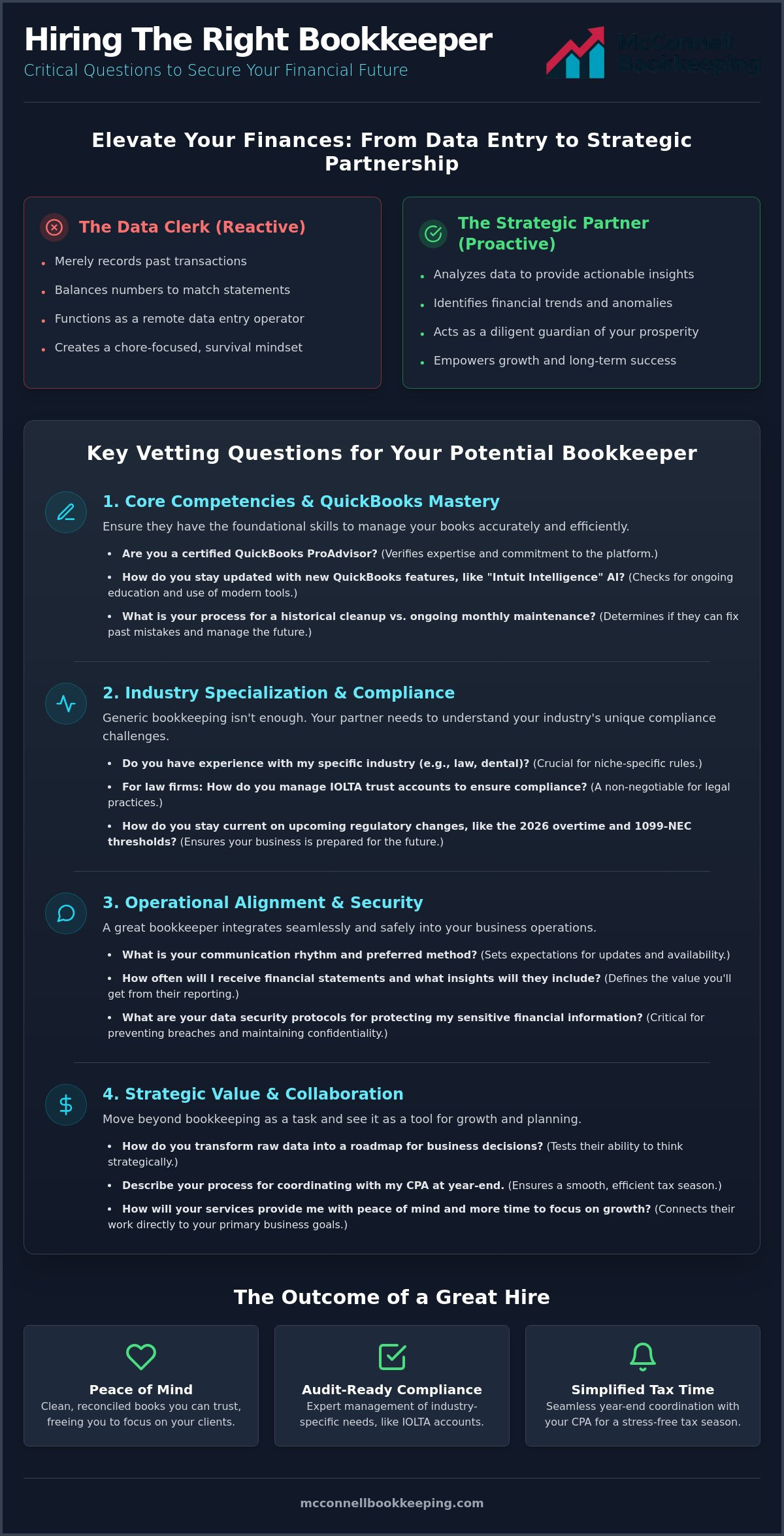
Many entrepreneurs view financial record-keeping as a chore to be minimized. This reactive approach often leads to missed deductions, compliance risks, and tax-time panic. A professional bookkeeper serves as a diligent guardian of your business's financial health. They don't just record the past; they protect your future. Traditional Bookkeeping involves recording transactions, but a modern professional transforms those numbers into actionable insights. Choosing the right partner means moving away from a survival mindset toward a state of informed confidence. You gain the freedom to lead your company while an expert ensures every dollar is accounted for. It's the difference between merely staying afloat and building a legacy.
The Difference Between a Clerk and a Strategic Partner
A clerk merely balances the numbers to ensure they match your bank statement. A strategic mentor analyzes those numbers to identify trends that could impact your bottom line. They look for anomalies in spending or sudden shifts in revenue that require your immediate attention. This level of expert oversight provides a peace of mind bookkeeping service that allows you to focus on high-level growth. Regular financial statement preparation turns raw data into a roadmap for your next big move. You stop guessing about your profitability and start making decisions based on verified facts. This proactive relationship shifts the focus from simple record-keeping to long-term prosperity.
Identifying Your Specific Needs: Maintenance vs. Cleanup
Before you begin interviewing, evaluate the current state of your ledgers. One of the most important questions to ask a potential bookkeeper is how they approach historical accounting errors. If your books haven't been touched in months or contain duplicate entries, you likely need backlogged bookkeeping help to restore your financial clarity. There's a significant difference between daily maintenance, like accounts payable management, and the rigorous monthly closing procedures required for accuracy. A professional cleanup ensures that your foundation is solid before you layer on ongoing monthly reconciliations. Understanding these differences helps you frame the questions to ask a potential bookkeeper to ensure they can handle your specific mess. A partner who can both clean up the past and manage the future is a rare and valuable asset for any small business.
Core Competencies: Probing Technical Expertise and QuickBooks Mastery
QuickBooks Online remains the undisputed foundation for Phoenix small business accounting in 2026. With the recent integration of "Intuit Intelligence" AI features, the software now automates bank transaction matching and flags duplicate entries with significant precision. However, advanced technology is only as effective as the professional driving it. When vetting candidates, the technical questions to ask a potential bookkeeper must focus on their ability to manage these automated systems while maintaining meticulous human oversight.
Start your evaluation by asking, "Are you a certified QuickBooks ProAdvisor and how do you stay updated?" This certification isn't a one-time achievement; it requires annual recertification to master new features like the modernized reporting experience that became the standard in May 2026. If you prefer to maintain some hands-on control, verify if they offer QuickBooks training for business owners. A mentor who can teach your internal team best practices for data entry ensures your records remain organized from the moment a transaction occurs.
Assessing Software Proficiency and Training
Software mastery reduces errors and saves your business valuable time. Ask about their experience with third-party app integrations, particularly for payroll or bill pay. As of August 2026, Bill Pay Elite is included with QuickBooks Advanced, and your bookkeeper should know how to leverage this to streamline your accounts payable. They should also be prepared to handle complex transactions, such as payroll journal entries that now require separate tracking for qualified tips and overtime. You can find more inspiration for technical vetting in this list of 30 Questions to Ask a Bookkeeper.
The Critical Nature of Monthly Bank Reconciliations
Data integrity begins and ends with your bank statements. A professional monthly bank rec service is the only way to ensure that your general ledger perfectly mirrors your actual cash position. Ask your candidate about their specific process for resolving discrepancies between bank records and the ledger. Reconciliations must happen monthly rather than quarterly to catch errors before they snowball into tax-time nightmares. If you feel your current records are slipping, reaching out for a professional books cleanup can restore the financial clarity your business requires to thrive.
Industry Specialization: Vetting for Law and Dental Practice Expertise
Generalist bookkeepers often provide a broad range of services that work for standard retail or service businesses, but they frequently lack the nuanced understanding required for high-compliance fields. Hiring a professional who doesn't grasp your specific industry risks more than just messy files; it can lead to regulatory fines or professional licensing issues. One of the most vital questions to ask a potential bookkeeper involves their familiarity with your industry's specific compliance landscape. Expert oversight ensures that your financial records meet the rigorous standards set by state boards and professional associations. You can explore additional Inc. Magazine on bookkeeping best practices to understand why specialized knowledge is a non-negotiable asset for modern entrepreneurs.
Questions for Phoenix-Area Law Practices
Legal accounting requires a level of precision that goes far beyond standard ledger entries. You must ask, "Do you have experience managing IOLTA or trust accounts for Arizona law firms?" A qualified partner understands that three-way reconciliation is the only way to maintain IOLTA compliance and protect your license. They should also explain how they track case costs and integrate those expenses with your QuickBooks Online setup. Proper management prevents the commingling of funds, which remains one of the leading causes of disciplinary action for attorneys. This specialized oversight transforms your accounting from a source of stress into a secure foundation for your practice.
Questions for Gilbert and Mesa Dental Offices
Dental practices face unique financial challenges, from managing complex insurance reimbursements to tracking high overhead costs. Ask your candidate how they handle PPO insurance adjustments and if they can provide detailed dental practice financial metrics to guide your profitability. Effective cash flow management often requires accounts receivable services in Mesa to ensure patient billing remains current and accurate. Additionally, inquire about their experience with outsourced payroll processing, specifically regarding the separate tracking of overtime and qualified tips required as of January 2026. Refining your list of questions to ask a potential bookkeeper helps you identify a partner who understands these nuances, allowing you to focus on patient care while they safeguard your practice's prosperity.
Operational Alignment: Communication, Security, and Scalability
Evaluating the operational fit is just as critical as verifying technical mastery. When you hire an outsourced firm, you are integrating their systems with your own. This integration requires a seamless alignment of values and workflows to be successful. The specific questions to ask a potential bookkeeper regarding their daily operations will reveal whether they can truly act as a proactive partner or if they will become another administrative bottleneck. You need a team that moves at the speed of your business, ensuring that your financial data is always ready for decision-making. A strategic partner protects your time by managing the details so you can lead with confidence.
Establishing Communication Rhythms and Reporting
Clarity in communication prevents misunderstandings and fosters trust. Ask your candidate, "What is your standard communication rhythm?" You should know if you'll receive weekly updates or if they only reach out during the monthly close. A dedicated point of contact is essential for maintaining a personal connection and ensuring your specific business nuances aren't lost in a generic pool of workers. Request a sample of their monthly report package. A high-quality package doesn't just list numbers; it explains the "why" behind your cash flow shifts. This level of insight transforms a standard report into a strategic tool for growth. You should also verify their turnaround time for monthly financial statements. Receiving reports within ten business days of the month's end provides the agility needed to pivot when necessary.
Data Security and Cloud-Based Workflow
Protecting your sensitive financial information is a non-negotiable responsibility for any modern firm. In 2026, simple passwords are no longer sufficient. Inquire about their use of multi-factor authentication and secure document portals for all file transfers. These tools ensure that your bank statements and payroll data remain shielded from unauthorized access. You should also discuss their backup procedures for digital records to guarantee that your history is never at risk of being lost. Ask how they manage access levels for your internal staff. A disciplined firm limits access to only what is necessary, reducing the risk of internal errors or data breaches. This methodical approach to security makes you feel that your business is in safe, capable hands.
Operational alignment also extends to how they handle your obligations to others. Ask, "How do you handle accounts payable management to ensure vendors are paid on time?" Timely payments protect your professional reputation and can often secure early-payment discounts. If you're ready to experience this level of organized oversight, contact McConnell Bookkeeping today to discuss how our operational rhythms can support your business goals.
Making the Decision: Transitioning to Professional Oversight
The final phase of your search involves synthesizing the information you have gathered to identify the most reliable partner. When you transition your books to a professional firm, you aren't just outsourcing a task; you're investing in the long-term clarity of your business operations. The final set of questions to ask a potential bookkeeper should center on the logistics of your partnership and how they handle the hand-off from your current systems. A seamless transition ensures that your daily operations continue without interruption while your financial records undergo a professional transformation.
Clarity regarding year-end procedures is essential for a stress-free tax season. Ask your candidate, "How do you coordinate with my CPA at year-end for tax filing?" A proactive partner prepares a clean, reconciled trial balance that allows your CPA to focus on tax strategy rather than fixing basic entry errors. You should also inquire about their onboarding process and what specific information they need from you to get started. An organized professional will provide a clear checklist of required documents, such as bank access and prior year tax returns. Finally, discuss their pricing structure to determine if they utilize a flat monthly fee or an hourly rate. Understanding these logistics helps you budget accurately and prevents surprise costs as your business scales.
Red Flags to Watch for During the Interview
Pay close attention to how a candidate responds to technical inquiries. Vague answers regarding their monthly reconciliation processes often signal a lack of depth or a reliance on unmonitored automation. If a bookkeeper shows zero interest in your specific industry or your long-term business goals, they're unlikely to provide the strategic insight you need. Additionally, take note of their response times during your initial inquiry phase. Slow communication before you've even signed a contract is a strong indicator of how they'll handle your urgent financial questions in the future. Trust your intuition if the candidate feels more like a cold transaction than a collaborative partner.
How McConnell Bookkeeping Empowers Arizona Entrepreneurs
McConnell Bookkeeping serves as a strategic mentor for small business owners across Mesa, Phoenix, and Scottsdale. We act as a diligent guardian of your financial health, focusing on the meticulous bank reconciliations that form the foundation of accurate reporting. Our team understands the relief that comes from knowing your books are organized, compliant, and ready for your CPA at any moment. We specialize in the nuances of law and dental practice accounting, ensuring that industry-specific regulations are always met with precision. If you are uncertain about the current state of your ledgers, we invite you to a diagnostic review of your books. Contact us today to discover how professional oversight can provide the financial clarity you need to thrive in 2026.
Securing Your Financial Future with Confidence
Selecting a financial partner is one of the most consequential decisions you'll make for your small business. By utilizing the specific questions to ask a potential bookkeeper explored here, you move from a state of administrative stress to a position of strategic power. You now understand how to identify mastery in QuickBooks Online and why specialized industry expertise is non-negotiable for maintaining compliance. This professional oversight doesn't just organize your ledgers; it provides the clarity needed to make bold, informed decisions for your company's future.
McConnell Bookkeeping acts as your diligent guardian, providing the meticulous care your finances deserve. As a Mesa-based professional with years of local experience and QuickBooks Online Certified ProAdvisor status, we offer specialized expertise in legal and dental bookkeeping. We transform messy files into reliable assets, giving you the freedom to focus on your clients and patients. Ready for financial clarity? Schedule your consultation with McConnell Bookkeeping today. You've worked hard to build your business; you deserve a partner who is just as invested in your prosperity as you are.
Frequently Asked Questions
How much does a bookkeeper for a small business typically cost in Arizona?
Pricing for professional bookkeeping varies based on your monthly transaction volume, the number of bank accounts, and the complexity of your specific industry. A dental practice with high payroll needs or a law firm requiring IOLTA management will have different requirements than a solo consultant. Instead of focusing on a single number, consider the value of specialized expertise and the time you'll reclaim to focus on your core business operations.
What is the difference between a bookkeeper and a CPA?
A bookkeeper focuses on the daily and monthly foundation of your financial health, including transaction entry, monthly bank reconciliations, and financial statement preparation. A CPA typically handles high-level tax strategy, annual tax return filing, and certified audits. These roles are complementary; your bookkeeper ensures your records are clean and accurate so your CPA can work efficiently when tax season arrives.
Do I need a local bookkeeper in Mesa or can I work with someone remotely?
Cloud-based technology allows for seamless remote collaboration, but working with a local expert in Mesa or Phoenix provides a unique level of personal investment. A local partner understands the regional business climate and offers a "neighborly expert" persona that makes the relationship feel like a true partnership. You gain the convenience of digital workflows combined with the reliability of a professional who is part of your own community.
How often should I meet with my bookkeeper to review financial statements?
Monthly meetings are the standard for maintaining financial clarity and proactive growth. Reviewing your Profit and Loss statement and Balance Sheet every thirty days allows you to identify spending trends and cash flow shifts before they impact your bottom line. This methodical rhythm ensures you're always leading your business from a state of informed confidence rather than guessing at your profitability.
Can a bookkeeper help me get a business loan?
Yes, because lenders require verified, up-to-date financial statements to evaluate your creditworthiness. A bookkeeper ensures your books are reconciled and your financial reports are accurate, which is exactly what a bank looks for during the application process. Having professional records prepared by a QuickBooks ProAdvisor demonstrates that your business is managed with discipline and transparency.
What happens if my bookkeeper finds a major error in my past books?
They will perform a comprehensive books cleanup to restore your financial integrity and ensure your history is accurate. This process involves identifying the source of the errors, correcting historical journal entries, and performing retroactive bank reconciliations to match your statements. While finding errors can be stressful, fixing them is the only way to ensure your future tax filings and financial decisions are based on the truth.
Should I give my bookkeeper full access to my bank accounts?
You should typically provide "view-only" access to your bank accounts, which allows your bookkeeper to download statements for reconciliation without having the ability to move funds. For services like accounts payable or payroll management, professionals use secure, permission-based platforms that maintain strict security protocols. This balanced approach allows your bookkeeper to act as a diligent guardian while you maintain ultimate control over your capital.
How do I transition from DIY bookkeeping to a professional service?
The transition begins with a diagnostic review of your current QuickBooks Online files to assess the accuracy of your data. Once you've identified the right questions to ask a potential bookkeeper and selected your partner, they'll handle the heavy lifting of cleaning up backlogged entries and setting up automated workflows. This shift empowers you to trade the anxiety of messy files for the peace of mind that comes from expert oversight.


Comments