The Small Business Guide to Payroll: Choosing the Right Solution in 2026

What if the software you bought to save time is actually creating a hidden backlog of manual data entry and tax risks? Many Phoenix Valley business owners discover too late that a subscription alone doesn't guarantee an error-free payroll cycle or seamless integration with their financial records. While automation is helpful, it lacks the professional oversight needed to catch subtle discrepancies before they become costly liabilities.
You likely started your practice to serve your clients, not to spend your weekends deciphering Arizona's $15.15 per hour minimum wage or specific city regulations. It's natural to feel overwhelmed by the meticulous nature of tax compliance and the fear of a simple data entry error triggering an audit. This guide provides a strategic framework to help you master payroll management, ensuring every team member is paid accurately while providing you with total peace of mind regarding state tax filings. We'll examine how to choose a solution that integrates with your existing bookkeeping and helps you reclaim the hours you currently lose to administrative stress.
Key Takeaways
Transform payroll from a repetitive weekly chore into a strategic driver of healthy cash flow management.
Identify why technical integration between your payroll provider and monthly bookkeeping is essential for maintaining error-free financial statements.
Evaluate the "Control Myth" to understand how professional oversight provides more clarity and security than managing DIY software alone.
Protect your practice by mastering 2026 Arizona compliance standards, including specific withholding percentages and updated SUTA requirements.
Implement a reliable five-step workflow that prioritizes a "Cleanup Phase" to guarantee the integrity of your historical financial records.
Table of Contents
The Hidden Risks of DIY Payroll for Small Businesses
Payroll is often viewed as a back-office burden, but it serves as the heartbeat of your company's financial health. When you treat it as a strategic function, you gain a comprehensive overview of payroll and its vital role in your long-term growth. Conversely, viewing it as a weekly chore leads to a dangerous "set it and forget it" mentality. This neglect creates a ripple effect that complicates your monthly bank reconciliations, as unrecorded checks or incorrect tax withholdings make it impossible to verify your actual cash balance. Relying on manual entry introduces three primary vulnerabilities that can jeopardize your hard work.
Tax Penalties: Missing a filing deadline or miscalculating a local rate results in immediate, expensive fines.
Disgruntled Employees: Errors in paychecks erode the trust your team has in your leadership and stability.
Skewed Profit Margins: If labor costs aren't tracked accurately, your financial statements will reflect a false sense of profitability.
Why Software Alone Is Not a Strategy
Software is merely a tool, not a complete solution. While platforms like QuickBooks provide the framework, they don't replace the need for a rigorous process. Many business owners fall into the trap of "user error" by misclassifying staff or failing to update state-specific rates manually. These small mistakes snowball into expensive cleanup projects that require professional intervention to resolve later. Maintaining data integrity ensures your financial statement preparation remains accurate, providing a clear window into your actual business performance.
The Impact of Payroll on Your Cash Flow
Your payroll timing dictates your liquidity. Unrecorded tax liabilities can blindside a Phoenix small business, turning a seemingly profitable month into a stressful cash crunch when the state of Arizona demands payment. There's a direct connection between these outflows and your strategic accounts receivable services. When you synchronize your incoming payments with your outgoing payroll, you stabilize your bank account. This consistency builds immense trust with both vendors and employees, positioning your business as a reliable and successful pillar of the local community.
Key Criteria for Evaluating Payroll Solutions
Selecting a provider involves more than comparing monthly fees; it requires finding a partner that understands the specific pulse of the Phoenix Valley. Many national providers offer generic support centers that lack the nuance of local tax regulations. You deserve a system that empowers your growth rather than one that complicates your administrative duties. When comparing options, use this checklist to ensure your choice aligns with your long-term vision:
Technical Integration: Does the system sync automatically with your general ledger to prevent data silos?
Compliance Accuracy: Does the provider handle Arizona-specific withholding and SUTA filings with a zero-error guarantee?
Dedicated Support: Will you have a direct line to a professional who knows your business by name rather than a ticket number?
Industry Nuance: Can the platform manage the specific labor tracking required for your professional field?
Following SBA guidelines on employee management provides a solid foundation for your hiring practices, but your payroll solution must translate those guidelines into accurate financial data. Professional oversight ensures that your internal processes remain compliant while you focus on high-level leadership.
Integration with Your Accounting Ecosystem
Your financial records only provide value if they are accurate and timely. Choosing a payroll solution that "talks" directly to your QuickBooks Online file eliminates the friction of manual data entry. This seamless flow of information ensures that your labor costs are reflected in real-time, allowing for precise cash flow forecasting. Investing in QuickBooks training for business owners equips you with the skills to interpret this data, transforming your bookkeeping from a static record into a strategic asset. By reducing double-entry, you free up valuable hours to reinvest in your practice.
Specialized Industry Requirements
A one-size-fits-all approach rarely works for specialized professional services. Dental practices must monitor dental practice financial metrics to ensure hygiene production and lab costs align with total compensation. Similarly, Scottsdale law firms face unique challenges when balancing partner draws against W2 wages. Meticulous tracking of case-related labor costs is essential for accurate job costing and client billing. Having a "neighborly expert" manage these complexities provides the clarity needed to make informed decisions about your firm's future. If you're ready to simplify these processes, exploring professional payroll management can be your first step toward liberation from administrative stress.
Software-Only vs. Bookkeeper-Led Payroll
Software companies often market their platforms as total solutions, suggesting that automation replaces the need for human expertise. This marketing often promotes the "Control Myth," the false belief that business owners must personally click every button to maintain visibility over their finances. In reality, managing your own software often obscures the truth of your financial health under layers of un-reconciled transactions and manual workarounds. Choosing outsourced payroll processing provides a strategic protective layer that actually increases your visibility. When a professional manages the data, you receive accurate, high-level reports that reflect your true labor costs, allowing you to make decisions based on facts rather than guesses.
Payroll is typically the first system to break when a ledger becomes disorganized. Because it involves frequent, high-volume transactions, even a small error in classification or a missed decimal point can throw off your entire balance sheet. Professional oversight ensures that payroll entries match your bank statements exactly, maintaining the integrity of your books throughout the year. This consistency prevents the "cleanup crisis" that many small businesses face during tax season, ensuring your financial records remain a reliable source of truth.
The Professional Oversight Advantage
A professional acts as a diligent guardian, identifying potential issues before they escalate into federal inquiries or expensive audits. By following the IRS Employer's Tax Guide (Publication 15), a dedicated bookkeeper ensures your filings meet every current federal requirement while staying aligned with local Arizona standards. This meticulous attention to detail simplifies your year-end tax preparation, as your CPA receives a clean, verified set of data that requires no additional sorting. Bookkeeper-Led Payroll is a proactive partnership that ensures compliance.
When to Make the Switch
Most businesses reach a complexity threshold when they surpass five employees or begin hiring across state lines. If you find yourself spending more than ten hours a month on administrative data entry, the return on investment for professional management becomes undeniable. Your time as a business owner is your most valuable asset, and spending it on repetitive administrative tasks hinders your firm's potential. Signs that you need backlogged bookkeeping help often include un-reconciled payroll accounts, confusing ledger entries, or late-filing notices from the state. Reclaiming those hours allows you to focus on strategic growth and client relationships while we ensure your team is paid on time, every time.
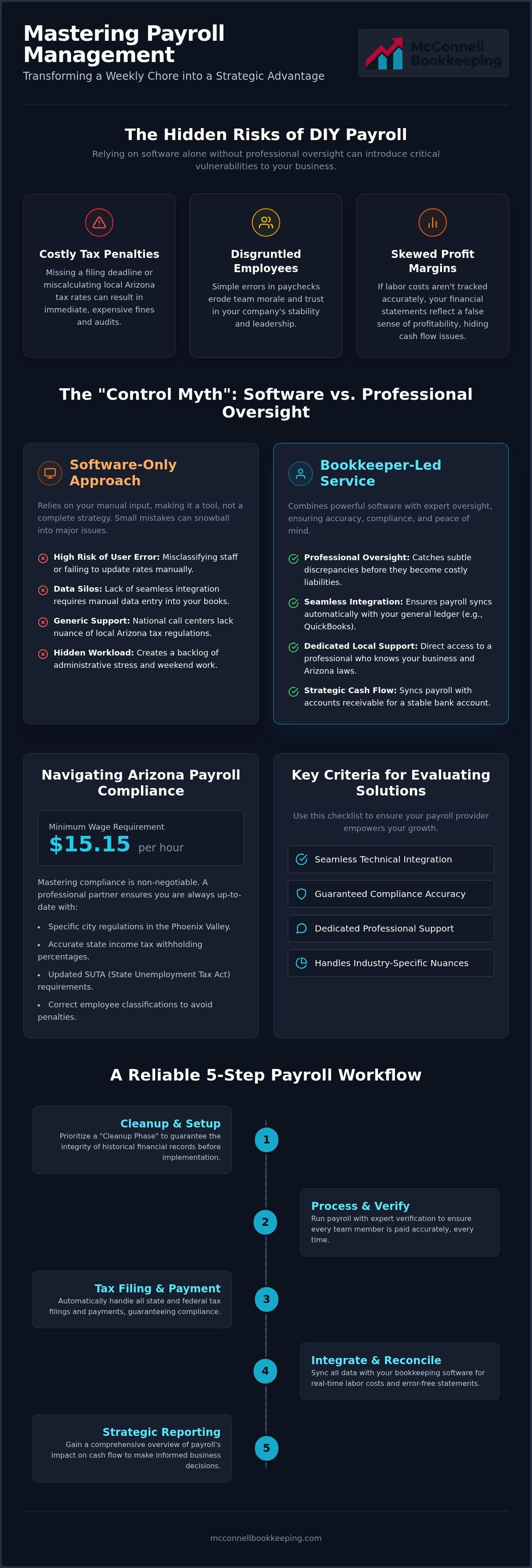
Navigating Arizona Payroll Compliance in 2026
Maintaining compliance in the Phoenix-Mesa-Scottsdale metro area requires more than a passing glance at federal tables. Arizona has specific mandates that demand meticulous attention, especially regarding the state's flat 2.5% income tax rate. Every employee must complete Form A-4 to select their payroll withholding percentage, which ranges from 0.5% up to 3.5% of gross taxable wages. Accurate employee classification between W2 staff and 1045 contractors is essential for avoiding misclassification penalties that could derail your financial stability. Integrating these payments into your strategic accounts payable management ensures that tax obligations are funded and paid on time, protecting your cash flow from unexpected state inquiries.
Arizona State Tax & Reporting
Arizona Form A1-QRT serves as the cornerstone of your quarterly reporting, requiring a precise summary of taxes withheld. While new employers typically start with a State Unemployment Insurance (SUI) rate of 2.0% on the first $8,000 of each employee's wages, experienced employers may see rates climb as high as 20.93% based on their claim history. A bookkeeper acts as a strategic mentor in this process, verifying that your quarterly reports and annual reconciliations match your internal ledger perfectly. This oversight prevents the common discrepancies that lead to state-issued assessment letters and ensures your records are ready for any inquiry.
Local Labor Standards & Record Keeping
Arizona's Proposition 206 mandates specific paid sick time requirements that must be tracked within your payroll system. Employees accrue one hour of leave for every 30 hours worked, with maximum annual accruals capped at 40 hours for larger firms or 24 hours for those with fewer than 15 employees. Proper record keeping isn't just a suggestion; it's a legal requirement. Small businesses in Phoenix must retain these records for specific periods to remain compliant with local labor standards and the statewide $15.15 per hour minimum wage. Configuring your QuickBooks setup to reflect these accruals automatically reduces administrative friction and ensures your team receives their entitled benefits without manual calculation errors. If these complexities feel like a burden, investing in professional payroll management provides the expert oversight needed to keep your practice secure.
Implementing a Seamless Payroll Workflow
Transitioning to a professionally managed payroll system is a transformative step that liberates you from the repetitive minutiae of administrative data entry. It replaces a reactive "fix it as you go" approach with a structured, proactive framework designed for long-term stability. This journey begins with a comprehensive evaluation of your current records, followed by a rigorous cleanup of historical data to ensure your financial foundation is secure. By aligning your systems now, you prevent the recurring headaches that often plague small business owners during year-end reporting. Utilizing peace of mind bookkeeping services ensures that every transaction is accounted for, giving you the clarity needed to lead with confidence.
To achieve a seamless transition, we follow a methodical five-step path:
Analysis: Reviewing existing employee records and tax setup for accuracy.
Cleanup: Rectifying historical data errors to ensure a clean starting point.
Synchronization: Connecting the payroll platform directly to your QuickBooks Online file.
Automation: Establishing automated bank feeds for real-time expense tracking.
Verification: Implementing a monthly review cycle to maintain ongoing data integrity.
The Onboarding and Cleanup Process
The "Cleanup Phase" serves as the most critical component of a successful transition. We meticulously review past runs to identify classification errors or tax miscalculations that could trigger future audits. Once the data is verified, we align your chart of accounts in QuickBooks with your reports, ensuring that labor costs are categorized correctly for financial statement preparation. Setting up automated bank feeds further streamlines this process, allowing for real-time tracking of expenses and virtually eliminating the need for manual data entry.
Ongoing Maintenance and Reporting
Consistency is the primary driver of financial health. Establishing a monthly review cycle for both your payroll and bank reconciliations ensures that any discrepancies are caught and corrected immediately. This routine maintenance transforms your raw data into a strategic tool for growth planning, allowing you to see exactly how labor costs impact your bottom line. When your books are clean and your systems are integrated, you can make informed decisions about hiring and expansion with total confidence. If you're ready to reclaim your time and focus on your practice, let us handle the details so you can lead your business.
Securing Your Practice's Financial Future
Mastering your company's financial health begins with moving beyond the limitations of standalone software. You've seen how professional oversight transforms payroll from a weekly administrative burden into a reliable pillar of your cash flow strategy. By prioritizing integration with your QuickBooks Online file and ensuring 100% accurate monthly bank reconciliations, you protect your practice from the "cleanup crisis" that plagues so many Phoenix Valley owners. Whether you lead a specialized dental office or a busy law firm in Mesa, having a diligent guardian manage these complexities provides the clarity you need to make confident growth decisions.
Our team of QuickBooks Online ProAdvisors brings specialized expertise to legal and dental practices, ensuring your records remain meticulous and compliant with every Arizona mandate. You don't have to navigate these technical requirements alone. We invite you to Get Peace of Mind with Professional Payroll Management today. Let's work together to restore your financial clarity and free your time for the high-level leadership your business deserves. Your prosperity is our priority, and we're ready to help you thrive.
Frequently Asked Questions
What is the most common payroll mistake Mesa small businesses make?
The most frequent error is neglecting the reconciliation between payroll disbursements and monthly bank statements. Without this step, many Mesa owners overlook discrepancies in tax withholdings or uncashed checks, leading to inaccurate financial reporting. This oversight often snowballs into expensive cleanup projects during tax season. Maintaining a strict monthly review cycle ensures your ledger reflects your actual cash position and prevents costly administrative errors from impacting your bottom line.
Do I need a separate bank account for payroll in Arizona?
Arizona law doesn't strictly mandate a separate account, but utilizing a dedicated bank account is a best practice for security and organization. This strategy isolates your largest expense, making it easier to track liabilities and prevent fraud. It also simplifies your monthly bank reconciliations by keeping employee-related transactions separate from general operating expenses. This clarity is essential for maintaining a healthy cash flow and ensuring funds are always available for your team on payday.
How does payroll management differ for law firms vs. dental practices?
Law firms often require specialized tracking for partner draws and case-related labor costs to ensure accurate billing and IOLTA compliance. In contrast, dental practices focus on metrics like hygiene production relative to compensation to monitor profitability. We tailor our payroll approach to these specific needs, ensuring your QuickBooks setup reflects the unique operational requirements of your field. Whether managing attorney compensation or tracking dental staff productivity, professional oversight ensures your financial statements remain precise.
Can QuickBooks Online handle all my Arizona state payroll taxes?
QuickBooks Online provides the technical tools to calculate Arizona's 2.5% flat tax and SUI rates, but it requires meticulous setup to ensure total compliance. Software only processes the data you provide; it doesn't verify the accuracy of employee A-4 forms or classification choices. Expert-led oversight acts as a protective layer, catching software-syncing errors before they reach the state. This partnership ensures your technical ecosystem supports your business rather than creating hidden tax liabilities.
What is the difference between payroll processing and payroll management?
Processing is the mechanical task of calculating wages and issuing checks, while payroll management involves strategic oversight and financial integration. Management includes reconciling data with your general ledger, ensuring proper employee classification, and maintaining your overall financial statement integrity. It transforms a repetitive administrative chore into a proactive business function. By focusing on the broader financial picture, management provides the clarity and peace of mind that simple automated processing lacks.
How much does it cost to outsource payroll for a Phoenix small business?
The cost of outsourcing varies based on your employee count and the complexity of your specific industry requirements in the Phoenix Valley. While software providers often charge a base fee plus a per-employee rate, professional management is typically structured as part of a broader bookkeeping suite. This investment reflects the value of reclaiming your time and the security of having an expert guardian oversee your compliance. We focus on providing a high ROI by eliminating errors.
How do I switch payroll providers without disrupting my employees?
The most seamless way to switch is at the beginning of a new quarter to simplify state tax reporting. We manage this transition by performing a thorough cleanup of your historical data and verifying all year-to-date totals before the first run. This methodical approach ensures that employee pay remains consistent and accurate during the move. By handling the technical migration details, we allow you to lead your team without worrying about administrative interruptions or data loss.
Can a bookkeeper help me fix historical payroll errors in QuickBooks?
Yes, we specialize in comprehensive books cleanup to resolve historical errors in your software. Whether you have un-reconciled transactions or incorrect tax entries from previous years, we meticulously audit your records to restore financial clarity. This process ensures your chart of accounts aligns perfectly with your historical payroll reports. Fixing these errors now prevents them from complicating your future filings and provides a clean foundation for your practice's continued growth and success.


Comments