Small Business Bookkeeping Mistakes: 2026 Financial Guide

Your bank balance is often a deceptive narrator. While a positive number feels like success, failing to account for common bookkeeping mistakes for small businesses can create a false reality that stifles your growth. You likely started your business to pursue a specific vision, not to spend your evenings fixing bank feed errors or dreading the March 15 and April 15 tax deadlines. It's frustrating to work hard only to feel uncertain about your actual cash flow.
This guide identifies the hidden accounting errors that quietly drain profits and provides the strategic steps to reclaim your financial clarity. By addressing these issues, you move from administrative stress to empowered oversight. We'll examine how to clean up messy records, ensure your QuickBooks Online settings reflect your true operations, and build the organized financial statements necessary for business loan applications. You deserve the freedom to focus on your core operations while a diligent guardian ensures your books remain accurate, reliable, and ready for the future.
Table of Contents
The High Cost of Common Bookkeeping Mistakes for Small Businesses
Bookkeeping is the pulse of your business. When records are neglected, operational friction builds up, preventing you from scaling effectively. Many owners view financial tracking as a tax season chore, but this perspective ignores the strategic value of accurate data. Falling into common bookkeeping mistakes for small businesses creates a "hidden tax" on your growth. This tax isn't paid to the government; it's paid in lost hours and poor decision-making based on inaccurate figures.
If you're operating in high-competition Phoenix niches like law or dentistry, you can't afford to fly blind. Relying on flawed reports means you might hire too early, price your services too low, or miss warning signs of an impending cash crunch. Professional oversight replaces this administrative stress with a definitive sense of clarity, positioning your company as a reliable leader in the local market. Strategic growth requires a proactive partner who looks ahead to identify opportunities rather than just reacting to past errors.
Why DIY Bookkeeping Often Backfires
The "I'll do it later" trap is a common starting point for financial disarray. While it seems harmless to skip a week of reconciliations, falling behind creates an exponential cleanup cost as memories fade and receipts vanish. Many owners also fall for the myth that their bank balance equals their actual profit. Without applying fundamental bookkeeping principles, you ignore upcoming liabilities like payroll taxes or vendor payments that haven't cleared yet. Clean books serve as the essential foundation for any successful Arizona business loan application.
The Consequences of Inaccurate Financial Reporting
Inaccurate financial statements do more than just cause headaches; they actively block your access to capital. If a lender sees inconsistencies in your balance sheet or profit and loss statement, they'll likely reject your credit line or investment request. This lack of transparency signals a high risk that most financial institutions won't tolerate. Beyond the numbers, the emotional toll of financial uncertainty is heavy. It's difficult to lead with confidence when you're constantly worried about whether your records are correct. Reclaiming your financial health starts with moving toward peace of mind bookkeeping services, allowing you to focus on core operations while a diligent guardian handles the details.
The Big Three: Technical Errors That Ruin Your Records
Technical accuracy is the difference between a functional business and a chaotic one. Many owners fall into the "Bank Feed Illusion," believing that simply clicking "add" on transactions in QuickBooks Online is enough. This common misconception ignores the fact that adding data is not the same as reconciling it. Without comparing your software records against your actual bank statements, you risk double-counting income or missing hidden bank fees that quietly erode your margins. These common bookkeeping mistakes for small businesses often create a distorted view of your available cash, leading to overdrafts or missed vendor payments.
Specific industries face even higher stakes when technical errors occur. For legal practices, mismanaging an IOLTA account isn't just a clerical slip; it's a significant compliance risk that can threaten your professional license. Similarly, dental offices often struggle with the complexity of PPO insurance payments. When a single bulk deposit covers multiple patients with varying adjustments, your records become a tangled web without meticulous oversight. Professional dental practice bookkeeping ensures these payments are applied correctly, maintaining the integrity of your patient ledgers and practice health.
Mixing Personal and Business Finances
Co-mingling funds is a dangerous habit that can lead to "piercing the corporate veil." In Arizona, failing to maintain a clear boundary between your personal life and your business entity may allow creditors to bypass your liability protection and target your personal assets. Beyond the legal risks, this habit complicates the backlogged bookkeeping help process. Every personal meal or grocery trip found in your business records requires manual sorting, which exponentially increases the time and cost of restoring your financial clarity. To protect your future, open a dedicated business account immediately and use it exclusively for company transactions.
The Reconciliation Gap: Why It Matters
Monthly bank reconciliation serves as your primary defense against fraud, duplicates, and bank errors. This process involves verifying that every single transaction on your bank statement matches a corresponding entry in your books. Utilizing a monthly bank rec service is the single most important check for accuracy you can implement. It catches the "General Expenses" trap, where misclassified costs hide the true price of doing business. When you move away from vague categories and embrace precision, you gain the strategic insight needed to cut waste and reinvest in your growth.
QuickBooks Online: Tool vs. Strategy
QuickBooks Online is a robust engine for financial tracking, but it isn't an autopilot system for your business health. Many owners fall into the "set it and forget it" trap, assuming that software automation replaces the need for professional judgment. This reliance on defaults is one of the most common bookkeeping mistakes for small businesses, often leading to skewed data that stays hidden for years. With recent price increases, such as the QuickBooks Online Plus plan rising to $140 per month in August 2026, it's more important than ever to ensure you're extracting maximum value from your investment rather than just paying for a digital filing cabinet.
Strategic oversight transforms your software from a simple record-keeping tool into a growth-oriented asset. While DIY software use often results in a reactive scramble during tax season, professional management provides steady, actionable insights throughout the year. Investing in QuickBooks training for business owners empowers you to understand the "why" behind your numbers. This transition from data entry to strategic analysis allows you to spot trends, manage cash flow proactively, and make decisions with total confidence.
Automation vs. Human Oversight
Automation frequently fails when complex transactions meet rigid software rules. For example, QuickBooks might auto-categorize a recurring loan payment as a simple utility expense, which incorrectly inflates your expenses and hides your actual debt reduction. A bookkeeper acts as a strategic mentor, reviewing these automated entries to ensure every dollar is placed correctly. This meticulous human review prevents the need for expensive, time-consuming books cleanup projects in the future. By refining your bank rules and workflows, you create a system that works for you, rather than one you have to constantly fix.
Maximizing Your QBO Subscription
A clean Chart of Accounts is the backbone of useful financial reporting. If your categories are too broad or poorly organized, your Profit & Loss statements won't tell the true story of your business operations. This is especially critical for specialized fields that require custom tracking, such as dental practice financial metrics. Beyond standard reports, you should know how to analyze your Balance Sheet to understand your equity and liabilities. Tailoring your QBO setup to your specific industry ensures that the data you see every morning is accurate, relevant, and ready to support your next big move.
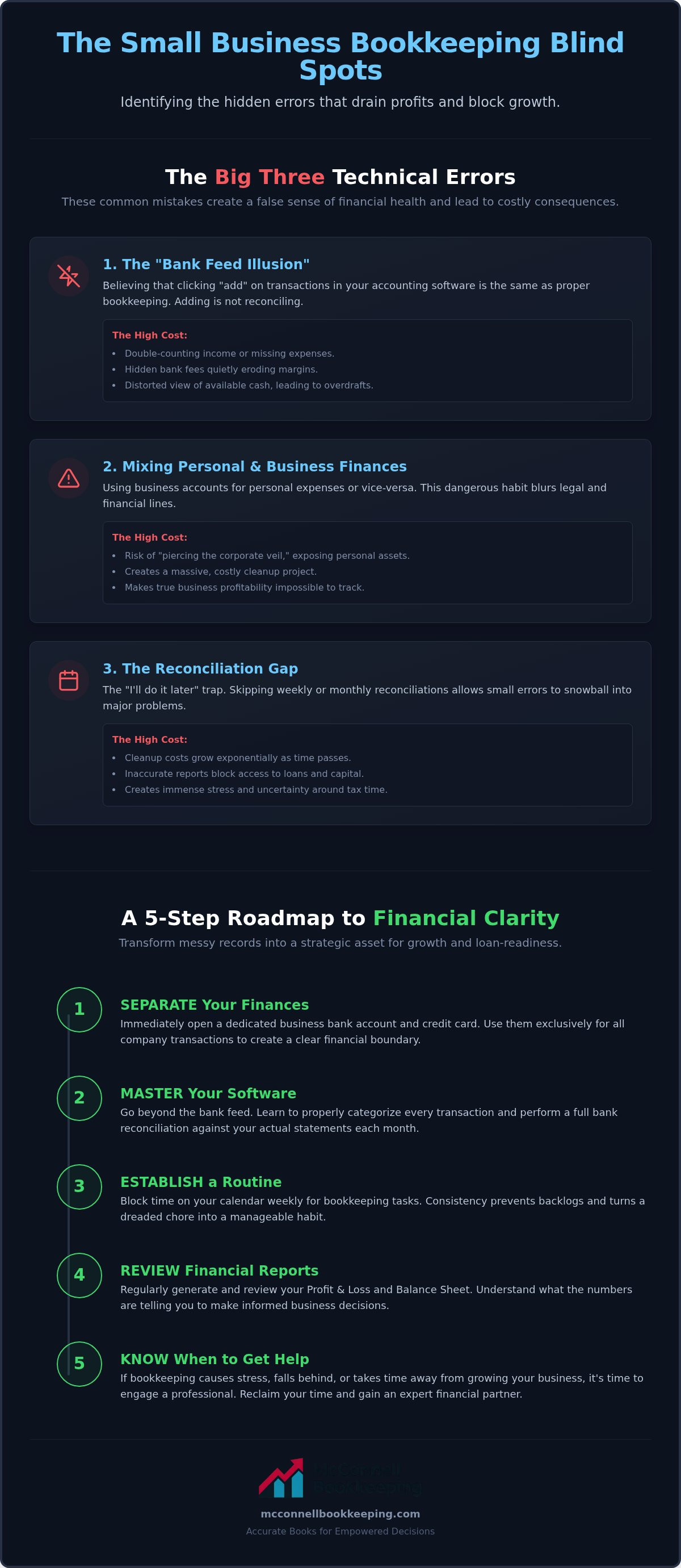
A 5-Step Roadmap to Clean Books and Better Growth
Establishing a rhythmic routine is the most effective way to eliminate common bookkeeping mistakes for small businesses before they compound. Mesa and Phoenix business owners often feel overwhelmed by the volume of transactions, but a structured 5-step roadmap provides the clarity needed to move forward. This isn't just about compliance; it's about building a foundation for sustainable growth. By following a methodical schedule, you transform your financial records from a source of stress into a strategic asset.
Step 1: Weekly Digital Organization. Capture receipts immediately using mobile apps to ensure you never lose a deduction. This simple habit prevents the "shoebox" disaster and saves hours of search time later.
Step 2: Monitoring Accounts Receivable. Review your outstanding invoices every Monday to identify late payers. Consistent follow-up ensures your cash flow remains healthy and predictable.
Step 3: Reviewing Accounts Payable. Track your upcoming bills to avoid late fees and maintain professional trust with your vendors.
Step 4: The Monthly Bank Reconciliation Ritual. Verify every transaction in your software against your actual bank statement. This process catches bank errors and identifies any duplicate entries that skew your profit figures.
Step 5: Strategic Review of Financial Statements. Sit down with your Profit & Loss and Balance Sheet to evaluate your performance against your monthly goals.
Optimizing Cash Flow Through AR/AP
Managing the timing of money entering and leaving your business is a delicate balance. Utilizing professional accounts receivable services ensures that your hard work translates into actual bank deposits without the awkwardness of constant collection calls. Simultaneously, expert accounts payable management allows you to optimize payment timing, preserving your liquidity while building a reputation for reliability. Transitioning to digital receipt management further streamlines this process, creating an audit-ready trail that protects your business from future scrutiny.
The Power of Monthly Financial Reviews
Reviewing your financial statements allows you to spot dangerous trends before they become critical problems. For Phoenix-area businesses, setting local benchmarks for labor costs or overhead provides a competitive edge in high-growth niches. This monthly review moves you from a reactive "survival mode" to a proactive "growth mode," where you make decisions based on data rather than intuition. If your records are currently behind, our books cleanup specialists can restore your financial health and help you implement this roadmap immediately.
When to Get Professional Help: Moving Beyond DIY
Recognizing when you've outgrown DIY bookkeeping is a pivotal moment for any growing company. If you find yourself spending more time fixing bank feed errors than serving your clients, or if the dread of tax season has become a year-round anxiety, you've reached a crossroads. Professional oversight isn't merely an administrative expense; it's a strategic investment that yields a high return through reclaimed hours and bulletproof accuracy. By delegating these tasks, you eliminate the common bookkeeping mistakes for small businesses that lead to costly cleanup projects later. Choosing a local partner who understands the Phoenix Metro market ensures your financial records are handled with an awareness of regional growth trends and industry-specific needs.
McConnell Bookkeeping acts as the bridge between software and strategy. While many owners struggle to make sense of their QuickBooks Online reports, we provide the clarity needed to turn those numbers into actionable growth plans. We don't just record history; we help you write your business's future by ensuring every transaction supports your long-term vision. This transition from self-management to expert oversight allows you to lead with a definitive sense of confidence.
The Value of a Strategic Bookkeeping Partner
A monthly bookkeeper provides a level of daily operational insight that a once-a-year tax preparer simply cannot offer. While a tax preparer focuses on past compliance, a strategic bookkeeper serves as a diligent guardian of your current financial health. This ongoing partnership allows you to catch errors in real-time, optimize your cash flow, and ensure your payroll is handled with precision. For example, utilizing outsourced payroll processing significantly reduces compliance risks and frees you from the burden of complex tax calculations. This proactive oversight ensures your business remains agile and ready for new opportunities.
Getting Started with a Books Cleanup
Moving forward with a clean slate for the 2026 fiscal year starts with a professional books cleanup. During this process, we meticulously review your past transactions, reconcile old bank statements, and correct the common bookkeeping mistakes for small businesses that have distorted your reports. This deep dive restores the integrity of your financial data, providing you with a reliable foundation for future decision-making. You'll emerge from the cleanup with organized financial statements and the clarity needed to apply for business loans or scale your operations. If you're ready to trade financial uncertainty for expert clarity, contact us for a consultation in the Phoenix Metro area today.
Secure Your Financial Future for 2026 and Beyond
Transitioning from reactive financial management to proactive growth requires more than just software; it demands a commitment to accuracy and strategic oversight. By identifying and correcting common bookkeeping mistakes for small businesses, you protect your company from invisible profit drains and legal risks. Whether you're refining your monthly reconciliation ritual or finally separating your personal and business accounts, these steps build the foundation for a resilient enterprise. Clear records are not just for tax season; they're the roadmap for your next big expansion.
You don't have to navigate these complexities alone. McConnell Bookkeeping provides specialized expertise for legal and dental practices throughout the Phoenix Metro area, ensuring your records meet industry-specific compliance standards. From expert QuickBooks Online ProAdvisor training to comprehensive books cleanup, we act as your diligent guardian and strategic mentor. Get the financial clarity your business deserves—Contact McConnell Bookkeeping today. We're here to help you reclaim your time and lead your business with total confidence.
Frequently Asked Questions
What is the most common bookkeeping mistake for new small businesses?
The most frequent error for new owners in Mesa and Gilbert is co-mingling personal and business funds. This is one of the most common bookkeeping mistakes for small businesses because it complicates tracking and threatens your liability protection. Maintaining separate accounts from day one ensures that your records remain transparent and audit-ready. This simple boundary saves countless hours during year-end reporting and provides a clear view of your actual performance.
Can I use QuickBooks Online without a professional bookkeeper?
You can certainly use the software yourself, but automation often creates a false sense of security. Without professional oversight, bank feed errors and misclassifications can go unnoticed for months. We offer specialized QuickBooks Online training for Phoenix business owners to help you manage the platform effectively. This training empowers you to use the tool correctly while knowing exactly when to call for expert assistance to maintain your financial health.
How often should I reconcile my business bank accounts?
You should reconcile your accounts at least once every month. Monthly bank reconciliations act as a critical safety check to catch fraudulent charges, duplicate entries, or bank errors. For dental practices in Scottsdale, this process is essential for verifying that insurance payments match your patient ledgers. Regular reconciliation ensures that the data in your software accurately reflects the cash you have available for operations and growth.
What happens if I mix my personal and business expenses in Arizona?
Mixing funds in Arizona can lead to "piercing the corporate veil," which puts your personal assets at risk during legal disputes. It's one of the common bookkeeping mistakes for small businesses that creates significant administrative friction. If you've already co-mingled expenses, a professional books cleanup can help untangle your records. Establishing a clean separation protects your legal standing and simplifies the preparation of accurate financial statements for your business.
How do I fix messy books from previous years?
Fixing messy books requires a methodical professional cleanup to reconcile historical data and correct past errors. We specialize in restoring financial clarity for legal and dental practices throughout the Phoenix Metro area. This process involves reviewing every transaction, adjusting entries, and ensuring your Chart of Accounts is properly structured. Starting the new fiscal year with organized records allows you to make strategic decisions based on reliable, verified information.
Why is my QuickBooks balance different from my actual bank balance?
Your software balance often differs from your bank balance because of outstanding checks, pending deposits, or uncleared transactions. It can also stem from "bank feed illusions" where transactions are added but not properly reconciled. This discrepancy is a primary reason why monthly oversight is necessary. By identifying these timing differences, you gain a realistic understanding of your cash flow and avoid the risk of overextending your business capital.
Do I need a bookkeeper if I already have a CPA for taxes?
Yes, because a bookkeeper manages your daily operational health while a CPA focuses on year-end tax returns and audits. Since McConnell Bookkeeping doesn't offer tax filing, we focus 100% on maintaining your monthly accuracy and financial statement preparation. This collaborative approach ensures your records are always ready for your CPA, which often reduces your tax preparation fees and prevents expensive last-minute corrections during tax season.
What financial reports should a small business owner review every month?
Every small business owner in Chandler or Tempe should review their Profit and Loss statement and Balance Sheet monthly. These reports provide a high-level view of your revenue trends and current liabilities. For specialized fields, monitoring accounts receivable and accounts payable is also vital for maintaining liquidity. Regular review allows you to identify operational friction early, ensuring you have the data needed to apply for business loans or invest in new equipment.


Comments