Mesa IOLTA Compliance: 2026 Trust Accounting Guide

Nearly 10% of lawyers have faced disciplinary action related to trust account violations, a statistic that underscores the high stakes of Arizona's Rule 43 requirements. For attorneys in the Phoenix metro area, maintaining IOLTA compliance for law firms Mesa is often the most stressful part of practice management. You likely feel the weight of this responsibility every time you handle client funds, knowing that a single commingling error or a missed reconciliation could put your professional reputation at risk. It's a heavy burden to carry when your primary focus should be on winning cases for your clients.
This guide will empower you to master Arizona’s strict trust accounting rules with a practical, bookkeeping-first approach that secures your law license. You'll learn how to implement the gold standard of three-way reconciliations and move beyond time-consuming manual processes. We will walk through the essential 2026 compliance updates, clear up confusion regarding commingling, and show you how a methodical financial strategy provides the transparency your clients deserve while protecting your firm from the threat of an audit.
Table of Contents
Understanding IOLTA and Arizona Supreme Court Rule 43
Arizona Supreme Court Rule 43 establishes the strict parameters for trust accounting, creating a mandatory framework that every Mesa attorney must follow. At its heart, IOLTA (Interest on Lawyers' Trust Accounts) is a method of pooling client funds that are too small in amount or held for too short a time to generate net interest for the individual client. Instead, this interest is remitted to the Arizona Foundation for Legal Services & Education (AZFLSE). In 2026, the AZFLSE continues to use these funds to bridge the justice gap, funding legal aid and education programs throughout the state. Understanding IOLTA and its historical purpose helps clarify why the State Bar views these accounts with such scrutiny. You aren't just a business owner; you're a fiduciary. This standard requires a level of precision that exceeds standard business accounting, as you're responsible for every cent of someone else's property.
What Qualifies as IOLTA Funds?
Identifying which deposits belong in your trust account is the first step toward maintaining IOLTA compliance for law firms Mesa. Rule 43 specifies that nominal or short-term funds must be placed in these pooled accounts. If a settlement or retainer is large enough to earn interest that exceeds the cost of administering a separate account, it should generally be placed in a client-specific interest-bearing account. For most Mesa legal matters, unearned retainers and advanced costs for filing fees are the primary residents of the IOLTA. You must also adhere to the prompt distribution rule. Once you've earned a fee or a third party needs payment, those funds must be moved out of the trust account immediately to avoid technical commingling.
The Ethical Stakes of Compliance
The consequences of clerical errors can be severe, ranging from formal State Bar reprimands to permanent disbarment. According to a 2021 American Bar Association survey, nearly 10% of lawyers have faced disciplinary action related to trust account violations. In 2026, the State Bar's focus on audits in Maricopa County remains sharp. Good intentions or honest mistakes won't shield your license if your books don't balance. Relying on a "we'll fix it later" mentality is a dangerous gamble that can lead to devastating results. True IOLTA compliance for law firms Mesa requires a proactive, meticulous approach to recordkeeping that proves your integrity before an auditor ever knocks on your door.
The 3 Pillars of Arizona Trust Account Compliance
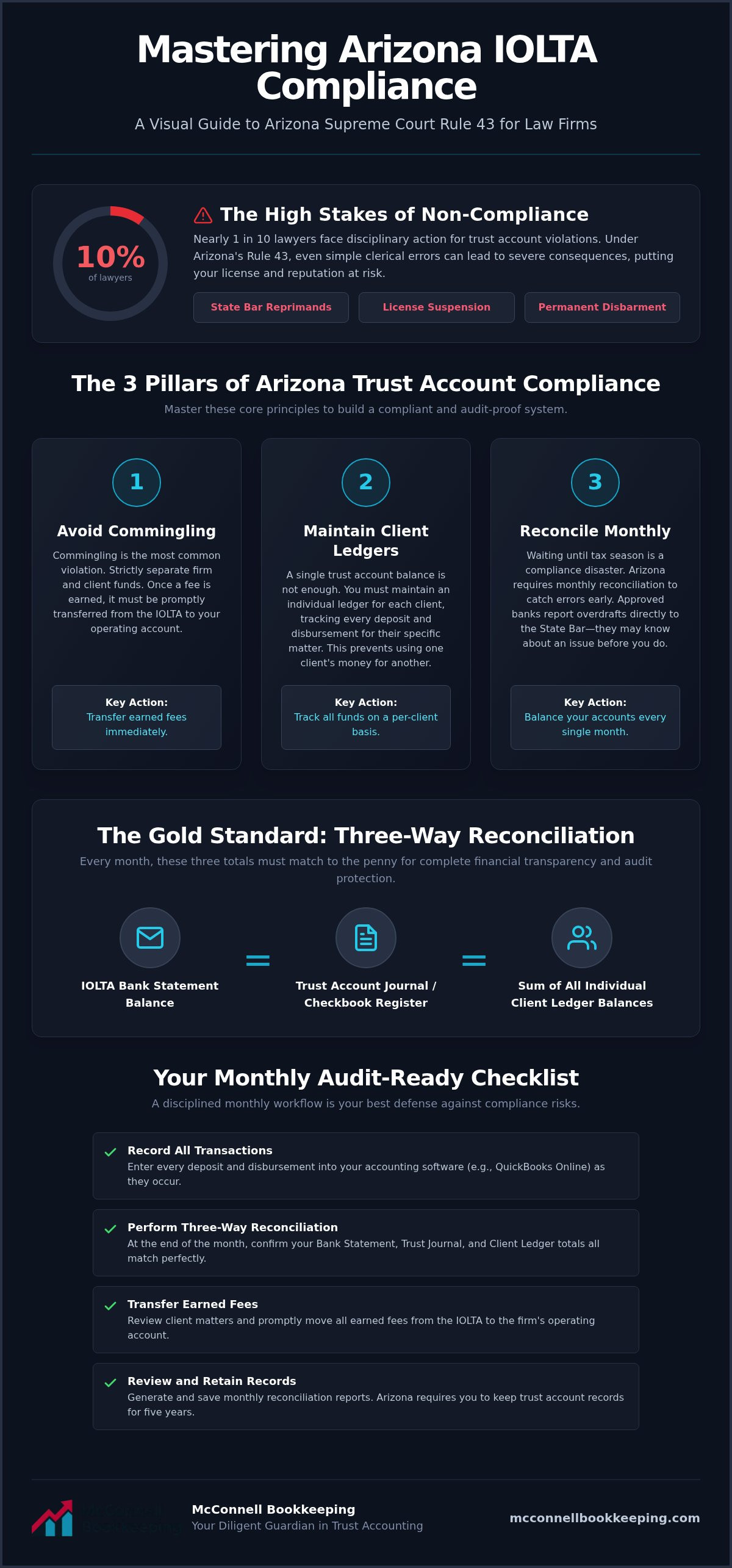
Compliance rests on three foundational pillars that transform trust accounting from a source of anxiety into a streamlined business process. For attorneys in the East Valley, achieving IOLTA compliance for law firms Mesa requires more than just checking a box once a year. It demands a proactive rhythm of meticulous recordkeeping and strict separation of funds. By mastering these pillars, you create a transparent financial environment that satisfies the State Bar and reinforces your professional authority.
Avoiding the Commingling Trap
Commingling is the most frequent path to disciplinary action, often occurring through simple clerical oversight rather than malice. Arizona Rule 43 allows you to keep a small amount of firm money in the trust account solely to cover bank service charges, but this is a narrow exception. The real danger lies in leaving earned fees in the IOLTA for too long. Once you've earned your fee, you must transfer it to your operating account promptly. Delayed transfers create "contaminated" accounts that are difficult to audit accurately and can lead to immediate red flags during a Bar review.
Individual Client Ledger Management
A single trust account balance in your general ledger is never sufficient for true accountability. You must maintain individual client ledgers that track every deposit and disbursement by specific case number within QuickBooks Online. This granular level of detail ensures that you never inadvertently spend one client's money on another's matter. When a case concludes, your records should reflect a clear "zero-balance" audit trail. This proves that every cent was handled according to the client's instructions and provides a definitive record for your five year retention requirement.
The final pillar of your defense is the monthly reconciliation requirement. Waiting until tax season to balance your trust account is a compliance disaster waiting to happen. Arizona requires you to use an Approved Financial Institution that has agreed to report any overdrafts directly to the State Bar. This means the Bar will often know about an error before you do. Establishing a monthly discipline of matching your bank statements to your internal ledgers provides the ultimate defense against these automated notifications. If your current books feel like a source of stress rather than a strategic tool, expert IOLTA management can restore your focus to your practice and your clients.
The Gold Standard: Three-Way Reconciliation Explained
Three-way reconciliation is the most critical monthly task for ensuring IOLTA compliance for law firms Mesa. While a standard business might simply match their bank statement to their books, legal trust accounting requires a third, vital layer of verification. This process involves aligning your adjusted bank statement balance, your general trust account ledger in QuickBooks, and the sum of every individual client ledger. When these three figures match exactly, you have mathematical proof of your firm's financial integrity: Bank Statement = QuickBooks Trust Balance = Total of All Client Ledgers.
Relying on a simple two-way reconciliation leaves your practice vulnerable to internal errors that a bank statement alone won't reveal. You might have a book balance that matches the bank, but if your individual client ledgers are out of sync, you're technically in violation of Arizona's rules. Utilizing a professional monthly bank rec service allows you to identify these "hidden" discrepancies before they escalate into Bar complaints. It transforms a complex mathematical hurdle into a source of informed confidence and relief.
Identifying and Fixing Discrepancies
Discrepancies often stem from mundane clerical issues like uncleared checks or minor bank errors. However, "mystery" deposits or unidentified client funds present a significant risk to your license. If you can't tie a deposit to a specific case number, you can't fulfill your fiduciary duty to the State Bar. The Trust Account Gap is the delta between the total of your individual client ledgers and the actual balance held in the bank statement. Resolving these issues immediately prevents small errors from snowballing into systemic failures that could trigger an audit.
Maintaining the Audit Trail
Arizona law practices must retain all trust account records for five years following the termination of representation. In 2026, digital recordkeeping has become the preferred standard for Mesa firms due to its ease of retrieval and enhanced security. Storing your monthly reconciliation reports electronically creates a robust defense during any State Bar inquiry. These reports aren't just administrative paperwork; they're the physical evidence of your commitment to ethical practice. By maintaining this trail, you protect your license and provide your clients with the highest level of financial transparency.
Monthly IOLTA Checklist for Mesa Law Firms
Implementing a consistent monthly workflow transforms your trust accounting from a looming deadline into a predictable routine. To maintain IOLTA compliance for law firms Mesa, you must follow a structured checklist that leaves no room for clerical ambiguity. This proactive discipline ensures your records remain audit-ready throughout the year, rather than just during the annual certification period. It's the most effective way to eliminate administrative stress.
Step 1: Download and review your monthly statement from an Arizona-approved bank to verify all transactions match your internal records.
Step 2: Record every trust deposit and disbursement in QuickBooks Online, ensuring each entry is tied to a specific client and case number.
Step 3: Perform the three-way reconciliation to confirm that your bank balance, book balance, and the sum of individual client ledgers align perfectly.
Step 4: Review client ledgers specifically for negative balances. This is a major red flag that indicates you've inadvertently spent more than a client has on deposit.
Step 5: File and secure the final reconciliation report in a digital vault to provide an immediate defense for future Bar inquiries.
Leveraging QuickBooks Online for Compliance
Setting up your Chart of Accounts correctly is the prerequisite for accurate reporting. You must establish a 'Trust Liability' account to represent the funds you hold for others, ensuring these never mix with your firm's revenue. Many attorneys utilize QuickBooks training for business owners to master these legal-specific entries and avoid common setup errors. While you can automate bank feeds for efficiency, you should always maintain manual oversight for trust entries. It's a vital safeguard.
When to Seek Professional Help
Identifying the signs of a failing system early saves your practice from severe disciplinary action. If your accounts haven't been reconciled for 90 days or more, your firm is in a state of high risk. The ROI of outsourcing this task is clear. The cost of a professional bookkeeper is a fraction of the cost of legal malpractice or a suspended license. If you've fallen behind, backlogged bookkeeping help can restore your financial clarity before audit season arrives. Reclaiming your time allows you to focus on billable hours while we handle the meticulous details of IOLTA management.
McConnell Bookkeeping: Your Diligent Guardian in Mesa
McConnell Bookkeeping understands that your legal reputation depends on more than just your courtroom performance. It requires an unwavering commitment to financial integrity. We provide specialized IOLTA management for Arizona firms, acting as a diligent guardian for your trust accounts to ensure IOLTA compliance for law firms Mesa remains unshakeable. By choosing a partner with local expertise in Mesa, Phoenix, and Gilbert, you ensure your practice remains aligned with the specific expectations of the State Bar of Arizona. We don't just record transactions; we serve as a strategic mentor to help you build a scalable, compliant practice that grows without administrative friction.
Our 'Peace of Mind' promise centers on delivering accurate financial statements and maintaining audit-ready trust accounts at all times. This high level of oversight eliminates the fear of disbarment due to clerical errors. It gives you the freedom to focus entirely on your billable hours. We believe that professional bookkeeping is the ultimate defense for your law license, providing a clear window into your firm's financial health. You deserve to practice law with the confidence that your books are in expert hands.
Customized Support for Legal Practices
We offer monthly bank reconciliations that go far beyond basic bookkeeping to include the mandatory three-way trust checks required by Rule 43. This rigorous process ensures your bank statement, book balance, and client ledgers are always in perfect harmony. For firms that have fallen behind, our books cleanup services restore order to your records, resolving discrepancies before they attract regulatory attention. We view our role as a collaborative partnership. We handle the meticulous numbers so you can handle the complexities of the law for your clients.
Ready for a Compliant 2026?
The path forward involves moving from a state of uncertainty to a state of informed confidence. As we move through 2026, having a proactive partner ensures no detail is overlooked. We invite Mesa law firm owners to schedule a consultation to discuss how our tailored services can support your firm's unique needs. Whether you need ongoing management or a one-time cleanup, we provide the relief and clarity you deserve. Take the first step toward a more secure future today. You can get the peace of mind bookkeeping services Phoenix law firms trust and protect your professional legacy.
Securing Your Practice with Expert Trust Accounting
Mastering the intricacies of Rule 43 doesn't have to be a source of constant administrative stress. By implementing a rigorous three-way reconciliation process and maintaining granular client ledgers, you establish a standard of financial integrity that satisfies even the most meticulous State Bar auditor. These proactive habits transform your trust account from a liability into a transparent reflection of your firm's professional standards. True IOLTA compliance for law firms Mesa is built on the foundation of consistent, monthly discipline and a commitment to accurate recordkeeping.
You don't have to navigate these complex regulatory waters alone. As a specialized law practice bookkeeping firm and expert QuickBooks ProAdvisor, McConnell Bookkeeping provides the local Mesa and Phoenix support you need to remain audit-ready. We act as your diligent guardian, ensuring every deposit and disbursement is handled with the precision your license deserves. Schedule your IOLTA compliance consultation with McConnell Bookkeeping today and reclaim the time you need to focus on your clients. Your professional legacy is worth the protection of expert oversight.
Frequently Asked Questions
What is the most common IOLTA mistake Mesa law firms make?
Commingling funds is the most frequent error Mesa attorneys make, often occurring when earned fees remain in the trust account too long. This creates a situation where your firm's operating capital mixes with client property, violating the strict boundaries set by Arizona Rule 43. Establishing a methodical monthly transfer rhythm ensures you stay compliant and protects your license. It turns a potential disciplinary risk into a predictable routine that doesn't jeopardize your practice.
Can I use one trust account for all my clients in Arizona?
Yes, Arizona rules allow you to use a single pooled IOLTA account for nominal or short-term client funds. However, you must maintain individual client ledgers for every person or entity represented within that account to ensure total transparency. While the bank sees one total balance, your internal bookkeeping must prove exactly how much of that balance belongs to each specific matter. This granular tracking prevents you from inadvertently spending one client's money on another's case.
How often does the State Bar of Arizona audit trust accounts?
The State Bar of Arizona typically conducts audits based on specific triggers rather than a set random schedule. Common triggers include overdraft notifications from your bank or formal complaints from clients regarding fund handling. In 2026, the Bar continues to prioritize compliance for high-volume practices in Maricopa County. Maintaining audit-ready records every month protects your firm from the stress of an unexpected investigation and proves your commitment to your professional fiduciary duty.
What should I do if I find an overage in my IOLTA account?
Identify the source of the overage immediately by reviewing your individual client ledgers against the bank balance. An overage often suggests that a deposit wasn't recorded or an earned fee was never transferred to your operating account. If you can't identify the owner of the funds after a diligent search, you may need to treat them as unclaimed property according to Arizona law. Promptly resolving these gaps is a key part of IOLTA compliance for law firms Mesa.
Is QuickBooks Online sufficient for IOLTA compliance?
QuickBooks Online is an excellent tool for IOLTA management when configured correctly by a professional. You must set up a Trust Liability account and use sub-accounts or tags to track individual client balances accurately. While the software provides the framework, it requires manual oversight and specialized knowledge to handle legal-specific entries. Expert-led training ensures your digital records meet the high standards required by the Arizona Supreme Court, providing you with much-needed peace of mind.
Can my bookkeeper sign checks on my IOLTA account?
No, a non-lawyer bookkeeper should never be the sole signatory on an IOLTA account in Arizona. While a bookkeeper can prepare checks and manage the ledgers, the ultimate fiduciary responsibility rests entirely with the attorney. You must personally review and sign each disbursement to ensure client funds are being used appropriately. This level of oversight protects your license and ensures that no funds leave the trust account without your direct authorization and professional approval.
What happens if my IOLTA account is overdrawn?
Your bank will automatically notify the State Bar of Arizona if your IOLTA account becomes overdrawn. Arizona-approved financial institutions are required to report these incidents within five business days. An overdraft is a significant red flag that often triggers an immediate inquiry or a formal audit. If this happens, you should immediately reconcile your books to find the error and prepare a detailed explanation for the Bar to demonstrate your proactive and responsible resolution.
How do I report IOLTA compliance to the Arizona State Bar?
Attorneys in Arizona must certify their compliance with trust account rules annually when renewing their bar dues. This certification is a formal statement that you've followed Rule 43 and performed the necessary three-way reconciliations throughout the year. For firms seeking IOLTA compliance for law firms Mesa, keeping organized monthly reports makes this annual task a simple formality. Having clear financial transparency for clients and the Bar ensures your practice remains in good standing year after year.


Comments