How to Analyze Small Business Financials: 2026 Guide

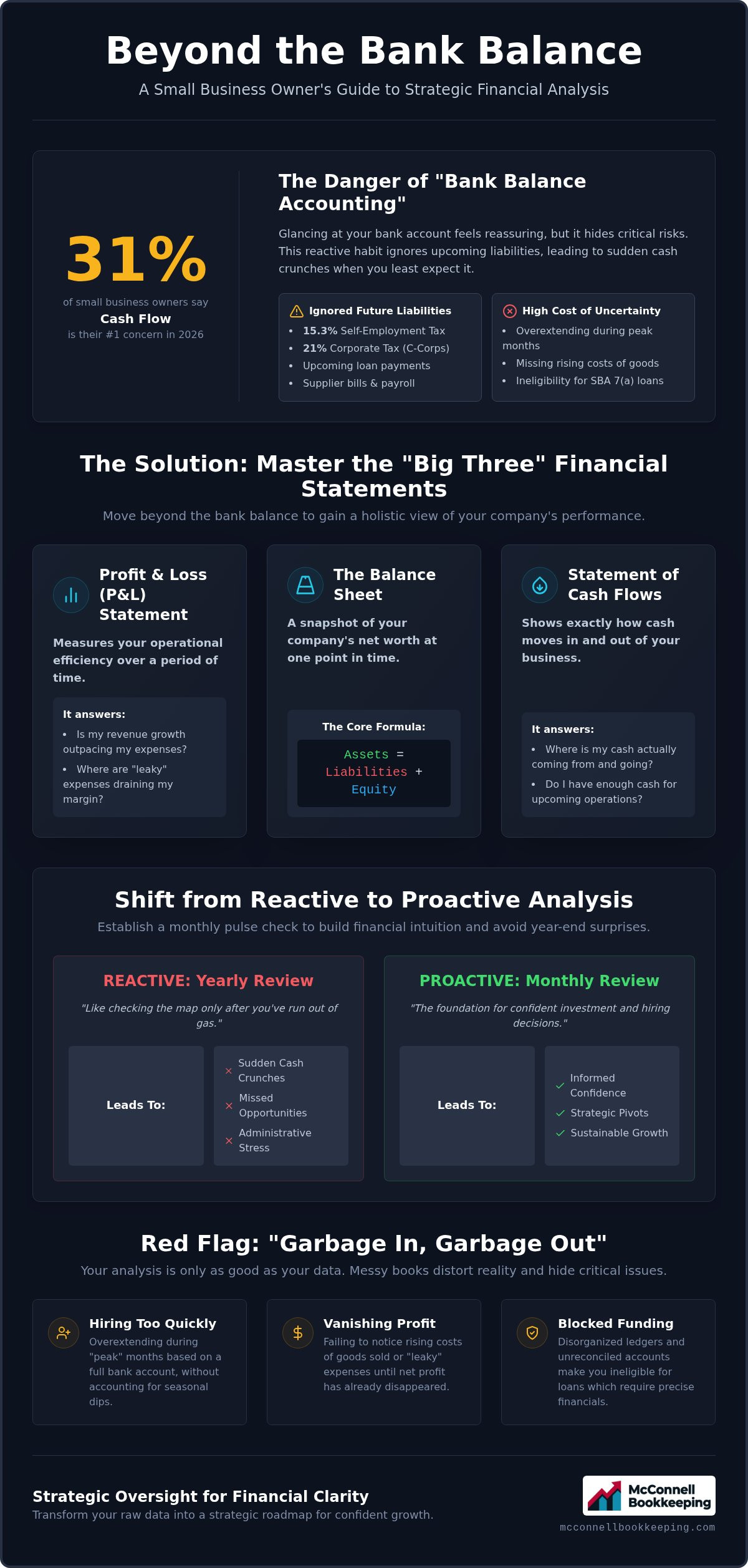
Did you know that in 2026, cash flow has officially surpassed inflation as the primary concern for 31% of small business owners? It's a sobering reality that highlights why simply glancing at your bank balance isn't enough to gauge your company's true health. Many entrepreneurs feel like they're flying blind, struggling to understand why their account looks full while their profit margins remain razor thin. Learning how to analyze financial statements for small business is the definitive solution to this administrative stress. It transforms your bookkeeping from a chore into a strategic roadmap for your future.
We understand the fear of missing a hidden red flag that could lead to a sudden cash crunch. When you master the nuances of your balance sheet, income statement, and cash flow report, you replace uncertainty with informed confidence. This guide will teach you to transform raw data into strategic growth by mastering these three essential documents. We'll show you how to identify the profitability metrics that matter most in the current economic climate. By the end, you'll have the clarity needed to make hiring or investment decisions with total peace of mind that your books are accurate.
Table of Contents
Why Small Business Owners Struggle with Financial Analysis
Many entrepreneurs confuse data entry with strategic intelligence. Keeping the books is a compliance task, while understanding the numbers is a leadership skill. If you only look at your bank balance to determine your success, you are practicing "bank balance accounting." This reactive habit ignores upcoming liabilities like the 2026 self-employment tax rate of 15.3% or the 21% corporate tax rate for C-Corps. This gap often leads to a sudden cash crunch just when you think you are ahead. Understanding how to analyze financial statements for small business is the bridge between mere record-keeping and true business mastery.
The High Cost of Financial Uncertainty
Delayed reporting is more than a nuisance; it's a barrier to growth. When your records are months behind, you can't pivot quickly to seize new market opportunities or adjust pricing to protect your margins. This uncertainty creates a cycle of administrative stress. Utilizing peace of mind bookkeeping services allows you to outsource the meticulous details while retaining the strategic insights. By applying principles of Financial Statement Analysis, you transform raw data into a narrative about where your business is going, not just where it's been.
Financial uncertainty often manifests in several dangerous ways:
Overextending during "peak" months: Hiring too quickly because the bank account looks full, without accounting for seasonal dips.
Missed red flags: Failing to notice rising costs of goods sold until your net profit has already vanished.
Ineligibility for funding: Lenders for SBA 7(a) loans require precise, up-to-date financials that "messy books" simply cannot provide.
Analysis as a Monthly Strategic Pulse Check
Waiting until tax season to review your performance is like checking a map only after you've already run out of gas. A yearly review is reactive. A monthly review is proactive. Establishing a routine for how to analyze financial statements for small business builds your financial intuition. You begin to recognize patterns in your spending and revenue before they become crises. This process starts with monthly bank reconciliations. These reconciliations ensure every dollar is accounted for, providing the data integrity you need to make confident investment decisions. You deserve the relief that comes from knowing your financial health is monitored with precision and care.
Decoding the "Big Three" Financial Statements
True financial clarity requires a holistic view of your business health. While many owners fixate on their bank balance, sophisticated leaders look to the "Big Three" documents to understand their trajectory. Learning how to analyze financial statements for small business involves more than just reading numbers; it's about interpreting the story they tell. This Beginner's Guide to Financial Statements provides a solid foundation for those just starting this journey. By mastering the Profit and Loss Statement, the Balance Sheet, and the Statement of Cash Flows, you gain the confidence to lead with precision.
Mastering the Profit and Loss Statement
The Profit and Loss (P&L) statement measures your operational efficiency over a specific period. It reveals whether your revenue growth is outpacing your expenses or if rising costs are quietly eroding your hard-earned gains. Analyzing these trends helps you identify "leaky" expenses, like underutilized software subscriptions or inefficient supply chains, that drain your monthly margin. When you use your P&L to set realistic budget targets for the next quarter, you transform a historical record into a proactive growth tool. This level of insight ensures that every dollar spent is an investment in your company's future.
The Balance Sheet: Your Business Net Worth
Your Balance Sheet provides a snapshot of your company's financial position at a single point in time. It follows a simple but powerful formula: your assets must always equal your liabilities plus your equity. Tracking your assets is critical, particularly your accounts receivable. Utilizing strategic accounts receivable services ensures you are actually collecting the money you've earned, which keeps your cash position strong. Additionally, monitoring your debt levels helps you maintain a healthy debt-to-equity ratio. This balance is vital for long-term stability and makes your business more attractive to lenders or investors.
The final piece of the puzzle is the Statement of Cash Flows. This document tracks the actual movement of money into and out of your business, which is often different from the "paper profit" shown on your P&L. It reconciles your net income with your actual cash on hand. When these three documents interact, they reveal the full story. Your P&L shows your efficiency, your Balance Sheet shows your stability, and your Cash Flow shows your liquidity. If you find these reports confusing or disorganized, a professional books cleanup can restore the accuracy you need to make informed decisions.
Key Financial Ratios for Phoenix Small Businesses
Ratios act as the diagnostic tools of your business, turning a sea of numbers into clear, actionable health indicators. While the "Big Three" statements provide the raw data, knowing how to analyze financial statements for small business through ratios reveals the underlying strengths and weaknesses of your operation. These metrics allow you to benchmark your performance against industry standards and make proactive adjustments before minor issues become major crises. Consulting the SBA guide to managing business finances provides a helpful framework for integrating these calculations into your monthly routine.
Pricing for Profitability in Arizona
Gross Profit Margin is the percentage of revenue exceeding the cost of goods sold. This ratio is your first line of defense against rising costs in the Phoenix market. If your margin is shrinking, it's a signal that your pricing hasn't kept pace with labor or supply cost increases. Once your core services are priced correctly, you must monitor your Net Profit Margin. This tells you what is actually left over after every bill, from payroll to rent, is paid. A healthy net margin for most U.S. small businesses in 2026 typically falls between 5% and 10%, providing the cushion needed for future growth.
Liquidity ratios ensure you can withstand unexpected economic shifts. The Current Ratio, which compares your current assets to your short-term debts, is a vital metric for stability. A ratio between 1.5 and 3.0 is generally considered healthy, indicating you have enough liquidity to cover your obligations. Finally, calculate your Burn Rate to understand how many months you could operate if revenue suddenly stopped. This number is the ultimate source of peace of mind for the diligent business owner who wants to avoid a sudden cash crunch.
Industry-Specific Metrics: Dental and Law Practices
Local professional services require a more nuanced approach to financial analysis. For medical professionals, mastering dental practice financial metrics like collection ratios and overhead percentages is essential to maintaining a thriving office. These specific numbers reveal whether your billing department is keeping pace with your clinical work and if your overhead is within a sustainable range for the Phoenix area.
Law practices face different challenges, such as tracking billable hours versus realization rates. Understanding the gap between the time worked and the time actually paid is critical for maintaining firm profitability and ensuring proper IOLTA management. By focusing on these niche-specific metrics, you move beyond generic advice and gain the strategic insight necessary to lead your practice with authority and precision.
Identifying Red Flags: When Messy Books Distort Analysis
Financial reporting relies entirely on the integrity of the underlying data. This is known as the "Garbage In, Garbage Out" principle. If your ledger is cluttered with errors, any attempt at how to analyze financial statements for small business will yield flawed results. Even a fundamentally healthy company can appear to be failing if historical errors or miscategorized transactions distort the figures. Meticulous data entry is the only way to ensure your strategic decisions are based on reality rather than fiction.
The Dangers of Unreconciled Accounts
A monthly bank rec service serves as the essential foundation for all financial analysis. Without it, you risk missing transactions that lead to underreported expenses. This oversight doesn't just skew your profit margins; it often results in overpaid taxes because you aren't claiming every legitimate deduction. Another common red flag is the presence of duplicate entries. These glitches artificially inflate your revenue, giving you a false sense of security that can lead to dangerous overspending. A disciplined reconciliation process identifies these discrepancies before they compromise your reporting.
When to Seek Books Cleanup Services
If you feel overwhelmed by a growing pile of unrecorded receipts, you may need backlogged bookkeeping help. Suspense account bloat is a major warning sign that your books require professional intervention. These accounts act as a "catch-all" for transactions that the user didn't know how to categorize, effectively hiding potential liabilities or losses. Resolving these historical accounting errors is the first step toward regaining control. This clarity is especially vital when preparing your books for a bank loan or a business valuation, as lenders require pristine records to assess your creditworthiness.
A professional diagnostic review identifies these hidden issues and provides the peace of mind that your records are accurate. When your books are clean, you can trust the numbers and focus on scaling your operations. If you suspect your data is compromised, engaging a professional books cleanup is the most effective way to restore your financial clarity and protect your business's future.
Strategic Oversight: Partnering for Financial Clarity
A professional partnership transforms your bookkeeping from a back-office burden into a forward-looking strategy. While many owners start by handling their own records, the transition to expert oversight marks a significant milestone in a company's growth. A bookkeeper acts as a strategic mentor, helping you understand how to analyze financial statements for small business while you focus on high-level leadership. This collaborative relationship ensures that your financial data isn't just accurate; it's useful. By utilizing QuickBooks Online to its full potential, you gain access to real-time reporting that informs every hire, purchase, and expansion plan.
Empowering Your Internal Team
Investing in your team's skills is a powerful way to maintain data integrity. We provide QuickBooks training for business owners to help you and your staff master the software's advanced features. When you establish best practices for daily data entry, you ensure that your monthly reports remain clean and reliable. We help you set up custom dashboards that highlight the specific metrics that drive your success. This transparency allows you to spot trends at a glance, giving you the power to pivot before small issues become obstacles. You deserve the confidence that comes from knowing your internal systems are optimized for accuracy.
Next Steps for Your Business Growth
Sustainable growth requires strategic delegation. As your operations expand, you might find that you need outsourced payroll processing or specialized accounts payable support to keep things running smoothly. This is where the relief of having a "diligent guardian" becomes truly apparent. You shouldn't have to spend your weekends worrying about tax deadlines or payroll compliance. Partnering with an expert allows you to reclaim your time while knowing that a proactive mentor is watching your numbers for you. This transition liberates you from administrative stress and allows you to return to the visionary work that started your business.
Scheduling a consultation is the first step toward moving from a state of uncertainty to a state of informed confidence. We look ahead to identify opportunities for your business, acting as a proactive partner rather than just a reactive service provider. When you master how to analyze financial statements for small business with an expert by your side, you gain the peace of mind that your books are in safe, capable hands. Your business prosperity is our priority, and we are committed to seeing you thrive in the competitive Phoenix market.
Empower Your Business with Financial Mastery
Success in the 2026 economic landscape requires moving beyond simple bank balance accounting. You now have the framework to look past the surface and understand the strategic stories told by your profit and loss, balance sheet, and cash flow reports. Mastering how to analyze financial statements for small business is the definitive step toward gaining the foresight needed to lead your company with authority. By identifying red flags early and utilizing key financial ratios, you transform raw data into a roadmap for sustainable growth.
As a Mesa based partner with specialized experience in law and dental practice bookkeeping, we act as a diligent guardian for your numbers. We focus on monthly reconciliations to ensure 100% accuracy; providing you with the relief and clarity you deserve. Whether you need expert led QuickBooks Online training or a comprehensive books cleanup, we are here to support your prosperity. Get the financial clarity you deserve, schedule a consultation with McConnell Bookkeeping today. Your business is in safe, capable hands, and we look forward to seeing you thrive.
Frequently Asked Questions
How do I read a Profit and Loss statement if I am not an accountant?
Focus on the "Net Income" line at the bottom to see your actual earnings after all costs are deducted. You should also examine your gross margin to ensure your pricing adequately covers labor and materials. In the Mesa market, service businesses often struggle with rising overhead, so comparing your monthly totals against previous periods helps you spot trends. This statement tracks operational efficiency, showing you exactly where your revenue goes before it becomes profit.
What is the most important financial statement for a small business?
While the Profit and Loss statement is vital for measuring efficiency, the Statement of Cash Flows is arguably the most critical for survival. It tracks the actual movement of money, which prevents you from overextending during a "paper profit" month. A healthy balance sheet is also necessary to show your company's net worth. For Phoenix entrepreneurs, understanding how these documents interact is the key to mastering how to analyze financial statements for small business.
How often should a small business owner analyze their financial statements?
You should analyze your financials at least once a month to maintain proactive control over your growth. Waiting until tax season is a reactive approach that leaves you vulnerable to sudden cash flow gaps. Reviewing your reports monthly allows you to identify profitable opportunities or "leaky" expenses in real time. We recommend scheduling a dedicated strategic pulse check following your monthly bank reconciliations to ensure you are making decisions based on 100% accurate data.
What is the difference between cash basis and accrual basis accounting?
Cash basis accounting records transactions only when money physically enters or leaves your bank account. In contrast, accrual basis accounting records revenue when it's earned and expenses when they are incurred, regardless of when cash moves. Accrual provides a more accurate long term picture of profitability, which is essential for Phoenix law and dental practices managing billing cycles. Choosing the right method depends on your specific operational needs and long term growth goals.
Can I use QuickBooks Online to perform my own financial analysis?
Yes, QuickBooks Online offers powerful built in reporting tools for custom analysis. However, the reports are only as good as the data entered into the system. Many business owners in Chandler and Scottsdale benefit from expert led QuickBooks Online training to ensure they are utilizing dashboards and KPIs correctly. Learning how to analyze financial statements for small business within the software empowers you to monitor your company health without waiting for an outside report.
What are some common mistakes in small business financial analysis?
The most common mistake is "bank balance accounting," where owners assume a high bank balance equals high profit. Other errors include ignoring upcoming tax liabilities, such as the 15.3% self employment tax, or failing to account for depreciation. Messy books with unreconciled accounts also lead to flawed analysis. Avoiding these pitfalls requires a disciplined approach to monthly reporting and a clear understanding of the difference between cash on hand and actual net income.
How do I know if my bookkeeping is accurate enough for analysis?
Your bookkeeping is ready for analysis when your bank and credit card accounts are fully reconciled to the penny. If you see a "suspense" account with a high balance or duplicate entries in your revenue, your data is likely compromised. Professional books cleanup can resolve these historical errors, providing a clean slate for strategic planning. Accurate books ensure that your current ratio and profit margins reflect the true state of your Phoenix area business.
Why do my financial statements look different from my bank balance?
Your financial statements include non cash items like depreciation and upcoming liabilities that don't immediately affect your bank account. Timing differences also play a role; your Profit and Loss statement might show revenue from a client who hasn't paid their invoice yet. This is why accounts receivable management is vital for maintaining a clear picture. Reconciling these differences helps you understand your actual liquidity versus your theoretical profit in the competitive Phoenix market.


Comments