Bookkeeper vs. Accountant: Which Do You Need in 2026?

Hiring the most expensive tax professional to manage your daily transactions is often the fastest way to drain your budget without gaining the clarity you actually need. If you've ever stared at a messy QuickBooks file with a sense of mounting anxiety, you aren't alone. Many owners struggle to understand the real difference when comparing a bookkeeper vs accountant for small business needs. It's a common trap to assume one can simply replace the other, yet this confusion is exactly what causes administrative burnout and those dreaded surprises during tax season.
We understand that you want to spend your time caring for patients or clients, not untangling bank reconciliations. This guide clarifies the distinct roles of these two financial professionals so you can build a cost-effective team that grows with you. We'll explore how a diligent bookkeeper acts as your daily guardian to keep records pristine, while an accountant serves as your strategic architect for high level tax planning. By the end, you'll know exactly how to achieve tax-ready books and lower professional fees through a smarter, more organized approach to your firm's finances.
Table of Contents
Defining the Roles: Bookkeeper vs. Accountant in 2026
Success in business requires a clear, unobstructed view of your financial health. While many owners use the terms interchangeably, the distinction between a bookkeeper vs accountant for small business growth is significant. Think of your bookkeeper as the diligent guardian of your daily transactions and your accountant as the strategic architect of your long-term tax plan. In 2026, cloud technology has shifted these roles closer together, yet their core purposes remain distinct and equally vital.
Bookkeeping serves as the foundational record-keeping process that captures every dollar moving through your firm. Without this precise data, an accountant's high-level strategy is based on guesswork rather than reality. A collaborative relationship between these two professionals ensures that your books are always accurate, your taxes are optimized, and your stress levels remain low.
What a Modern Bookkeeper Actually Does
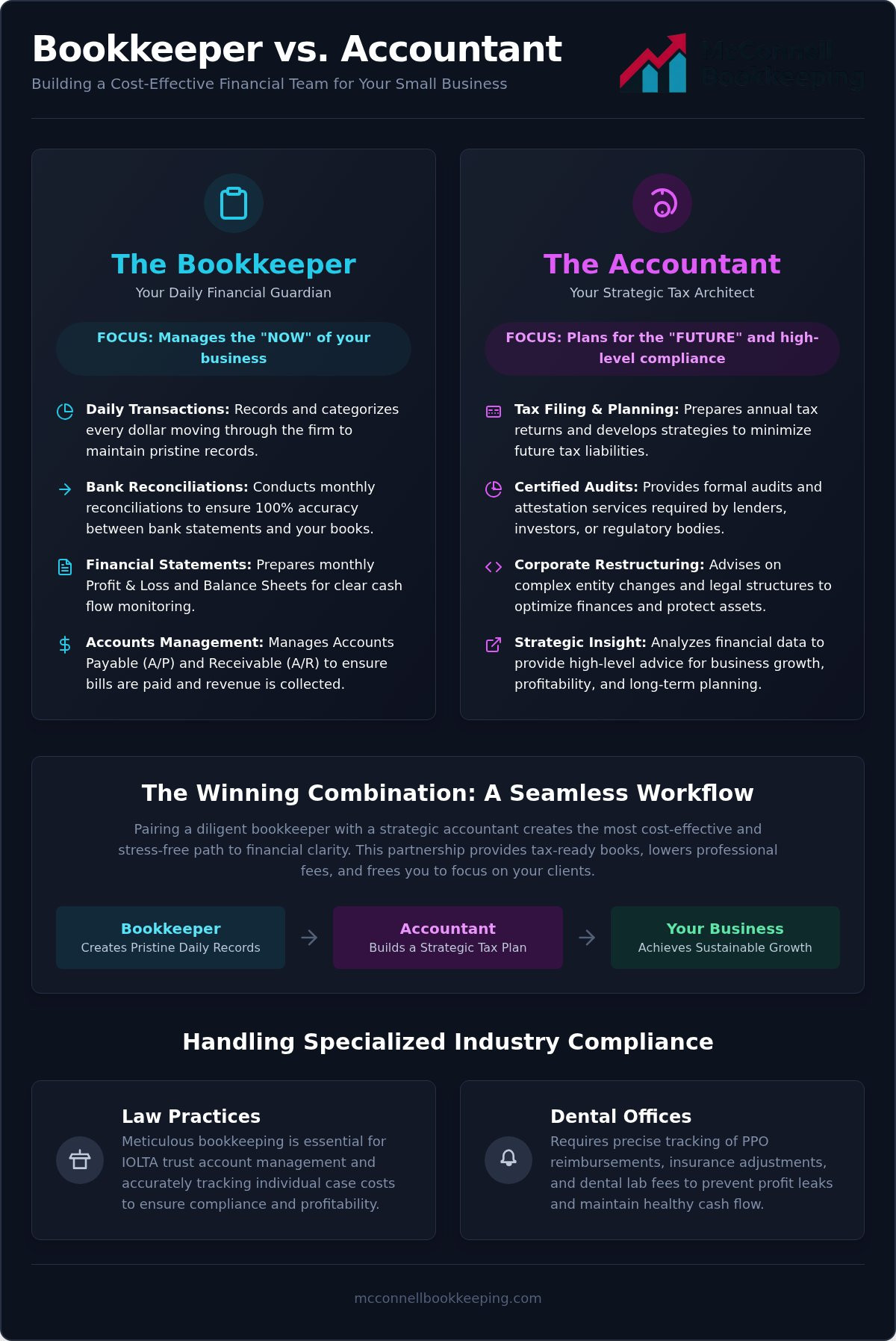
A modern bookkeeper manages the "now" of your business. They handle daily transaction categorization and bank feed management to ensure your QuickBooks Online file remains current and organized. This consistent oversight prevents the administrative burnout that often strikes during busy seasons. Specific tasks include:
Monthly Bank Reconciliations: Matching bank statements to your records provides 100% accuracy in your financial data.
Financial Statement Preparation: Generating monthly Profit and Loss statements and Balance Sheets gives you the clarity needed to monitor cash flow.
Accounts Management: Overseeing accounts payable and receivable ensures your vendors are paid and your revenue is collected promptly.
What an Accountant Handles
An accountant focuses on the "future" and complex compliance. While a bookkeeper maintains the data, the accountant analyzes it to provide strategic insights for business growth. Their expertise is essential for specific high-stakes requirements that a bookkeeper does not perform. These responsibilities typically include:
Tax Filing and Planning: Preparing annual income tax returns and creating strategies to minimize your future tax liability.
Certified Audits: Providing attestation services and audits required by lenders or regulatory bodies.
Corporate Restructuring: Advising on business entity changes or complex tax legalities to protect your assets.
For a Mesa small business, a team approach is the most cost-effective path forward. You don't need to pay high hourly accounting rates for monthly reconciliations. Instead, pairing a dedicated bookkeeper for daily oversight with an accountant for annual filings creates a seamless financial workflow. This partnership liberates you from the desk, giving you more time to focus on your clients and patients.
Core Responsibilities: From Data Entry to Strategic Insight
Financial clarity starts with a reliable foundation of daily details. It isn't just about recording numbers; it's about building a system that reflects the true health of your operation. When evaluating a bookkeeper vs accountant for small business management, it helps to view the bookkeeper as the person who maintains the accuracy of your financial "scorecard" while the accountant uses that card to plan your next winning play.
Effective financial management requires a proactive approach to your records. Meticulous accounts receivable management ensures that your revenue is collected on time, providing the liquidity needed for expansion. Similarly, organized accounts payable management protects your vendor relationships and prevents late fees. To manage your small business finances successfully, you must bridge the gap between simple data entry and high-level strategic planning.
The Bookkeeper’s Daily and Monthly Workflow
A dedicated bookkeeper manages the operational pulse of your business. They ensure that every dollar is accounted for, which is especially critical for specialized fields like law or dentistry. For example, tracking dental lab fees or law firm case costs with precision prevents profit leaks that often go unnoticed in messy files. Their workflow includes:
Cash Flow Management: Monitoring the flow of funds through Accounts Receivable to keep your business liquid.
Accuracy Checks: Performing monthly bank reconciliations to catch bank errors and prevent duplicate entries.
Payroll Oversight: Ensuring your team is paid accurately and on time, which maintains morale and compliance.
The Accountant’s Seasonal and Strategic Workflow
While the bookkeeper maintains the "now," the accountant focuses on the "future" and complex compliance. They step in during specific seasons or major business milestones to provide oversight that requires specialized licensure. Their strategic workflow typically involves:
Tax Optimization: Analyzing year-end reports to identify every legal deduction available to your business.
Entity Strategy: Advising on whether your growth justifies a change in business structure, such as moving from an LLC to an S-Corp.
Audit Representation: Acting as your formal representative if the IRS selects your business for an audit.
Operational accounting is the middle ground where your business truly thrives. By having a professional handle your books cleanup and ongoing maintenance, you provide your accountant with the clean data they need to save you money. This collaborative effort ensures your financial foundation is strong enough to support your loftiest business goals.
When Does Your Small Business Actually Need an Accountant?
Identifying the right moment to engage a CPA is critical for balancing your budget with your compliance needs. While a bookkeeper manages your daily financial health, certain trigger events require the advanced licensure of an accountant. For example, when you apply for a business loan in Phoenix, lenders usually demand CPA-reviewed financial statements to verify your creditworthiness. Understanding the nuances of a bookkeeper vs accountant for small business success allows you to deploy the right expert at the right time without overextending your budget.
The High Cost of DIY Bookkeeping
Attempting to manage your own records often leads to expensive cleanup premiums from your tax professional. CPAs typically charge significantly higher hourly rates to untangle messy QuickBooks files than a dedicated bookkeeper charges for monthly maintenance. If you've let your records slide throughout the year, seeking backlogged bookkeeping help is a strategic move that restores financial clarity before the April deadline. This proactive step eliminates the shoebox of receipts panic and ensures your tax architect has a solid foundation for planning.
Strategic Mentorship vs. Tax Filing
High-revenue law and dental practices require a specific blend of daily oversight and annual strategy. Your bookkeeper serves as a strategic mentor who monitors your cash flow and ensures every dental lab fee or case cost is tracked accurately. Conversely, you need an accountant for complex tax planning and high-level corporate restructuring. If your practice is considering a transition from an LLC to an S-Corp, an accountant provides the legal and tax analysis necessary to make that leap. They handle the specialized attestation that a bookkeeper cannot perform.
Maintaining a clear distinction between a bookkeeper vs accountant for small business operations ensures you aren't overpaying for basic tasks. You should bring in an accountant for certified audits or formal IRS representation. For daily operational insights, your bookkeeper provides the internal management reports that keep you informed. This division of labor saves you thousands in professional fees. By presenting a clean, reconciled set of books to your accountant, you reduce the time they spend on data entry and increase the time they spend on strategic tax savings.
Specialized Needs: Why Law and Dental Practices Require a Specific Approach
While basic record-keeping is a universal need, law and dental practices operate under unique regulatory and financial pressures that demand specialized oversight. Choosing a generalist when comparing a bookkeeper vs accountant for small business needs in these fields can lead to expensive compliance gaps. Specialized bookkeeping ensures that industry-specific nuances, like trust accounting or insurance reimbursement tracking, are handled with the precision required to protect your professional license. This proactive management transforms your books from a source of anxiety into a strategic tool for growth.
Bookkeeping for Phoenix Law Practices
Arizona law firms face the rigorous challenge of IOLTA (Interest on Lawyers' Trust Accounts) management. Maintaining compliance requires a meticulous three-way reconciliation process that matches the bank statement, the book balance, and the individual client ledgers. This level of detail prevents the commingling of funds and ensures that every dollar is accounted for during a State Bar audit. Modern legal bookkeeping also involves seamless integration between practice management software like Clio or PracticePanther and QuickBooks Online. This connectivity allows for accurate tracking of case-related expenses, ensuring that client billing is both transparent and timely.
Financial Clarity for East Valley Dental Offices
Dental practices in Mesa and Chandler deal with a complex web of PPO reimbursements and high overhead costs. Success depends on mastering dental practice financial metrics to identify where profit leaks occur. A specialized bookkeeper tracks lab costs and supplies as a percentage of production, providing a clear view of your margins. They also generate separate reports for hygiene and doctor production, which is essential for managing provider compensation in multi-provider clinics. Streamlining your administrative tasks through outsourced payroll processing further liberates your office manager to focus on patient care rather than tax tables.
Local expertise matters because Arizona-specific regulations, particularly regarding IOLTA compliance, are constantly evolving. A partner who understands the Phoenix Valley business climate provides a level of security that generic, virtual firms simply cannot match. This neighborly expert approach ensures that your internal controls are robust enough to handle growth without sacrificing accuracy. If you're ready to move from administrative burnout to financial confidence, our team at McConnell Bookkeeping is here to serve as your diligent guardian.
Finding Your Financial Guardian in the Phoenix Valley
Choosing a local partner over a "big box" virtual firm ensures your practice receives the personal attention it deserves. While virtual platforms offer convenience, they often lack the nuanced understanding of the Arizona business environment. A neighborly expert provides the reliability and calm needed to transform your financial chaos into a structured path for growth. When you evaluate the choice of a bookkeeper vs accountant for small business success, remember that local insight often identifies opportunities that a remote algorithm might miss. Our team at McConnell Bookkeeping serves as a diligent guardian for firms in Mesa and Phoenix, ensuring your records reflect the true potential of your hard work.
Transitioning from a DIY approach to professional oversight is a significant milestone for any practice. It marks the moment you stop working in your business and start working on it. Meticulous record-keeping serves as the backbone of this transition. By outsourcing your monthly bank reconciliations, you gain the clarity needed to make informed decisions without the stress of administrative burnout. This partnership creates a rhythmic flow of problem-solving that keeps your firm moving forward. Professional cleanup leads to loan approvals and better vendor relationships, providing a solid foundation for every strategic move you make.
Empowering Your Team with Knowledge
Knowledge is the most effective tool for reducing financial friction. We believe in empowering our clients through QuickBooks training for business owners and the surrounding East Valley. This education ensures that your internal staff can manage daily entries with confidence, which directly improves the accuracy of your monthly reports. A well-trained team produces cleaner data. Cleaner data ultimately lowers your professional fees and streamlines your relationship with your tax accountant. We act as strategic mentors, guiding your staff through the complexities of cloud accounting to ensure long-term success.
Next Steps for Financial Peace of Mind
Restoring your financial health begins with a clear assessment of where you stand. A diagnostic review of your current books identifies historical errors and provides a roadmap for a complete cleanup. Once your records are accurate, establishing a monthly reconciliation schedule maintains that integrity year-round. You deserve to experience peace of mind bookkeeping services that allow you to focus entirely on your clients and patients. This proactive approach identifies opportunities before they become problems. Taking these steps today secures your firm's prosperity for 2026 and beyond.
Securing Your Financial Future in 2026
Building a successful practice requires more than just clinical or legal expertise; it requires a structured financial foundation. We've explored how the distinction between a bookkeeper vs accountant for small business operations helps you allocate resources effectively. By utilizing a bookkeeper for monthly bank reconciliations and books cleanup, you provide your tax professional with the clean data they need to maximize your deductions. Specialized fields like law and dentistry benefit specifically from trust accounting and production tracking that generic services often overlook.
You don't have to navigate administrative stress alone. As a QuickBooks Online ProAdvisor with specialized law and dental experience, McConnell Bookkeeping offers the local Mesa and Phoenix support your business deserves. We act as your diligent guardian, ensuring every transaction is categorized with precision so you can focus on your patients and clients. Get Financial Clarity with McConnell Bookkeeping Today. Your path to financial peace of mind starts with a single proactive step toward organization.
Frequently Asked Questions
Do I need both a bookkeeper and an accountant for my small business?
Most growing firms find that a team approach provides the best results for their financial health. You need a bookkeeper to manage daily transaction categorization and an accountant to handle annual tax filing and high level planning. This partnership ensures your records stay pristine throughout the year, which reduces the time your accountant spends on data entry. Utilizing both professionals allows you to build a cost effective financial team that scales with your operations.
Can a bookkeeper file my business income taxes in Arizona?
Bookkeepers generally don't file income tax returns or perform certified audits because these tasks require specific licensure. Their role is to serve as your daily financial guardian by ensuring your records are accurate and tax ready. While they prepare the financial statements your CPA needs, the actual filing is handled by your tax professional. This distinction allows your bookkeeper to focus on maintaining pristine books, while your accountant focuses on strategic tax savings.
Is it cheaper to hire a bookkeeper or an accountant?
Hiring a bookkeeper for daily and monthly tasks is significantly more cost effective than paying an accountant's higher hourly rate for the same work. You save money by delegating transaction management and bank reconciliations to a specialist. This strategy ensures you only pay accounting fees for complex tax planning or audits. When comparing a bookkeeper vs accountant for small business needs, the most affordable path involves using each professional for their specific strengths.
What is the difference between a bookkeeper and a CPA?
The primary difference lies in the scope of their oversight and their professional licensure. A bookkeeper maintains the accuracy of your daily financial data through transaction entry and monthly reconciliations. A CPA, or Certified Public Accountant, analyzes that data to provide tax planning and legal compliance advice. While the bookkeeper builds the foundation of your financial records, the CPA uses that foundation to architect your long term strategy and file official returns.
Does a bookkeeper handle payroll and accounts payable?
Managing payroll and accounts payable is a core responsibility for a professional bookkeeper. They ensure your vendors are paid on time and your staff receives accurate compensation, which protects your business reputation and team morale. By overseeing these administrative tasks, a bookkeeper liberates you from the desk so you can focus on patient care or client service. This daily management provides the operational clarity needed to monitor your practice's cash flow effectively.
How much does a bookkeeper for a small business cost in Mesa?
Costs for professional bookkeeping in Mesa vary based on the volume of your monthly transactions and the complexity of your accounts. Specialized needs, such as IOLTA management for law firms or dental practice metrics, also influence the service level required. Most local firms offer customized packages that scale with your growth. This flexible approach ensures you receive the exact level of oversight you need without paying for unnecessary services or expensive full time salaries.
Can a bookkeeper fix my messy QuickBooks Online account?
Professional bookkeepers specialize in books cleanup to resolve historical errors in your QuickBooks Online account. They conduct a diagnostic review to identify duplicate entries and unreconciled accounts, restoring your financial records to 100% accuracy. This process transforms a source of anxiety into a reliable scorecard for your business. Having clean books is the essential first step before your accountant can perform any meaningful tax planning or prepare your annual business tax return.
Why do law firms specifically need a specialized bookkeeper?
Law firms require specialized bookkeeping to manage the rigorous demands of IOLTA trust accounting and Arizona State Bar compliance. A specialist performs the mandatory three way reconciliations that match bank statements, book balances, and individual client ledgers. This meticulous oversight prevents the commingling of funds and protects your professional license. Generalist bookkeepers often lack the specific knowledge required to handle these complex legal requirements, which can lead to significant regulatory risks and audit failures.


Comments